
Introduction
In modern industries, reliability, energy efficiency, and safety are key factors that determine operational success. Chemical plants, fertilizer industries, refineries, power plants, and manufacturing facilities depend heavily on utility systems such as compressed air, steam, gases, and vacuum networks. Any leakage in these systems can result in significant energy losses, increased operating costs, reduced process efficiency, and potential safety hazards.
Many industrial leaks remain undetected because they are too small to be visible or audible to human ears. A compressed air leak, steam leak, or gas leakage may continue for months, consuming valuable energy and reducing plant profitability.
Ultrasonic Leak Detection is an advanced predictive maintenance technology that enables industries to quickly identify and locate leaks by detecting high-frequency sound waves generated during fluid escape. This non-invasive technique helps maintenance teams detect problems before they become major failures.
This article explains the working principle, equipment, applications, advantages, and best practices of ultrasonic leak detection in industrial environments.
What is Ultrasonic Leak Detection?
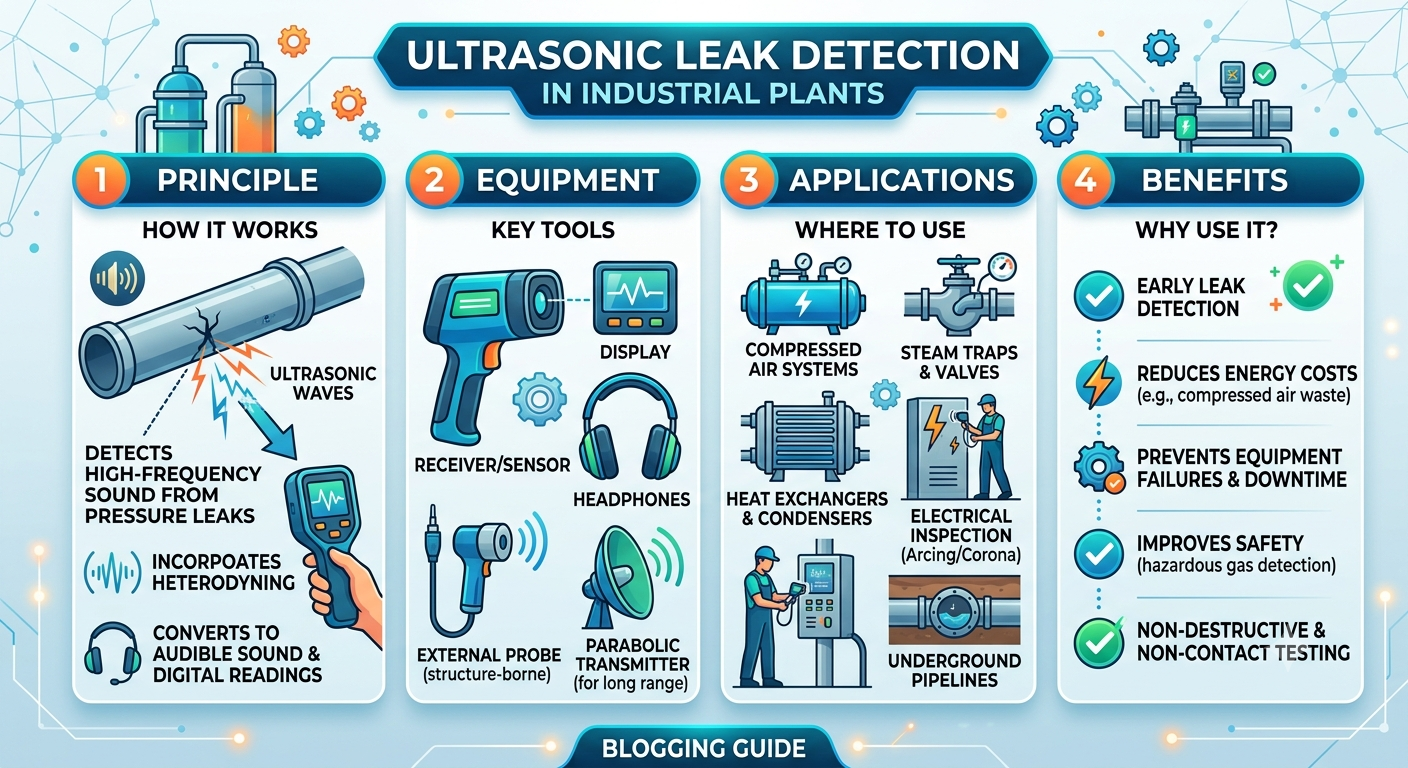
Ultrasonic Leak Detection is a condition monitoring method that uses ultrasonic sensors to identify leaks from pressurized systems. When a fluid such as air, steam, or gas escapes through a small opening, it creates turbulence that produces high-frequency sound waves.
These sound waves generally occur above the audible range of humans (above 20 kHz). An ultrasonic leak detector captures these signals, converts them into audible frequencies, and displays the leakage intensity for analysis.
Unlike traditional inspection methods, ultrasonic detection allows engineers to identify leaks without stopping production or dismantling equipment.
It is widely used in:
- Chemical processing plants
- Fertilizer manufacturing facilities
- Petrochemical industries
- Power plants
- Pharmaceutical industries
- Food processing industries
- Automotive and manufacturing plants
Principle of Ultrasonic Leak Detection
The working principle of ultrasonic leak detection is based on the relationship between pressure difference and sound generation.
When a fluid moves from a high-pressure region to a low-pressure region through a small opening:
- Fluid velocity increases at the leakage point.
- Turbulent flow develops around the opening.
- High-frequency ultrasonic waves are generated.
- The ultrasonic sensor detects these waves.
- The instrument processes the signal and indicates the leakage location.
The intensity of the ultrasonic signal is measured in decibels (dB). A higher dB value generally indicates a stronger leak.
For example:
- Small leaks produce low ultrasonic intensity.
- Large leaks produce higher ultrasonic intensity.
This allows maintenance engineers to prioritize repairs based on leak severity.
Components of an Ultrasonic Leak Detection System
A typical ultrasonic leak detection instrument consists of several important components.
1. Ultrasonic Sensor
The sensor is the primary detection element that captures ultrasonic sound waves.
Common sensor types include:
Airborne Sensors
Used for detecting leaks from a distance in:
- Compressed air pipelines
- Steam systems
- Gas networks
Contact Sensors
Used for detecting internal problems such as:
- Valve leakage
- Bearing defects
- Mechanical friction
Parabolic Sensors
Used for long-distance detection in large industrial areas.
2. Signal Processing Unit
The signal processing unit converts ultrasonic signals into meaningful information.
Its functions include:
- Noise reduction
- Frequency adjustment
- Signal amplification
- Leak intensity measurement
- Data recording
Modern instruments use digital processing technology to improve accuracy even in noisy industrial environments.
3. Display and Data Logging System
Advanced ultrasonic detectors provide:
- Digital readings
- Leakage severity indication
- Trend monitoring
- Maintenance reports
- Data storage capability
These features support predictive maintenance programs.
4. Headphones
Since ultrasonic frequencies are beyond human hearing, headphones allow technicians to hear converted sound signals and identify the exact leak location.
Types of Leaks Detected by Ultrasonic Technology
1. Compressed Air Leak Detection
Compressed air systems are among the biggest sources of industrial energy losses.
Common leakage locations include:
- Pipe joints
- Flanges
- Valves
- Pneumatic tools
- Air hoses
- Instrument air connections
Even a small compressed air leak can increase compressor loading and electricity consumption significantly.
Ultrasonic inspection helps industries:
- Reduce compressor running hours
- Lower electricity costs
- Improve system efficiency
2. Steam Leak Detection
Steam is an expensive utility, and leaks can cause substantial energy wastage.
Ultrasonic detectors are used for identifying:
- Steam trap failures
- Valve packing leaks
- Flange leakage
- Pipeline leaks
Benefits include:
- Reduced steam consumption
- Improved boiler efficiency
- Lower fuel usage
- Better process temperature control
3. Gas Leak Detection
Industrial gases require strict monitoring due to safety risks.
Ultrasonic leak detection can identify leakage from:
- Nitrogen systems
- Oxygen pipelines
- Hydrogen systems
- Natural gas networks
- Process gas equipment
Early detection helps prevent hazardous situations and improves workplace safety.
4. Vacuum Leak Detection
Vacuum systems are critical in many chemical processes, including:
- Evaporation
- Distillation
- Drying
- Filtration
Vacuum leakage can reduce process performance and increase energy consumption.
Ultrasonic testing helps locate:
- Vacuum pump leaks
- Seal failures
- Pipeline leakage
- Equipment flange problems
Ultrasonic Leak Detection Procedure
A systematic inspection process ensures accurate results.
Step 1: Prepare the System
Before inspection:
- Confirm operating pressure.
- Identify inspection areas.
- Review safety requirements.
- Ensure accessibility.
Step 2: Scan the Equipment
The technician moves the ultrasonic detector along:
- Pipelines
- Valves
- Flanges
- Connections
- Equipment joints
The instrument detects abnormal ultrasonic signals.
Step 3: Locate the Exact Leak Point
After detecting a signal:
- Reduce sensor distance.
- Adjust sensitivity.
- Identify the strongest ultrasonic point.
This determines the exact leakage location.
Step 4: Evaluate Leak Severity
The leak is evaluated based on:
- dB reading
- Operating pressure
- Leak size
- Fluid type
- Energy loss potential
Step 5: Repair and Verification
After repair:
- Repeat inspection.
- Confirm ultrasonic signal reduction.
- Record savings and maintenance history.
Applications in Chemical and Process Industries
Ultrasonic leak detection has significant applications in chemical plants.
Phosphoric Acid Plants
Applications include:
- Compressed air networks
- Steam distribution systems
- Vacuum equipment
- Instrument air systems
- Evaporator systems
Reliable utility systems are essential for maintaining continuous acid production.
Fertilizer Plants
Used for inspection of:
- Ammonia pipelines
- Pneumatic control systems
- Compressor systems
- Steam lines
Sulfuric Acid Plants
Applications include:
- Blower systems
- Gas handling equipment
- Vacuum systems
- Process air networks
Petrochemical Industries
Used for:
- Hydrocarbon gas leakage detection
- Process pipeline inspection
- Compressed air optimization
Advantages of Ultrasonic Leak Detection
1. Early Leak Identification
Ultrasonic technology can detect very small leaks before they become serious problems.
2. No Production Shutdown Required
One of the biggest advantages is that inspection can be performed during normal plant operation.
3. High Accuracy
The technology allows technicians to locate leaks precisely, reducing troubleshooting time.
4. Energy Saving
Leak elimination reduces:
- Electricity consumption
- Steam losses
- Compressor loading
- Operating expenses
5. Improved Safety
Early detection reduces risks associated with:
- Flammable gases
- Toxic chemicals
- High-pressure systems
Ultrasonic Leak Detection and Predictive Maintenance
Modern industries are moving from reactive maintenance toward predictive maintenance.
Ultrasonic inspection can be integrated with:
- Reliability-centered maintenance (RCM)
- Total Productive Maintenance (TPM)
- Energy management programs
- Six Sigma improvement initiatives
Regular surveys help create a database of leakage points and maintenance priorities.
Best Practices for Effective Leak Detection
For maximum benefits, industries should follow these practices:
- Conduct regular ultrasonic surveys.
- Inspect high-pressure systems first.
- Maintain leakage records.
- Repair leaks immediately.
- Monitor energy savings after repair.
- Train maintenance personnel.
- Include leak inspection in preventive maintenance schedules.
Conclusion
Ultrasonic Leak Detection is a powerful and reliable technology for improving industrial efficiency, reducing energy losses, and enhancing safety. By detecting high-frequency sound generated from escaping fluids, ultrasonic instruments allow engineers to identify leaks quickly without interrupting plant operations.
For chemical industries, fertilizer plants, and process manufacturing facilities, where continuous operation and energy efficiency are critical, ultrasonic leak detection provides significant economic and operational advantages.
A well-planned ultrasonic inspection program can reduce utility costs, improve equipment reliability, support sustainability goals, and contribute to overall operational excellence. As industries continue to focus on energy conservation and smart maintenance practices, ultrasonic leak detection will remain an essential tool for modern plant management.