
Introduction
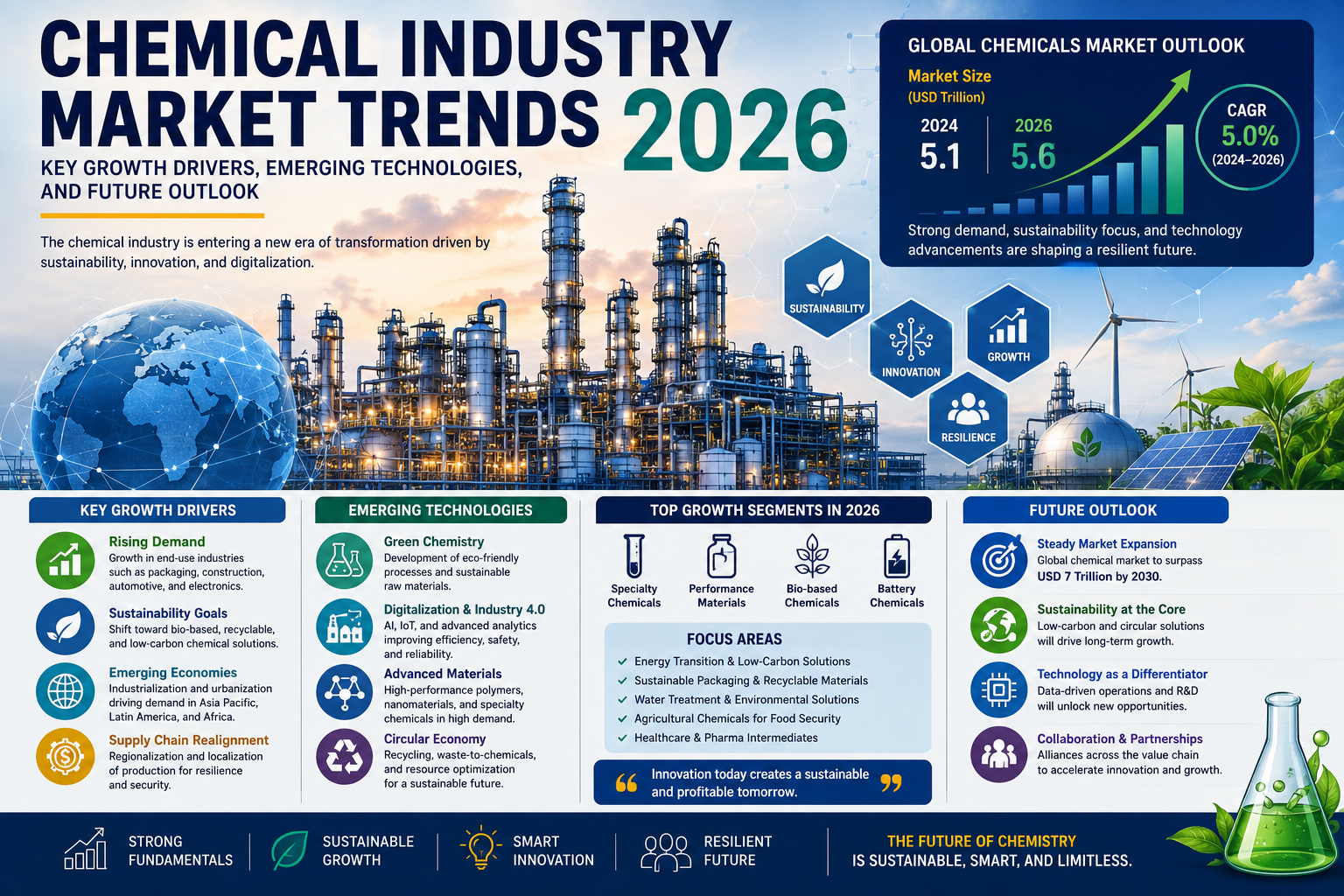
The global chemical industry is undergoing one of the most significant transformations in its history. While traditional growth was primarily driven by increasing industrial demand and expanding manufacturing capacity, today’s market is being reshaped by sustainability initiatives, digital transformation, geopolitical shifts, and changing customer expectations. Companies are no longer focused solely on production volumes; instead, they are prioritizing operational efficiency, innovation, environmental compliance, and long-term profitability.
In 2026, chemical manufacturers are investing heavily in artificial intelligence (AI), advanced process control, carbon reduction technologies, specialty chemicals, and circular economy practices. Simultaneously, increasing regulations, volatile raw material prices, and global supply chain disruptions continue to challenge the industry.
For industry professionals, understanding these market trends is essential for making strategic decisions, identifying investment opportunities, and maintaining a competitive advantage. This article explores the most important chemical industry market trends in 2026, the technologies shaping the future, and the opportunities available for manufacturers and investors.
1. Specialty Chemicals Continue to Lead Market Growth
Specialty chemicals remain one of the fastest-growing segments of the chemical industry due to their high value-added applications and strong demand across multiple industries. Unlike commodity chemicals, specialty chemicals are designed for specific performance characteristics and deliver higher profit margins.
Industries driving demand include pharmaceuticals, electronics, automotive, construction, agriculture, water treatment, and personal care.
Popular specialty chemical categories include:
- Performance additives
- Industrial coatings
- Adhesives and sealants
- Electronic chemicals
- Catalysts
- Water treatment chemicals
- High-performance polymers
With continuous product innovation and increasing customer requirements, specialty chemicals are expected to outperform commodity chemicals over the coming years.
2. Sustainability Is Reshaping the Chemical Industry
Environmental regulations and corporate sustainability commitments are transforming manufacturing practices across the globe. Chemical companies are investing in technologies that reduce carbon emissions, improve resource efficiency, and minimize waste generation.
Major sustainability initiatives include:
- Bio-based chemicals
- Green ammonia production
- Green methanol
- Biodegradable plastics
- Renewable feedstocks
- Low-carbon manufacturing processes
Many organizations have established ambitious net-zero carbon targets, making sustainability a core business strategy rather than merely a compliance requirement.
3. Artificial Intelligence Is Revolutionizing Manufacturing
Artificial Intelligence has become one of the most influential technologies in modern chemical manufacturing. AI enables plants to optimize operations, reduce downtime, improve product quality, and minimize operating costs.
Applications include:
- Predictive maintenance
- Process optimization
- Production planning
- Energy management
- Quality prediction
- Supply chain forecasting
Machine learning algorithms can analyze thousands of process variables simultaneously, allowing engineers to identify operating conditions that maximize efficiency while minimizing energy consumption.
Digital transformation is no longer optional—it has become a competitive necessity.
4. Digital Twins and Smart Manufacturing
Digital twin technology is rapidly gaining popularity among chemical manufacturers. A digital twin is a virtual representation of an operating plant that continuously receives real-time data from sensors and control systems.
Benefits include:
- Equipment performance monitoring
- Process simulation
- Operator training
- Failure prediction
- Production optimization
- Reduced shutdown duration
Combined with Industrial Internet of Things (IIoT) devices, digital twins enable real-time monitoring and data-driven decision-making throughout the plant.
5. Energy Efficiency Remains a Top Priority
Energy costs account for a significant portion of chemical manufacturing expenses. Rising electricity and fuel prices have encouraged companies to improve energy efficiency through modern technologies.
Key investments include:
- Waste heat recovery systems
- Heat integration
- High-efficiency heat exchangers
- Advanced evaporators
- Steam optimization
- Variable frequency drives
- Cogeneration systems
Improving energy efficiency not only reduces operating costs but also supports sustainability goals by lowering greenhouse gas emissions.
6. Supply Chain Resilience Becomes Essential
Recent global events have highlighted the vulnerability of international supply chains. Chemical companies are reducing dependence on single-source suppliers by adopting more resilient procurement strategies.
Key trends include:
- Multi-sourcing of raw materials
- Regional manufacturing hubs
- Nearshoring
- Strategic inventory management
- Digital supply chain monitoring
Companies with flexible supply chains are better positioned to withstand disruptions and maintain customer satisfaction.
7. Circular Economy and Chemical Recycling
The concept of a circular economy is becoming increasingly important within the chemical industry. Rather than disposing of waste materials, manufacturers are focusing on recovering, recycling, and reusing valuable resources.
Important developments include:
- Plastic chemical recycling
- Solvent recovery
- Industrial wastewater reuse
- By-product utilization
- Zero Liquid Discharge (ZLD) systems
Circular economy practices reduce environmental impact while creating additional revenue opportunities from recovered materials.
8. Rapid Growth in Battery Chemicals
The global transition toward electric vehicles and renewable energy storage has significantly increased demand for battery chemicals.
Key products experiencing strong growth include:
- Lithium compounds
- Nickel salts
- Cobalt chemicals
- Graphite materials
- Electrolytes
- Battery recycling chemicals
Battery manufacturing continues to expand worldwide, creating substantial opportunities for chemical producers capable of supplying high-purity materials.
9. Electronic and Semiconductor Chemicals
Semiconductor manufacturing requires extremely high-purity chemicals to produce advanced electronic devices.
Demand is increasing for:
- Electronic-grade sulfuric acid
- High-purity hydrochloric acid
- Nitric acid
- Hydrofluoric acid
- Ultra-pure solvents
- Photoresist chemicals
- CMP slurries
- Specialty gases
Growth in artificial intelligence hardware, data centers, and consumer electronics continues to support this high-value market.
10. Water Treatment Chemicals Gain Importance
Water scarcity and stricter environmental regulations are increasing investments in industrial water treatment technologies.
Demand is rising for:
- Coagulants
- Flocculants
- Corrosion inhibitors
- Scale inhibitors
- Biocides
- Membrane cleaning chemicals
Industries such as power generation, mining, fertilizers, pharmaceuticals, and petrochemicals are major consumers of these products.
Challenges Facing the Chemical Industry
Despite strong growth opportunities, the industry faces several significant challenges:
- Volatile crude oil and natural gas prices
- Global overcapacity in commodity chemicals
- Geopolitical uncertainties
- Increasing environmental regulations
- High energy costs
- Skilled workforce shortages
- Pressure on operating margins
- Currency fluctuations
Companies that embrace innovation, operational excellence, and digital technologies are better equipped to navigate these challenges successfully.
Indian Chemical Industry Outlook
India continues to strengthen its position as a global chemical manufacturing hub. Government initiatives, competitive manufacturing costs, and the China+1 sourcing strategy have attracted substantial investments across the sector.
High-growth segments include:
- Specialty chemicals
- Agrochemicals
- Pharmaceutical intermediates
- Fluorochemicals
- Water treatment chemicals
- Construction chemicals
The country’s expanding infrastructure, domestic consumption, and export potential make it one of the most attractive markets for future chemical industry investments.
Emerging Technologies to Watch
Several technologies are expected to shape the future of the chemical industry over the next decade:
- Artificial Intelligence (AI)
- Machine Learning
- Advanced Process Control (APC)
- Digital Twins
- Carbon Capture, Utilization and Storage (CCUS)
- Green Hydrogen
- Process Electrification
- Robotics and Automation
- Industrial Internet of Things (IIoT)
- Advanced Catalysis
- Membrane Separation Technologies
Early adoption of these innovations can improve efficiency, reduce costs, and enhance competitiveness.
Future Outlook
The chemical industry is entering a new era characterized by sustainability, digitalization, and technological innovation. Companies that invest in AI, specialty chemicals, energy-efficient operations, and circular economy practices will be well-positioned for long-term success.
For industry professionals, staying informed about evolving market dynamics is essential. Organizations that proactively adapt to changing customer demands, environmental expectations, and technological advancements will not only remain competitive but also lead the next phase of industrial growth.
As global markets continue to evolve, the focus will shift from simply producing more chemicals to producing smarter, cleaner, and higher-value products. Manufacturers that embrace innovation today will define the future of the chemical industry tomorrow.
Frequently Asked Questions (FAQs)
1. What are the major trends in the chemical industry in 2026?
The major trends include specialty chemical growth, AI-driven manufacturing, sustainability initiatives, digital twins, energy efficiency, circular economy practices, battery chemicals, and resilient supply chains.
2. Why are specialty chemicals growing faster than commodity chemicals?
Specialty chemicals offer customized performance for industries such as pharmaceuticals, electronics, automotive, and personal care, resulting in higher demand and better profit margins.
3. How is AI transforming chemical manufacturing?
AI helps optimize processes, predict equipment failures, improve quality control, reduce energy consumption, and enhance production planning through data-driven insights.
4. Which chemical sectors have the strongest growth potential?
Battery materials, specialty chemicals, electronic chemicals, water treatment chemicals, pharmaceutical intermediates, and sustainable chemical products are expected to experience the highest growth.
5. What is the future outlook for the chemical industry?
The industry is expected to grow through digital transformation, low-carbon technologies, process automation, and increasing demand for sustainable and high-performance chemical products.