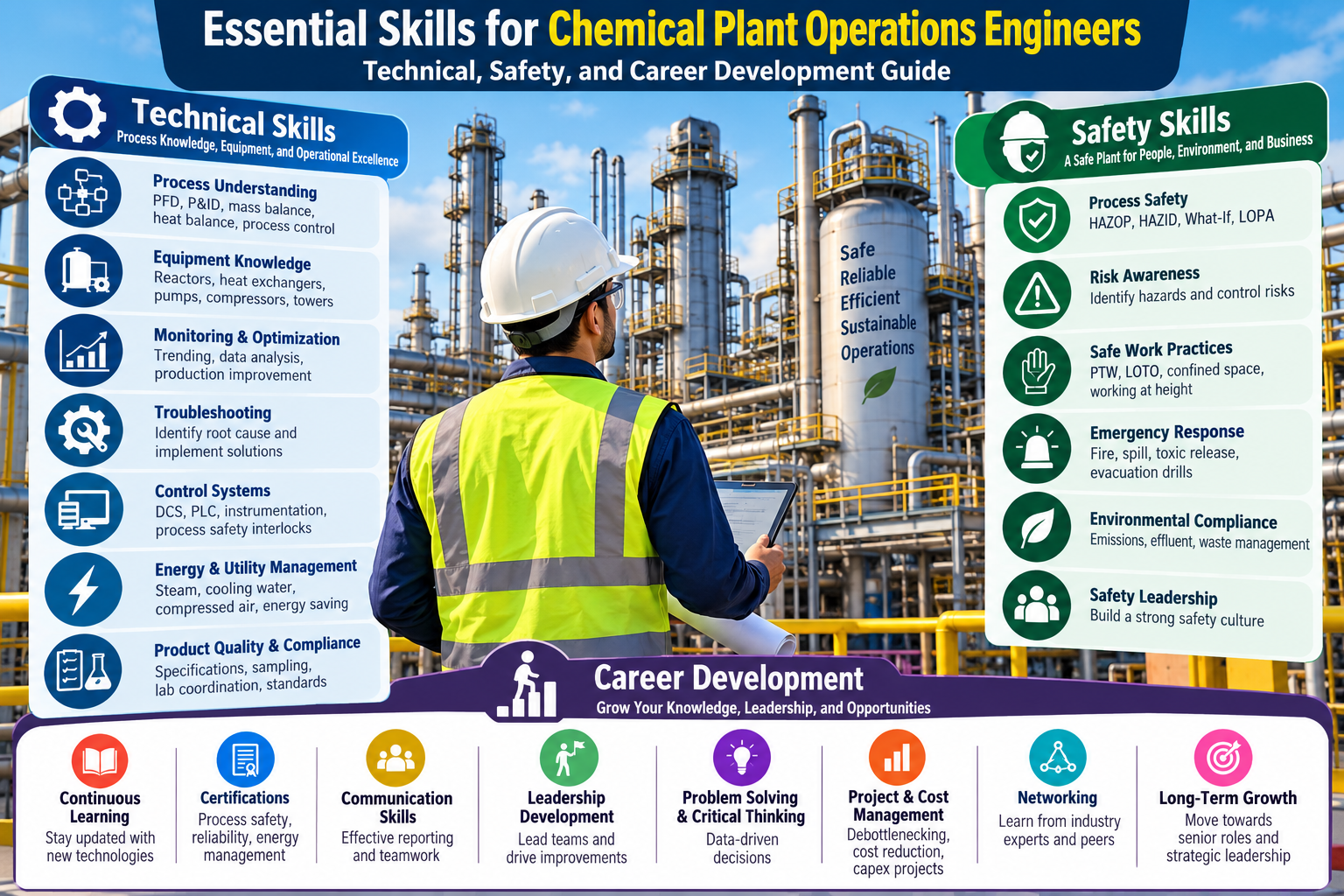
Chemical plant operations engineers play a critical role in ensuring safe, efficient, and reliable industrial production. From managing complex chemical reactions to optimizing equipment performance, these professionals are responsible for maintaining production targets while ensuring workplace safety, product quality, and environmental compliance.
Modern chemical industries require operations engineers who possess strong technical knowledge, practical troubleshooting abilities, leadership qualities, and digital skills. With increasing automation, energy costs, and sustainability requirements, the responsibilities of chemical plant engineers continue to evolve.
This article explores the essential skills for chemical plant operations engineers, including process engineering, equipment operation, industrial safety, troubleshooting, maintenance coordination, and professional development.
1. Strong Understanding of Chemical Engineering Fundamentals
A successful chemical plant operations engineer must possess a solid foundation in chemical engineering principles.
Important subjects include thermodynamics, fluid mechanics, heat transfer, mass transfer, chemical reaction engineering, and process control.
These fundamentals help engineers understand how industrial processes behave under different operating conditions.
For example, thermodynamics helps evaluate steam consumption and energy requirements, while fluid mechanics supports pump selection, pipeline design, and pressure drop calculations.
Similarly, mass transfer principles are essential for operating distillation columns, absorption towers, evaporators, and drying systems.
Engineers should understand how changes in temperature, pressure, concentration, and flow rate influence process performance.
Strong theoretical knowledge becomes particularly valuable when troubleshooting abnormal operating conditions.
2. Process Flow Diagram and P&ID Interpretation
Understanding Process Flow Diagrams (PFDs) and Piping and Instrumentation Diagrams (P&IDs) is among the most important skills for chemical plant operations engineers.
A PFD illustrates major process equipment, material flows, operating conditions, and process relationships.
A P&ID provides detailed information about piping connections, instruments, control valves, isolation valves, safety devices, and equipment arrangements.
Operations engineers should be capable of identifying equipment tags, tracing process lines, understanding control loops, and locating isolation points.
P&ID knowledge is particularly important during plant startup, shutdown, maintenance, troubleshooting, and emergency response.
Engineers must also understand the differences between actual plant configurations and approved engineering drawings.
Any permanent process modification should follow an established Management of Change procedure.
3. Industrial Equipment Operation and Troubleshooting
Chemical plants depend on numerous mechanical and process equipment systems.
Operations engineers should understand the working principles and limitations of centrifugal pumps, compressors, heat exchangers, reactors, agitators, filters, evaporators, and distillation columns.
For centrifugal pumps, essential operating parameters include suction pressure, discharge pressure, flow rate, motor current, vibration, and bearing temperature.
Engineers should recognize problems such as cavitation, mechanical seal leakage, impeller wear, and inadequate flow.
For heat exchangers, they should monitor temperature approach, pressure drop, fouling, and heat transfer efficiency.
Reactor operations require knowledge of mixing, reaction temperature, residence time, heat removal, and chemical reaction behavior.
Effective troubleshooting combines equipment knowledge, process data analysis, and field observations.
4. Process Safety and Hazard Identification
Safety is one of the most important responsibilities of a chemical plant operations engineer.
Industrial chemical facilities may involve toxic substances, corrosive chemicals, flammable materials, high-pressure systems, and elevated temperatures.
Operations engineers must understand process hazards and follow established safety procedures.
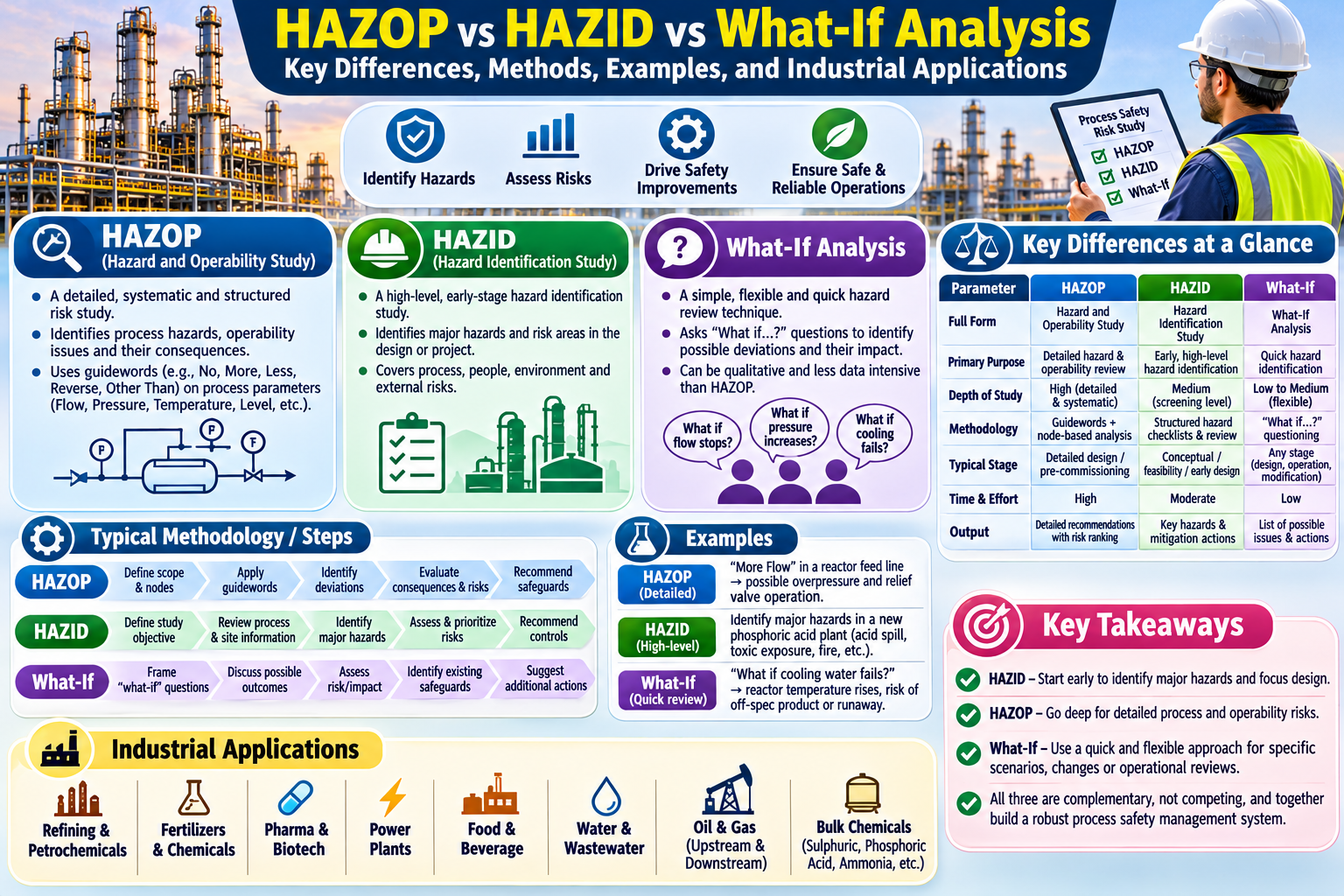
Important safety concepts include Hazard and Operability Studies (HAZOP), Hazard Identification (HAZID), Job Safety Analysis (JSA), and permit-to-work systems.
Engineers should also understand Lockout/Tagout (LOTO), confined space entry, emergency shutdown systems, and chemical handling procedures.
Knowledge of Safety Data Sheets (SDS) is essential for understanding chemical hazards, protective equipment requirements, and emergency response measures.
A strong safety culture requires proactive hazard identification, incident reporting, and continuous improvement rather than simply complying with written procedures.
5. Process Control and Instrumentation Knowledge
Modern chemical plants rely heavily on automation and instrumentation systems.
Operations engineers should understand Distributed Control Systems (DCS), Programmable Logic Controllers (PLC), and Supervisory Control and Data Acquisition (SCADA) systems.
Common process instruments include pressure transmitters, temperature sensors, flow meters, level transmitters, and analytical instruments.
Engineers must understand how control loops maintain stable operating conditions.
For example, a temperature control loop may regulate steam flow to a heat exchanger, while a level controller adjusts liquid discharge from a storage vessel.
Knowledge of PID control principles helps engineers recognize oscillations, slow responses, and unstable control behavior.
Operations engineers should also understand alarm priorities, interlocks, permissives, and emergency shutdown logic.
Unauthorized bypassing of protective systems must never be considered an acceptable troubleshooting practice.
6. Material Balance and Energy Balance Calculations
Material and energy balances are fundamental tools for evaluating chemical plant performance.
Operations engineers should calculate raw material consumption, product yield, process losses, utility requirements, and energy efficiency.
The general material balance equation is:
Input + Generation − Output − Consumption = Accumulation
For steady-state operations without chemical reaction, accumulation and generation or consumption terms are normally zero.
Energy balance calculations help evaluate steam consumption, cooling water requirements, heat exchanger duties, and process heating requirements.
For example, an engineer operating a phosphoric acid plant may calculate phosphate rock consumption, sulphuric acid requirements, gypsum losses, and evaporation steam demand.
Regular balance calculations help identify process inefficiencies, abnormal losses, and opportunities for production improvement.
7. Analytical Thinking and Problem-Solving Skills
Chemical plant operations frequently involve unexpected technical problems.
These may include reduced production, high energy consumption, equipment vibration, poor product quality, or abnormal process temperatures.
A competent operations engineer must identify the actual root cause rather than repeatedly treating symptoms.
Useful problem-solving techniques include Root Cause Analysis (RCA), the Five Whys method, fishbone diagrams, and trend analysis.
For example, reduced heat exchanger performance may result from fouling, inadequate circulation, poor steam quality, or instrument errors.
Instead of immediately increasing steam pressure, an engineer should evaluate operating data and determine the underlying cause.
Systematic troubleshooting improves equipment reliability and prevents repeated operational failures.
8. Production Planning and Operational Efficiency
Operations engineers are responsible for achieving production targets while maintaining quality and safety standards.
Effective production planning requires understanding plant capacity, equipment limitations, raw material availability, maintenance schedules, and utility constraints.
Important performance indicators include production rate, plant availability, specific energy consumption, raw material efficiency, and product recovery.
Engineers should regularly compare actual performance with established operating benchmarks.
For example, reducing filtration losses, improving reactor conversion, or minimizing equipment downtime can significantly improve plant profitability.
Continuous improvement techniques such as Lean Manufacturing, Six Sigma, and Kaizen can support operational excellence.
However, production improvements must never compromise equipment integrity or process safety.
9. Maintenance Coordination and Equipment Reliability
Chemical plant operations and maintenance departments must work closely to maintain equipment reliability.
Operations engineers should understand preventive maintenance, predictive maintenance, and breakdown maintenance strategies.
Knowledge of vibration analysis, lubrication, bearing failures, corrosion, and mechanical seal performance is particularly useful.
Before maintenance activities, engineers must ensure proper equipment isolation, depressurization, draining, cleaning, and permit authorization.
They should also participate in shutdown planning, equipment inspection, and post-maintenance commissioning.
Maintenance coordination helps reduce unplanned downtime and improves long-term equipment performance.
10. Communication and Team Leadership
Technical knowledge alone is insufficient for successful plant operations management.
Operations engineers must communicate effectively with control room operators, field technicians, maintenance personnel, laboratory teams, and management.
Clear shift handovers are particularly important in continuous-process industries.
A proper shift report should include production performance, equipment status, process abnormalities, maintenance activities, and pending operational concerns.
Engineers must also provide clear instructions during emergencies and abnormal operating conditions.
Leadership involves developing team capabilities, encouraging safety awareness, resolving operational conflicts, and maintaining accountability.
Strong communication skills improve coordination and reduce the risk of operational errors.
11. Digital Skills and Data Analysis
Digitalization is transforming chemical plant operations.
Engineers increasingly use Microsoft Excel, process historians, dashboards, and specialized engineering software to analyze plant performance.
Excel skills are useful for preparing material balances, equipment performance calculations, production reports, and energy consumption analysis.
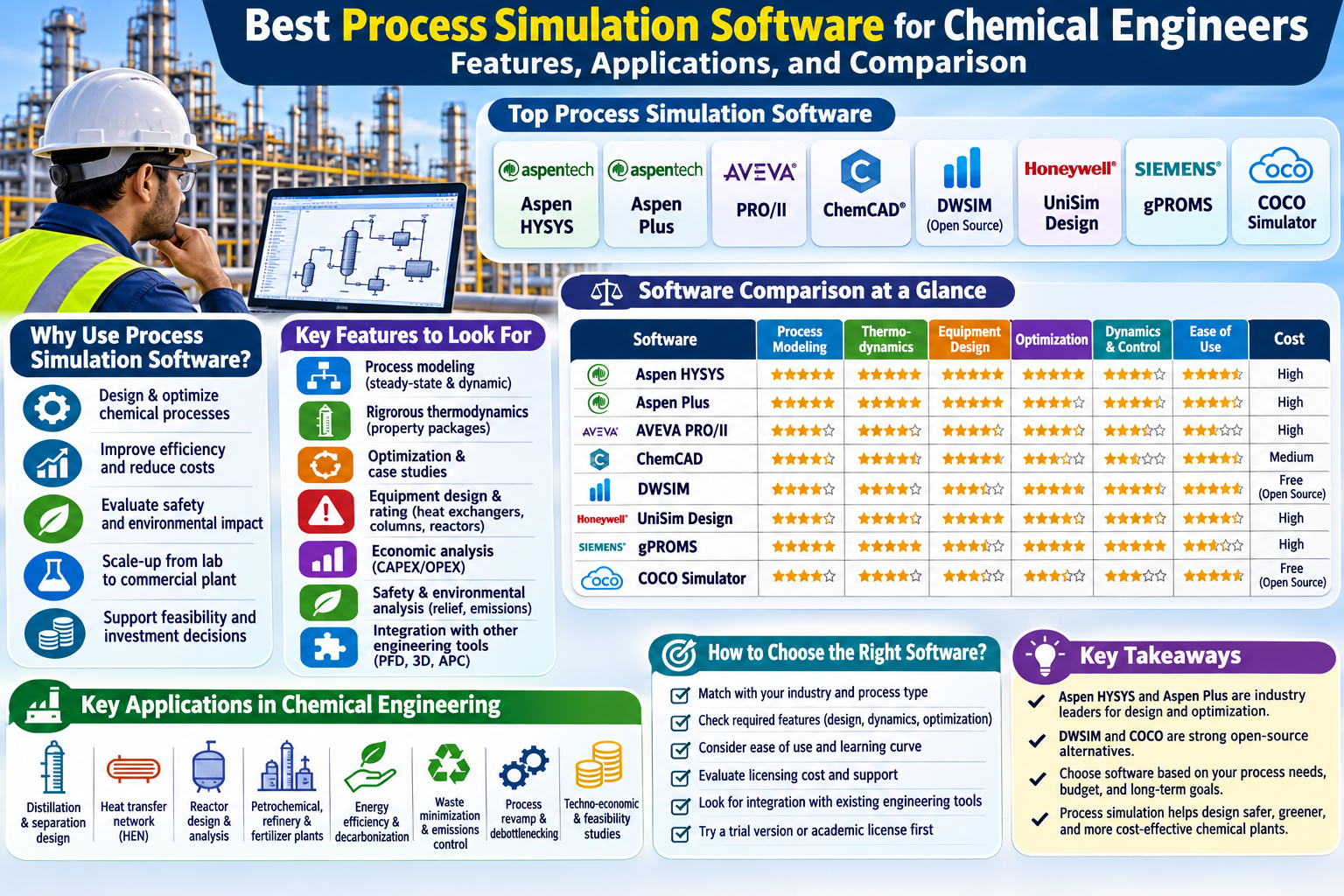
Process simulation software such as Aspen Plus and Aspen HYSYS can support engineering studies and process optimization.
Knowledge of Power BI, Python, and industrial data analytics can provide additional career advantages.
Digital twins, predictive analytics, and artificial intelligence are also emerging as important tools for improving operational efficiency.
However, digital recommendations must always be validated against actual process conditions and engineering principles.
12. Environmental Compliance and Sustainability
Chemical plant operations engineers must understand environmental regulations and sustainable manufacturing practices.
Important areas include wastewater treatment, air emission control, hazardous waste management, and energy conservation.
Engineers should monitor environmental performance indicators and ensure that operating practices comply with applicable regulations.
Opportunities for sustainability improvements include waste heat recovery, water recycling, process optimization, and reduced chemical consumption.
In fertilizer and chemical manufacturing plants, effective management of process effluents and industrial by-products is particularly important.
Environmental responsibility is increasingly becoming a core engineering competency rather than a separate compliance activity.
13. Continuous Learning and Career Development
Chemical manufacturing technologies are constantly evolving.
Operations engineers must continuously improve their technical and managerial capabilities through training, industrial experience, and professional development.
Important learning areas include advanced process control, equipment reliability, industrial safety, energy management, and process optimization.
Participation in technical seminars, certification programs, and professional engineering communities can improve industry knowledge.
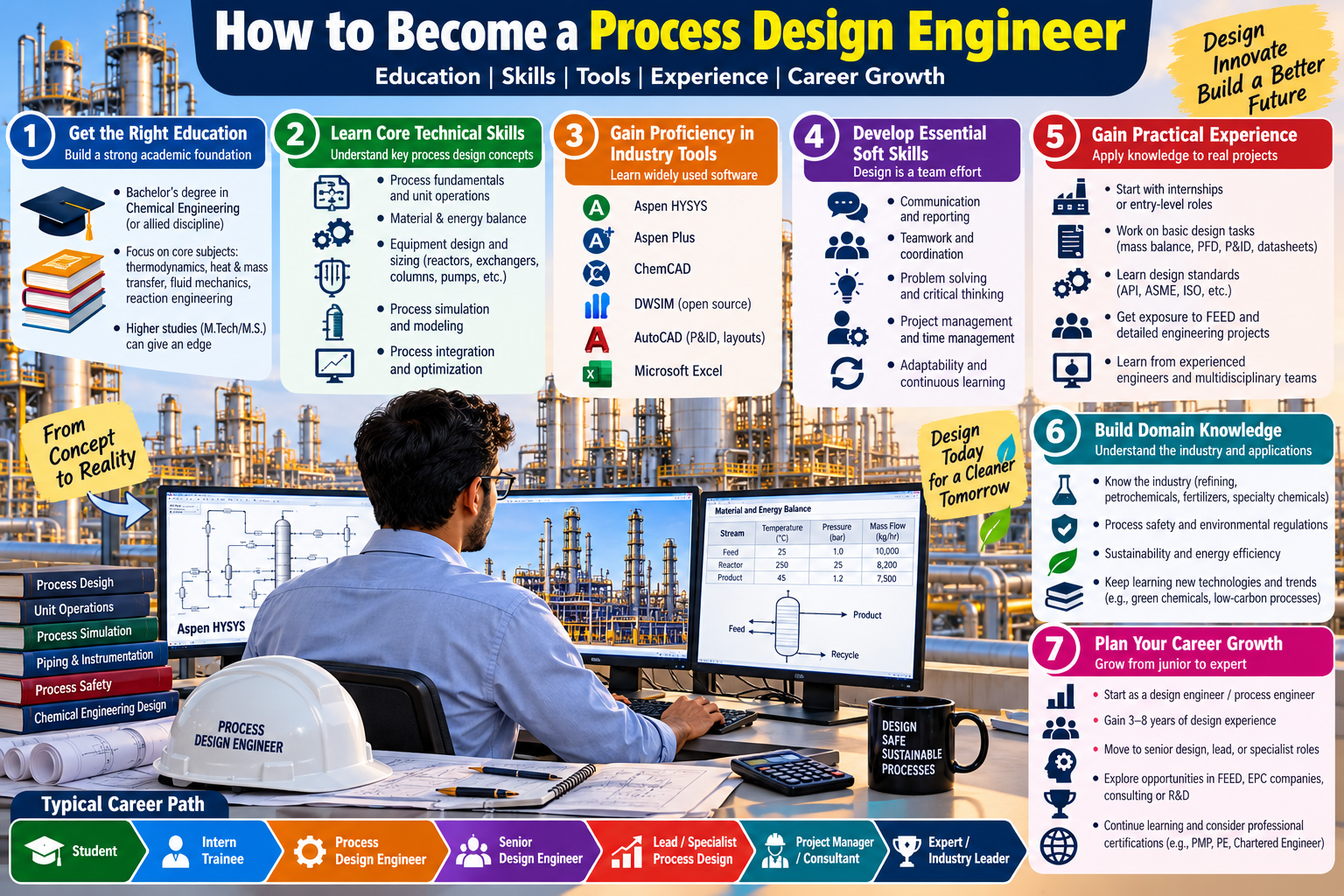
Young engineers should prioritize field experience, equipment understanding, and troubleshooting exposure during their early careers.
Experienced engineers should develop stronger leadership, project management, and strategic decision-making capabilities.
A combination of technical expertise, practical experience, and continuous learning creates opportunities for advancement into senior operations, production management, and plant leadership roles.
Conclusion
The essential skills for chemical plant operations engineers extend far beyond theoretical chemical engineering knowledge.
Successful engineers must combine process fundamentals, equipment troubleshooting, industrial safety, instrumentation, material balances, production optimization, maintenance coordination, and leadership.
As chemical industries adopt advanced automation and sustainable manufacturing technologies, digital literacy and environmental awareness are becoming increasingly valuable.
For aspiring chemical engineers, developing strong practical knowledge and a disciplined approach to safety provides a foundation for long-term career growth.
Ultimately, an effective chemical plant operations engineer is someone who can operate safely, solve problems systematically, improve process efficiency, and lead teams toward reliable industrial performance.