
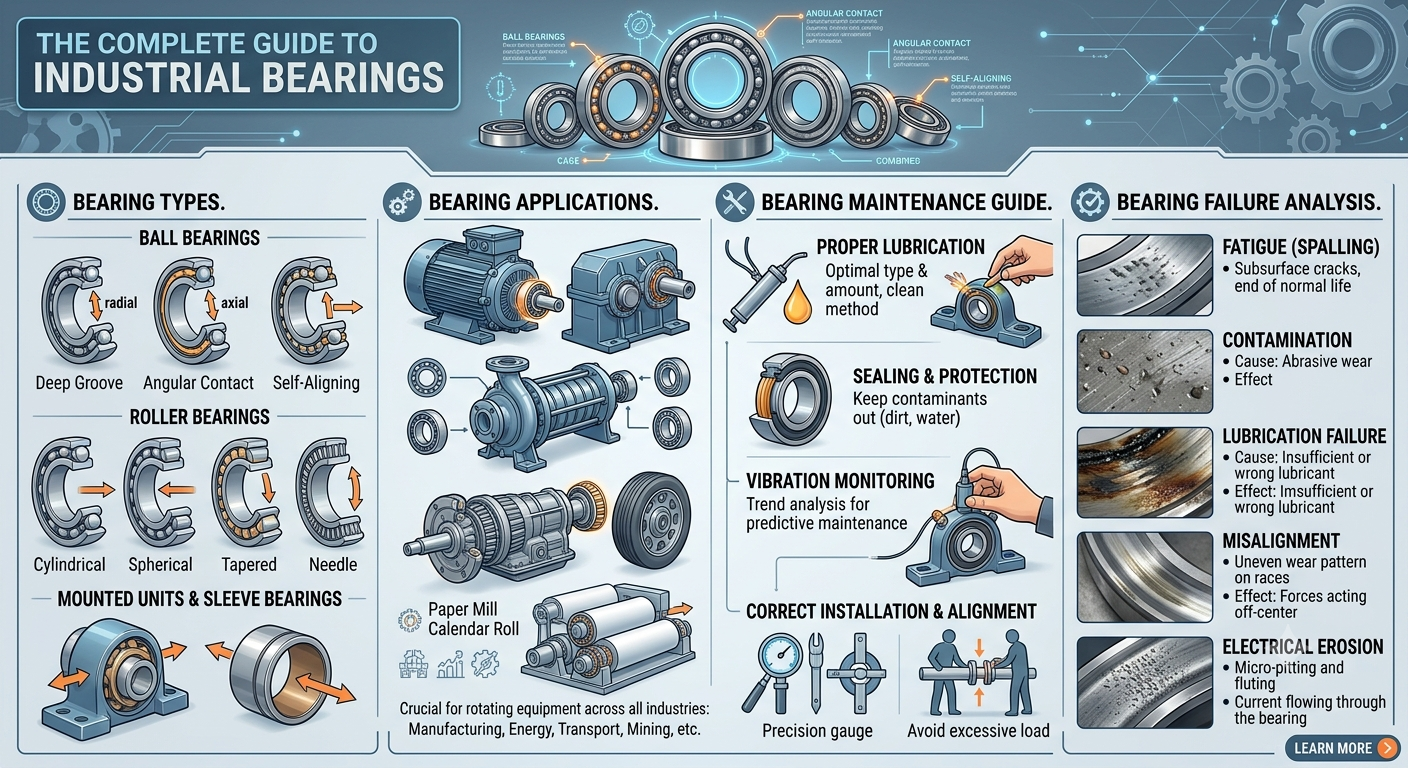
Industrial Bearings: Types, Applications, Selection, Maintenance, and Failure Analysis
Introduction
Industrial bearings are among the most important mechanical components used in rotating equipment across various industries, including chemical plants, power generation, steel, cement, mining, oil and gas, pharmaceuticals, and manufacturing facilities. They play a crucial role in ensuring smooth rotation, reducing friction, supporting loads, and improving the overall efficiency and reliability of machinery.
Almost every industrial plant depends on bearings for the operation of critical equipment such as pumps, compressors, motors, gearboxes, agitators, fans, blowers, turbines, conveyors, and process machines. A bearing failure can lead to unexpected equipment breakdown, production losses, increased maintenance costs, and potential safety hazards.
Proper understanding of industrial bearing types, operating principles, selection methods, lubrication practices, and failure mechanisms is essential for engineers and maintenance professionals to improve equipment reliability and achieve operational excellence.
What Are Industrial Bearings?
An industrial bearing is a mechanical device that supports rotating shafts and allows controlled movement while minimizing friction between moving parts. Bearings transfer loads from rotating components to stationary structures while maintaining accurate shaft positioning.
The primary functions of industrial bearings include:
- Supporting radial and axial loads
- Reducing friction between rotating components
- Maintaining shaft alignment
- Minimizing vibration and noise
- Improving equipment efficiency
- Increasing machine operating life
The correct bearing selection and maintenance strategy can significantly improve equipment performance and reduce unplanned shutdowns.
Basic Components of Industrial Bearings
Most rolling element bearings consist of four major components:
1. Inner Ring
The inner ring is mounted on the rotating shaft and provides the raceway surface where rolling elements move.
2. Outer Ring
The outer ring is installed inside the bearing housing and supports the overall bearing structure.
3. Rolling Elements
Rolling elements reduce friction between the inner and outer rings. Depending on application requirements, different types of rolling elements are used:
- Ball elements
- Cylindrical rollers
- Spherical rollers
- Tapered rollers
- Needle rollers
4. Cage or Separator
The cage maintains equal spacing between rolling elements and prevents direct contact, reducing friction and wear.
Types of Industrial Bearings
Industrial bearings are mainly classified into two categories:
- Rolling Element Bearings
- Sliding Bearings
1. Rolling Element Bearings
Rolling element bearings use balls or rollers between races to reduce friction and handle different loading conditions.
Ball Bearings
Ball bearings are commonly used where moderate loads and high rotational speeds are required.
Advantages:
- Low friction
- High-speed operation
- Compact design
- Easy availability
- Low maintenance requirement
Applications:
- Electric motors
- Small pumps
- Fans
- Gearboxes
- Instrumentation equipment
Deep Groove Ball Bearings
Deep groove ball bearings are one of the most widely used bearing types in industries. They can handle both radial loads and moderate axial loads.
Applications include:
- Centrifugal pumps
- Electric motors
- Blowers
- Small compressors
Their simple design, reliability, and ability to operate at high speeds make them suitable for general industrial applications.
Angular Contact Ball Bearings
Angular contact bearings are designed to handle combined radial and axial loads.
They are commonly used in:
- High-speed pumps
- Machine tools
- Compressors
- Precision rotating equipment
These bearings are available in single-row and double-row configurations depending on load requirements.
Cylindrical Roller Bearings
Cylindrical roller bearings use cylindrical rollers to support heavy radial loads.
Advantages:
- High load capacity
- High stiffness
- Suitable for shock loads
- Good performance in heavy machinery
Applications:
- Industrial gearboxes
- Crushers
- Large electric motors
- Heavy process equipment
Spherical Roller Bearings
Spherical roller bearings are designed for applications where misalignment and heavy loads are expected.
Advantages:
- Self-aligning capability
- High radial load capacity
- Excellent vibration resistance
Applications:
- Conveyors
- Crushers
- Cooling tower fans
- Mining equipment
- Paper manufacturing machines
Tapered Roller Bearings
Tapered roller bearings are designed to handle combined radial and axial loads.
Applications:
- Heavy-duty gearboxes
- Drives
- Industrial machinery
Their ability to withstand high axial forces makes them suitable for demanding applications.
2. Sliding Bearings (Plain Bearings)
Sliding bearings operate through sliding contact between surfaces instead of rolling elements.
Common types include:
- Journal bearings
- Sleeve bearings
- Bush bearings
- Thrust bearings
They are commonly used in large rotating equipment such as:
- Turbines
- Large compressors
- High-capacity pumps
- Steam equipment
Advantages include:
- High load capability
- Long service life
- Ability to support large shafts
Factors for Industrial Bearing Selection
Correct bearing selection is essential for reliable equipment operation. The following factors should be considered:
Load Capacity
Engineers must evaluate:
- Radial load
- Axial load
- Combined loading conditions
- Shock loads
Selecting a bearing with insufficient load capacity can result in premature failure.
Operating Speed
Bearing selection depends on shaft rotational speed.
High-speed applications require bearings with:
- Low friction characteristics
- Proper lubrication
- Accurate installation
- Suitable clearance
Temperature Conditions
Operating temperature affects bearing performance and lubricant life.
High-temperature applications may require:
- Special grease
- Heat-resistant seals
- Advanced bearing materials
Operating Environment
Industrial equipment may operate under harsh conditions involving:
- Dust
- Moisture
- Chemical vapors
- Corrosive atmosphere
Chemical industries require special consideration for corrosion-resistant materials and protective sealing arrangements.
Bearing Lubrication
Lubrication is one of the most important factors influencing bearing life. Proper lubrication reduces friction, controls temperature, prevents wear, and protects surfaces from corrosion.
Grease Lubrication
Grease is commonly used for:
- Electric motors
- Fans
- Small pumps
- Low to medium-speed equipment
Advantages:
- Easy application
- Good sealing capability
- Longer lubrication intervals
Oil Lubrication
Oil lubrication is preferred for high-speed and high-temperature applications.
Common methods include:
- Oil bath lubrication
- Circulating oil systems
- Oil mist lubrication
Applications:
- Turbines
- Compressors
- Gearboxes
- Large rotating equipment
Common Industrial Bearing Failure Modes
Understanding bearing failure causes helps prevent unexpected breakdowns.
Lubrication Failure
Poor lubrication is one of the most common reasons for bearing failure.
Causes:
- Incorrect lubricant selection
- Insufficient lubrication
- Excessive lubrication
- Contaminated oil or grease
Symptoms:
- Increased temperature
- Noise generation
- Surface damage
Overloading
Excessive mechanical loading can damage bearing surfaces.
Causes:
- Incorrect bearing selection
- Equipment overload
- Shaft problems
Symptoms:
- Cracks
- Deformation
- Raceway damage
Misalignment
Shaft misalignment causes uneven load distribution.
Common causes:
- Incorrect installation
- Shaft bending
- Foundation movement
Effects:
- Increased vibration
- Higher temperature
- Reduced bearing life
Contamination
Foreign particles entering bearings can cause severe damage.
Sources include:
- Dust
- Water
- Chemicals
- Metal particles
Contamination leads to:
- Abrasion
- Surface wear
- Premature failure
Industrial Bearing Maintenance Practices
A proper maintenance program improves bearing reliability and reduces downtime.
Preventive Maintenance
Recommended activities include:
- Regular lubrication
- Bearing inspection
- Alignment checking
- Temperature monitoring
- Vibration measurement
Predictive Maintenance
Modern industries use advanced monitoring techniques:
Vibration Analysis
Helps identify:
- Bearing defects
- Misalignment
- Imbalance
- Mechanical looseness
Thermography
Detects abnormal temperature increases caused by:
- Lubrication problems
- Overloading
- Electrical issues
Oil Analysis
Identifies:
- Wear particles
- Contamination
- Lubricant degradation
Bearing Applications in Chemical Industries
Chemical plants operate various rotating machines where bearings are critical components.
Applications include:
- Process pumps
- Agitators
- Reactors
- Cooling tower fans
- Compressors
- Vacuum pumps
- Centrifuges
- Conveyors
- Evaporators
Chemical industries require special bearing considerations due to:
- Corrosive environments
- Chemical exposure
- High temperatures
- Continuous operation requirements
Future Trends in Industrial Bearings
The future of industrial bearings is moving toward intelligent and high-performance solutions.
Smart Bearings
Modern bearings are being equipped with sensors to monitor:
- Temperature
- Vibration
- Load conditions
- Operating health
Advanced Materials
New bearing technologies include:
- Ceramic bearings
- Hybrid bearings
- Corrosion-resistant materials
These materials provide better performance in extreme conditions.
AI-Based Predictive Maintenance
Artificial intelligence is helping industries predict bearing failures before they occur.
Benefits include:
- Reduced equipment downtime
- Improved reliability
- Lower maintenance costs
- Increased production efficiency
Conclusion
Industrial bearings are essential components that directly influence equipment performance, reliability, and operational efficiency. Proper bearing selection, correct lubrication, accurate installation, and effective maintenance practices are key factors in extending bearing life.
For chemical and process industries, where equipment operates continuously under challenging conditions, bearing reliability plays a critical role in safe and efficient plant operation.
With advancements in smart monitoring systems, artificial intelligence, and advanced materials, industrial bearings are becoming more reliable, efficient, and intelligent. Companies that adopt modern bearing management practices can significantly reduce downtime, improve productivity, and achieve long-term operational excellence.