Introduction
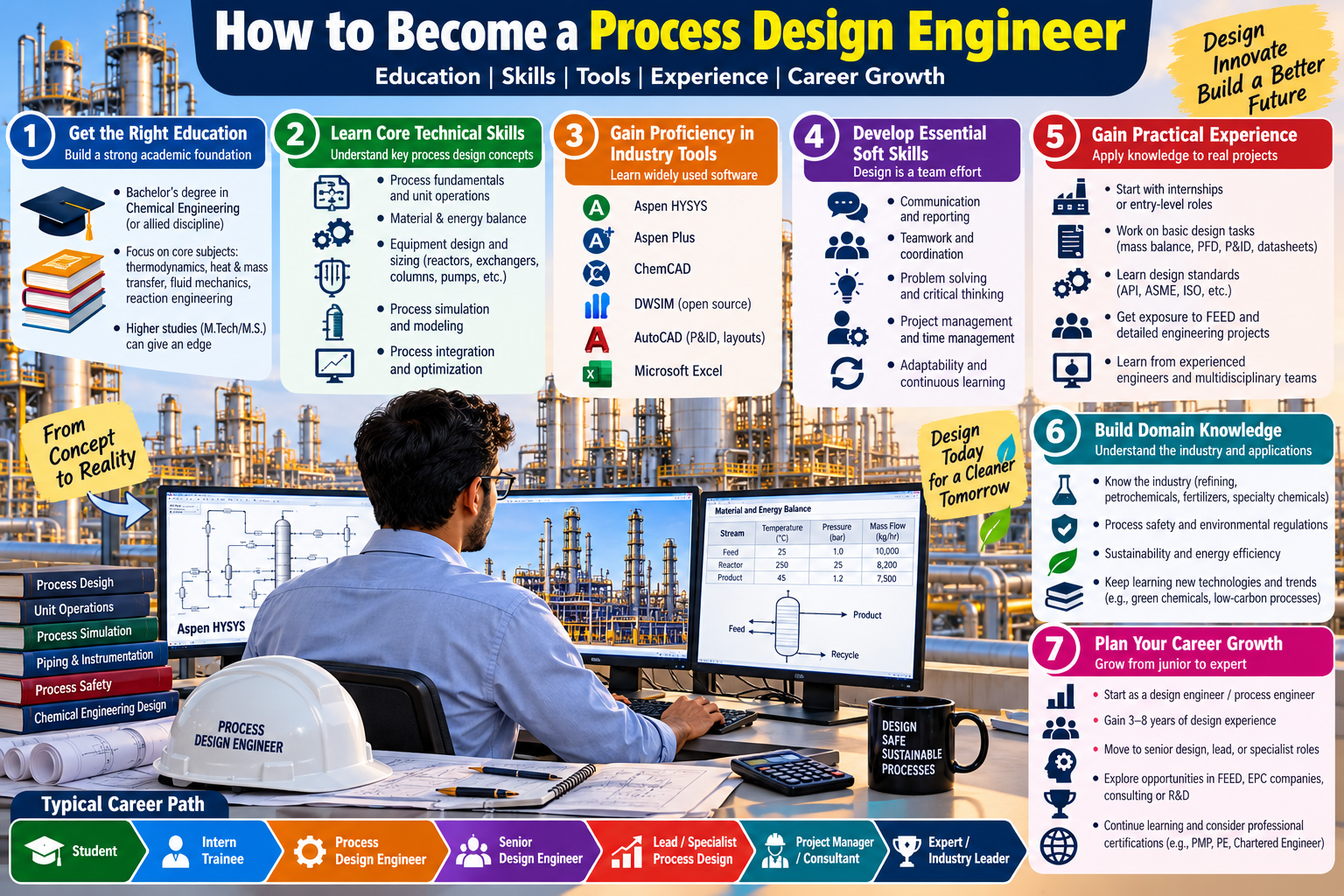
Process simulation software has become an essential engineering tool in modern chemical industries. Chemical engineers use simulation programs to design manufacturing processes, calculate material and energy balances, optimize equipment performance, and evaluate operating conditions before implementing changes in actual plants.
Industries such as petrochemicals, oil and gas, fertilizers, pharmaceuticals, specialty chemicals, and renewable energy rely on process simulation to improve efficiency and reduce engineering risks.
Selecting the best process simulation software for chemical engineers depends on process complexity, industry requirements, available thermodynamic models, engineering experience, and software licensing costs.
This article explores leading chemical process simulation tools, their important features, industrial applications, advantages, limitations, and suitability for students and professional engineers.
1. Aspen Plus – Comprehensive Chemical Process Simulation
Aspen Plus, developed by AspenTech, is widely used for steady-state chemical process simulation and engineering analysis.
It supports modeling of chemical reactions, distillation, absorption, extraction, heat exchangers, and various separation processes.
One of its major strengths is its extensive thermodynamic modeling capability, which helps engineers evaluate vapor-liquid equilibrium, physical properties, and chemical interactions.
Aspen Plus is particularly useful for specialty chemicals, petrochemicals, fertilizers, and other chemical manufacturing applications.
Engineers can perform material balances, energy balances, equipment studies, and process optimization.
Key advantages: Extensive thermodynamic models, broad unit-operation coverage, and strong industrial adoption.
Limitations: Commercial licensing costs and a relatively steep learning curve.
Aspen Plus is a strong choice for engineers pursuing careers in chemical process design and simulation.
2. Aspen HYSYS – Oil, Gas, and Petrochemical Simulation
Aspen HYSYS is another widely recognized process simulation platform from AspenTech.
It is particularly associated with oil and gas processing, refining, natural gas treatment, and hydrocarbon separation.
The software enables engineers to simulate compressors, pumps, heat exchangers, separators, distillation columns, and pipeline-related process systems.
Aspen HYSYS provides interactive flowsheet development and supports steady-state and applicable dynamic simulation workflows.
Typical applications include natural gas dehydration, gas sweetening, crude oil processing, and refinery operations.
Key advantages: Strong hydrocarbon-processing capabilities, interactive simulation, and useful dynamic modeling options.
Limitations: Commercial licensing requirements and specialized modeling considerations for certain non-hydrocarbon systems.
For chemical engineers interested in refinery and oil and gas careers, Aspen HYSYS is a valuable skill.
3. DWSIM – Best Free Process Simulation Software
DWSIM is a free, open-source chemical process simulator suitable for students, researchers, and practicing engineers.
It supports steady-state and dynamic simulation, thermodynamic property calculations, chemical reactions, and common unit operations.
DWSIM provides equipment models for pumps, compressors, heat exchangers, reactors, separators, and distillation columns.
It supports multiple operating systems, including Windows, Linux, and macOS.
One of its greatest advantages is that engineers can learn process simulation without purchasing expensive commercial software.
Key advantages: Free availability, open-source architecture, thermodynamic models, and useful educational applications.
Limitations: Some specialized industrial applications may require additional modeling, validation, or commercial software capabilities.
DWSIM is an excellent starting point for engineering students and professionals learning process simulation independently.
DWSIM+1
4. CHEMCAD – Chemical Process Design and Optimization
CHEMCAD is a commercial process simulation platform used for chemical process design, equipment analysis, and process optimization.
It provides capabilities for material and energy balances, thermodynamic calculations, distillation, heat transfer, and chemical reaction modeling.
CHEMCAD is suitable for applications involving specialty chemicals, chemical processing, and industrial separation systems.
Engineers can develop process flowsheets, evaluate operating alternatives, and analyze equipment performance.
Its integrated engineering environment makes it useful for process development and plant improvement projects.
Key advantages: Broad chemical engineering applications, integrated simulation tools, and equipment analysis capabilities.
Limitations: Commercial licensing costs and the need to validate specialized models.
CHEMCAD is worth considering for engineers working in chemical process development and industrial consulting.
5. AVEVA PRO/II – Refinery and Petrochemical Simulation
AVEVA PRO/II is an established process simulation tool used for steady-state engineering calculations.
It is particularly suitable for oil refining, petrochemical processing, and hydrocarbon separation applications.
Engineers use PRO/II for process material balances, energy calculations, distillation studies, and equipment performance evaluation.
The software supports thermodynamic property calculations and simulation of complex process flowsheets.
It is useful for conceptual design, engineering studies, and modifications to existing facilities.
Key advantages: Strong steady-state process simulation capabilities and established applications in hydrocarbon processing.
Limitations: Commercial licensing and a more specialized focus than some general-purpose simulation platforms.
6. gPROMS – Advanced Process Modeling and Optimization
gPROMS is an advanced modeling platform used for detailed process simulation, dynamic modeling, and optimization.
It is particularly useful when conventional flowsheet models cannot adequately represent complex physical or chemical behavior.
Engineers can develop mathematical models based on differential and algebraic equations.
Applications include chemical reaction engineering, crystallization, pharmaceutical manufacturing, and advanced process development.
gPROMS can support model-based optimization and process development where detailed equipment behavior is important.
Key advantages: Flexible mathematical modeling, dynamic simulation, and advanced optimization capabilities.
Limitations: A demanding learning curve, mathematical modeling requirements, and commercial licensing.
It is particularly suitable for engineers interested in research, advanced process development, and specialized industrial modeling.
7. Honeywell UniSim Design – Process Simulation and Dynamic Studies
Honeywell UniSim Design is a commercial process simulation platform used in oil and gas, refining, and chemical processing.
It supports process flowsheet development, thermodynamic calculations, equipment modeling, and dynamic simulation.
Engineers can evaluate process performance, control strategies, and operational changes.
Dynamic simulation is especially valuable for analyzing startup conditions, shutdown behavior, and process disturbances.
UniSim Design can also support the development of operator training and operational improvement applications.
Key advantages: Integrated process modeling, dynamic simulation, and applications in energy industries.
Limitations: Commercial licensing and training requirements.
8. ProSim – Specialized Chemical Engineering Simulation
ProSim provides process simulation and engineering calculation solutions for chemical and energy-related applications.
Its software portfolio includes tools for thermodynamic calculations, process simulation, and specialized engineering studies.
These capabilities can support chemical separation, process development, and equipment performance evaluation.
ProSim tools are particularly relevant when reliable physical property calculations and specialized process models are required.
Key advantages: Thermodynamic modeling expertise and specialized chemical engineering applications.
Limitations: Product-specific capabilities and commercial licensing requirements.
Engineers should evaluate individual ProSim products according to their project requirements.
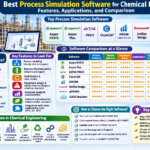
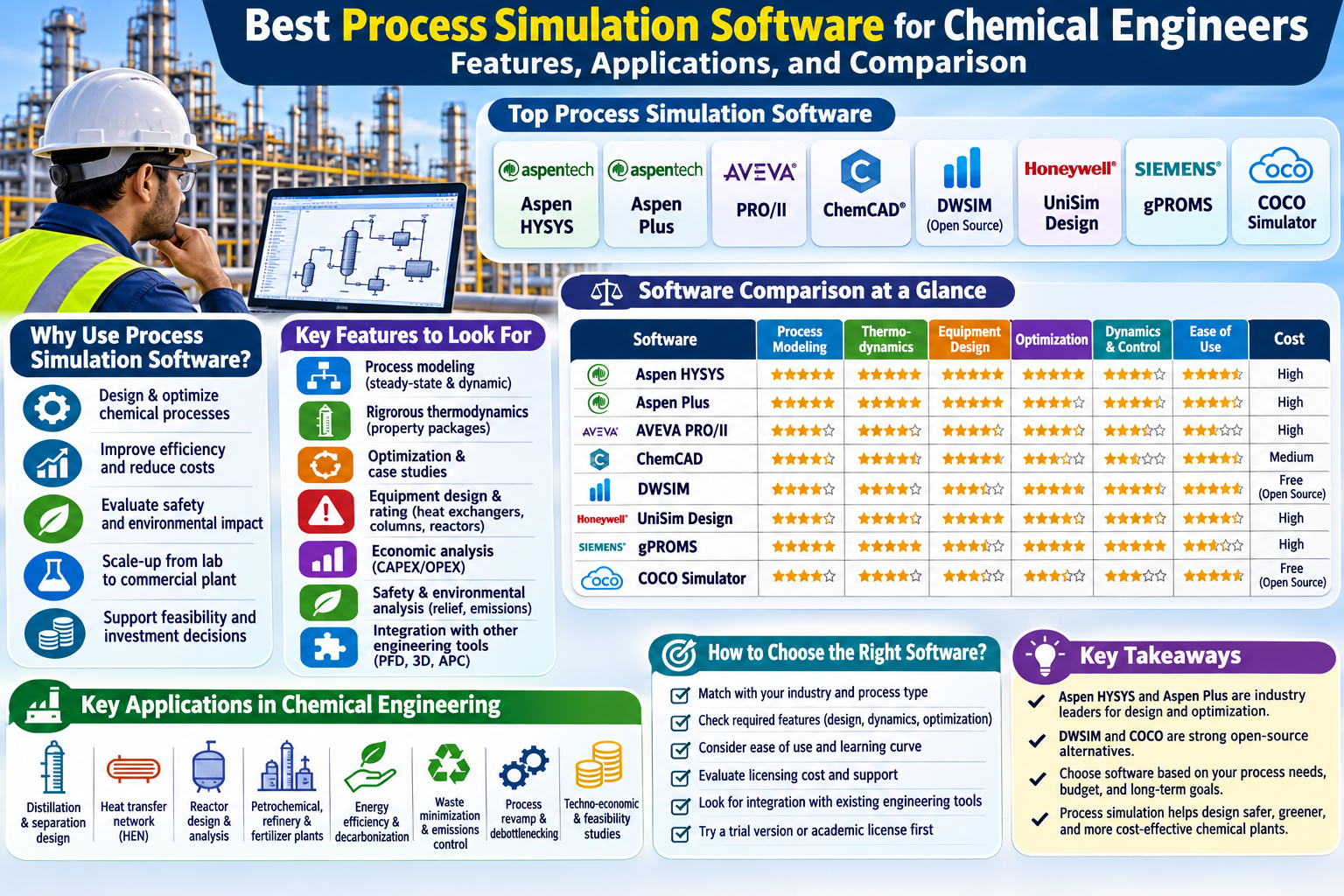
9. Comparison of Process Simulation Software
The following comparison summarizes the suitability of major simulation platforms.
Aspen Plus: Best suited for general chemical manufacturing, complex thermodynamics, and process design. Commercial software.
Aspen HYSYS: Particularly suitable for oil and gas processing, refining, and hydrocarbon systems. Commercial software.
DWSIM: Excellent for students, independent learning, and general process simulation. Free and open-source.
CHEMCAD: Suitable for chemical process development, separation systems, and equipment analysis. Commercial software.
AVEVA PRO/II: Strong option for steady-state refinery and petrochemical simulation. Commercial software.
gPROMS: Particularly suitable for advanced mathematical modeling, dynamic simulation, and process optimization. Commercial software.
UniSim Design: Useful for energy processing, plant simulation, and dynamic operational studies. Commercial software.
No single simulator is universally superior. Selection depends on the process, available models, licensing, and engineering requirements.
10. Which Process Simulation Software Should Students Learn?
Chemical engineering students should begin with fundamental engineering calculations before relying heavily on simulation software.
Material balances, energy balances, thermodynamics, fluid mechanics, and reaction engineering provide the foundation for understanding simulation results.
DWSIM is an attractive starting point because it offers free access to practical process modeling.
Students with institutional access to Aspen Plus or Aspen HYSYS should also learn these platforms.
Beginners can practice modeling pumps, heat exchangers, flash separators, reactors, and distillation columns.
More advanced projects may involve complete chemical plants, heat integration, and process optimization.
Developing a portfolio of validated simulation projects can strengthen employment opportunities.
11. Applications in Fertilizer and Chemical Plants
Process simulation software is valuable in fertilizer manufacturing, phosphoric acid production, ammonia plants, sulphuric acid facilities, and other chemical industries.
Engineers can simulate evaporation systems, heat exchangers, reactors, gas absorption units, and utility networks.
For example, phosphoric acid concentration systems require calculations involving feed concentration, evaporation rate, steam consumption, vacuum conditions, and heat transfer performance.
Simulation can help evaluate energy requirements and operating alternatives.
However, wet-process phosphoric acid systems contain complex electrolyte chemistry, suspended solids, crystallization, and impurity interactions.
Accurate modeling may require specialized thermodynamic methods, experimental data, and validated custom models.
Therefore, engineers must not assume that a conventional liquid-phase simulator automatically predicts slurry crystallization or filtration performance accurately.
12. Future Trends in Chemical Process Simulation
Process simulation is evolving through artificial intelligence, digital twins, cloud computing, and advanced optimization technologies.
Digital twins combine engineering models with operational data to represent actual plant behavior.
Artificial intelligence can assist with model calibration, parameter estimation, and identifying potential operating improvements.
Dynamic simulation is also becoming increasingly important for process safety, operator training, and control system evaluation.
Future simulation platforms are expected to support greater integration between process engineering, equipment design, energy management, and plant operations.
Nevertheless, engineering judgment and model validation will remain essential.
Conclusion
Selecting the best process simulation software for chemical engineers requires understanding both technical requirements and career objectives.
Aspen Plus is a strong option for general chemical process design, while Aspen HYSYS is particularly valuable for hydrocarbon processing.
DWSIM offers an accessible platform for students and independent learners, whereas CHEMCAD, PRO/II, UniSim Design, and gPROMS serve different specialized engineering needs.
Chemical engineers should focus on developing strong fundamentals, learning at least one simulation platform thoroughly, and validating results against engineering calculations.
Ultimately, process simulation software is most valuable when combined with practical plant knowledge, accurate thermodynamic data, and sound engineering judgment.