
The global chemical industry is undergoing a profound transformation. For decades, large-scale centralized manufacturing plants have dominated chemical production, leveraging economies of scale to produce vast quantities of products at competitive costs. While this model remains effective for commodity chemicals such as sulfuric acid, methanol, and polyethylene, it is increasingly being challenged in the specialty chemicals sector, where flexibility, customization, speed, and sustainability have become critical competitive advantages.
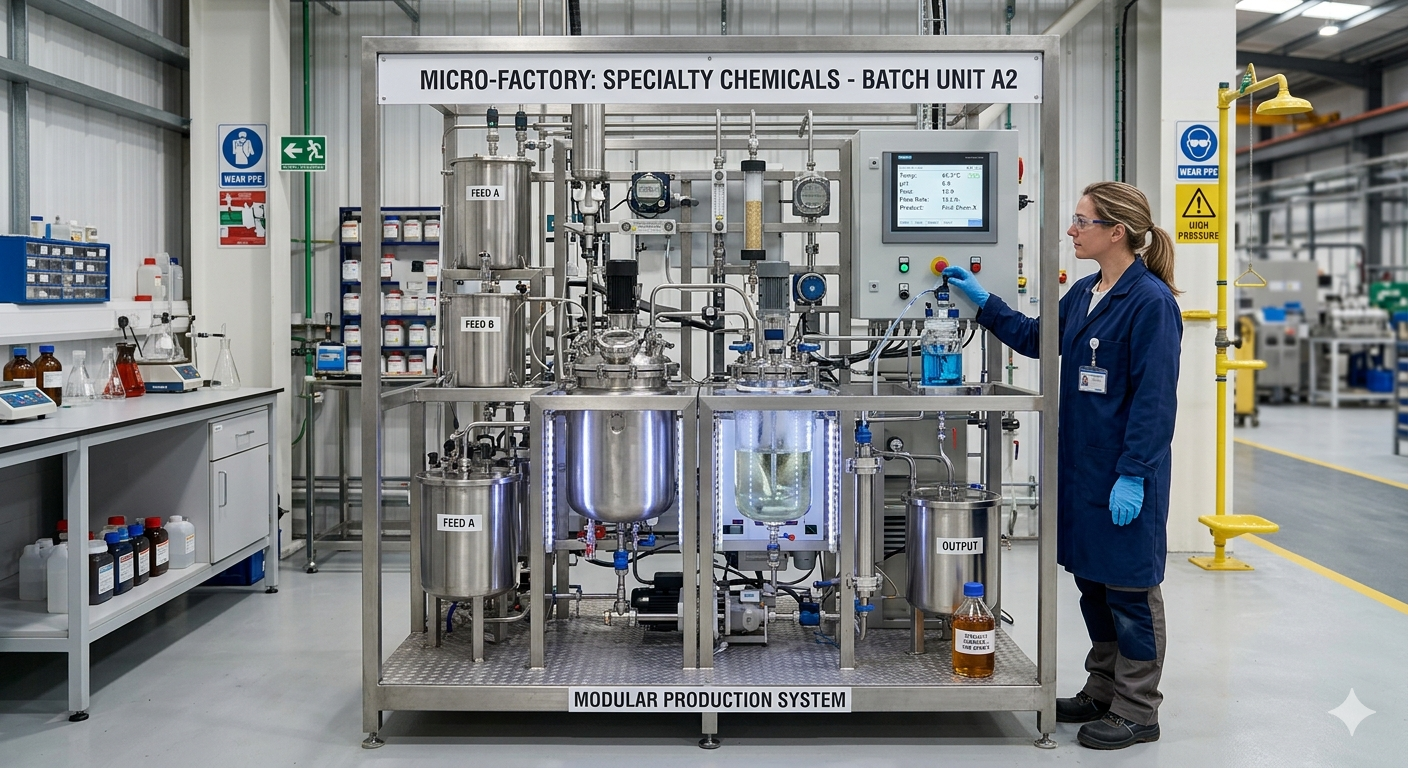
One of the most promising innovations driving this transformation is the emergence of micro-factories for specialty chemicals. These compact, modular, and highly automated production units are redefining how specialty chemicals are manufactured, distributed, and delivered to customers. By enabling smaller-scale, localized production, micro-factories offer a compelling alternative to traditional chemical plants and are opening new opportunities for entrepreneurs, manufacturers, and investors alike.
Understanding Chemical Micro-Factories
A micro-factory is a small-scale manufacturing facility designed to produce specialized products efficiently using modular equipment, advanced automation, and digital process controls. In the specialty chemicals industry, these facilities are typically built around continuous-flow reactors, modular processing units, and intelligent monitoring systems.
Unlike conventional chemical plants that may require hundreds of crores of investment and years to construct, micro-factories can often be deployed in a fraction of the time and at significantly lower capital costs. Their modular design allows manufacturers to add, remove, or reconfigure production units based on changing market demands.
The concept aligns perfectly with the requirements of the specialty chemicals industry, where production volumes are lower, product diversity is higher, and customer specifications frequently change.
Why Specialty Chemicals Are Different
Specialty chemicals differ significantly from commodity chemicals. While commodity chemicals are produced in large volumes with standardized specifications, specialty chemicals are tailored for specific applications and customers.
Examples include:
- Pharmaceutical intermediates
- Agrochemical ingredients
- Electronic and semiconductor chemicals
- Water treatment chemicals
- Flavors and fragrances
- Cosmetic ingredients
- Performance additives
- Specialty coatings and pigments
These products often require precise formulations, smaller batch sizes, and strict quality control. Customers may also request customized products, making manufacturing flexibility a key success factor.
Traditional large-scale plants are not always optimized for such requirements. Long production cycles, expensive changeovers, and large inventory requirements can reduce efficiency. Micro-factories address these challenges by enabling agile and responsive manufacturing.
Core Technologies Behind Micro-Factories
The success of specialty chemical micro-factories depends on several technological innovations.
Continuous Flow Chemistry
One of the most important technologies is continuous-flow processing. Unlike batch manufacturing, where materials are processed in large reactors over extended periods, continuous-flow systems move reactants continuously through compact reactors.
This approach offers numerous advantages:
- Improved reaction control
- Faster heat transfer
- Better product consistency
- Reduced waste generation
- Enhanced safety
Continuous-flow chemistry is particularly useful for complex reactions that are difficult or hazardous to perform in traditional batch reactors.
Modular Process Units
Micro-factories are typically built using modular process skids that perform specific functions such as reaction, separation, purification, and packaging.
These modules can be assembled like building blocks to create customized production lines. As demand grows, additional modules can be added without requiring major infrastructure changes.
This scalability allows manufacturers to expand gradually rather than making large upfront investments.
Automation and Digitalization
Modern micro-factories rely heavily on automation technologies.
Advanced sensors continuously monitor process parameters such as temperature, pressure, flow rates, and chemical composition. Artificial intelligence and machine learning systems analyze this data in real time, optimizing operations and ensuring product quality.
Digital manufacturing systems also enable predictive maintenance, reducing downtime and improving overall efficiency.
Containerized Manufacturing
Many micro-factory concepts are designed within container-sized units that can be transported and installed rapidly.
This portability allows manufacturers to deploy production closer to customers, reducing transportation costs and improving supply chain resilience.
Containerized facilities can also be relocated or expanded as market conditions evolve.
Key Benefits of Specialty Chemical Micro-Factories
Lower Capital Investment
Traditional specialty chemical plants often require substantial capital expenditure for land, infrastructure, utilities, and equipment.
Micro-factories significantly reduce these requirements by utilizing compact equipment and modular designs. This lower investment barrier makes chemical manufacturing more accessible to startups and small enterprises.
Faster Time to Market
Building a conventional chemical facility can take several years due to engineering, permitting, and construction requirements.
Micro-factories can often be designed, assembled, and commissioned within months, allowing companies to respond quickly to emerging market opportunities.
Greater Manufacturing Flexibility
One of the most significant advantages of micro-factories is their ability to switch between products with minimal disruption.
This flexibility is particularly valuable in specialty chemicals, where product lifecycles are shorter and customer requirements change frequently.
Manufacturers can produce multiple products using the same facility, improving asset utilization and profitability.
Improved Safety
Smaller reactor volumes reduce the risks associated with hazardous chemical reactions.
In the event of a process upset, the consequences are generally less severe compared to large-scale facilities. Continuous monitoring systems further enhance operational safety.
Sustainability Advantages
Environmental sustainability is becoming increasingly important across industries.
Micro-factories support sustainability goals through:
- Reduced energy consumption
- Lower material waste
- Shorter transportation distances
- Smaller physical footprints
- More efficient resource utilization
These benefits contribute to lower carbon emissions and improved environmental performance.
Emerging Business Models
The rise of micro-factories is creating new business opportunities across the chemical value chain.
Contract Manufacturing Services
Entrepreneurs can establish micro-factories that manufacture specialty chemicals for multiple clients.
This model is particularly attractive for pharmaceutical, cosmetic, and specialty ingredient companies that prefer outsourcing production rather than investing in their own facilities.
Distributed Manufacturing Networks
Companies can deploy multiple micro-factories across different regions to serve local markets.
Instead of shipping chemicals across countries or continents, products can be manufactured near customers, reducing logistics costs and improving responsiveness.
On-Demand Chemical Production
Digital manufacturing technologies enable chemicals to be produced only when needed.
This approach reduces inventory requirements, minimizes waste, and improves working capital efficiency.
Chemical Manufacturing-as-a-Service
Future micro-factory operators may offer production capacity as a service, allowing customers to access manufacturing capabilities without owning facilities.
This model could significantly lower barriers to entry for innovative chemical startups.
Opportunities in India
India is uniquely positioned to benefit from the growth of specialty chemical micro-factories.
The country has already established itself as a major global producer of pharmaceuticals, agrochemicals, dyes, pigments, and specialty chemical intermediates. Rising international demand, favorable government policies, and increasing investments in domestic manufacturing are strengthening the industry’s growth prospects.
Several factors make India particularly attractive for micro-factory deployment:
- Strong chemical engineering talent pool
- Expanding specialty chemical market
- Growing pharmaceutical sector
- Increasing demand for import substitution
- Competitive manufacturing costs
- Supportive industrial policies
Regions such as Gujarat, Maharashtra, Telangana, and Andhra Pradesh already possess well-developed chemical ecosystems that could support widespread adoption of micro-factory technologies.
High-Potential Applications
Several specialty chemical segments are especially well suited for micro-factory production.
Pharmaceutical Intermediates
The pharmaceutical industry increasingly requires flexible manufacturing solutions capable of producing multiple compounds in smaller volumes.
Micro-factories can meet these requirements while maintaining stringent quality standards.
Agrochemical Ingredients
Agricultural inputs often experience seasonal demand fluctuations.
Modular production facilities can adjust output levels quickly, improving efficiency and reducing excess inventory.
Battery Materials
The rapid growth of electric vehicles and energy storage systems is driving demand for battery chemicals and precursor materials.
Micro-factories can support localized production and supply chain diversification.
Semiconductor Chemicals
The semiconductor industry requires ultra-high-purity chemicals produced under tightly controlled conditions.
Automated micro-factories can provide the precision and consistency necessary for these applications.
Flavors and Fragrances
Consumer preference for customized products is increasing demand for specialized formulations.
Micro-factories offer the flexibility required to produce a wide variety of fragrance and flavor compounds efficiently.
Challenges and Limitations
Despite their advantages, micro-factories are not a universal solution.
Several challenges remain:
Regulatory Compliance
Chemical manufacturing is heavily regulated. Obtaining permits, certifications, and environmental approvals can still be complex, even for smaller facilities.
Process Development Costs
Developing optimized continuous-flow processes requires significant technical expertise and investment.
Quality Consistency
Maintaining consistent product quality across multiple distributed facilities can be challenging.
Scale Constraints
Micro-factories are best suited for high-value specialty products. Commodity chemicals will continue to favor large-scale production due to their dependence on economies of scale.
Market Acceptance
Many customers remain accustomed to traditional supply chains and may require time to adopt decentralized manufacturing models.
The Future of Specialty Chemical Manufacturing
As digital technologies, automation, and process intensification continue to advance, micro-factories are expected to become increasingly important in the specialty chemicals industry.
Their ability to combine flexibility, sustainability, safety, and economic efficiency aligns closely with the evolving needs of modern manufacturing. Businesses are seeking ways to reduce supply chain risks, shorten development cycles, and respond more rapidly to customer demands. Micro-factories provide a practical solution to these challenges.
For startups, they represent an opportunity to enter chemical manufacturing with lower capital requirements. For established companies, they offer a pathway to decentralized production and greater operational agility. For investors, they represent a growing industrial innovation trend with significant long-term potential.
While traditional large-scale chemical plants will continue to dominate commodity production, the future of specialty chemicals is likely to be shaped by smaller, smarter, and more connected manufacturing facilities. Micro-factories are not merely an incremental improvement in production technology—they represent a fundamental shift toward a more flexible, resilient, and sustainable model of chemical manufacturing.