
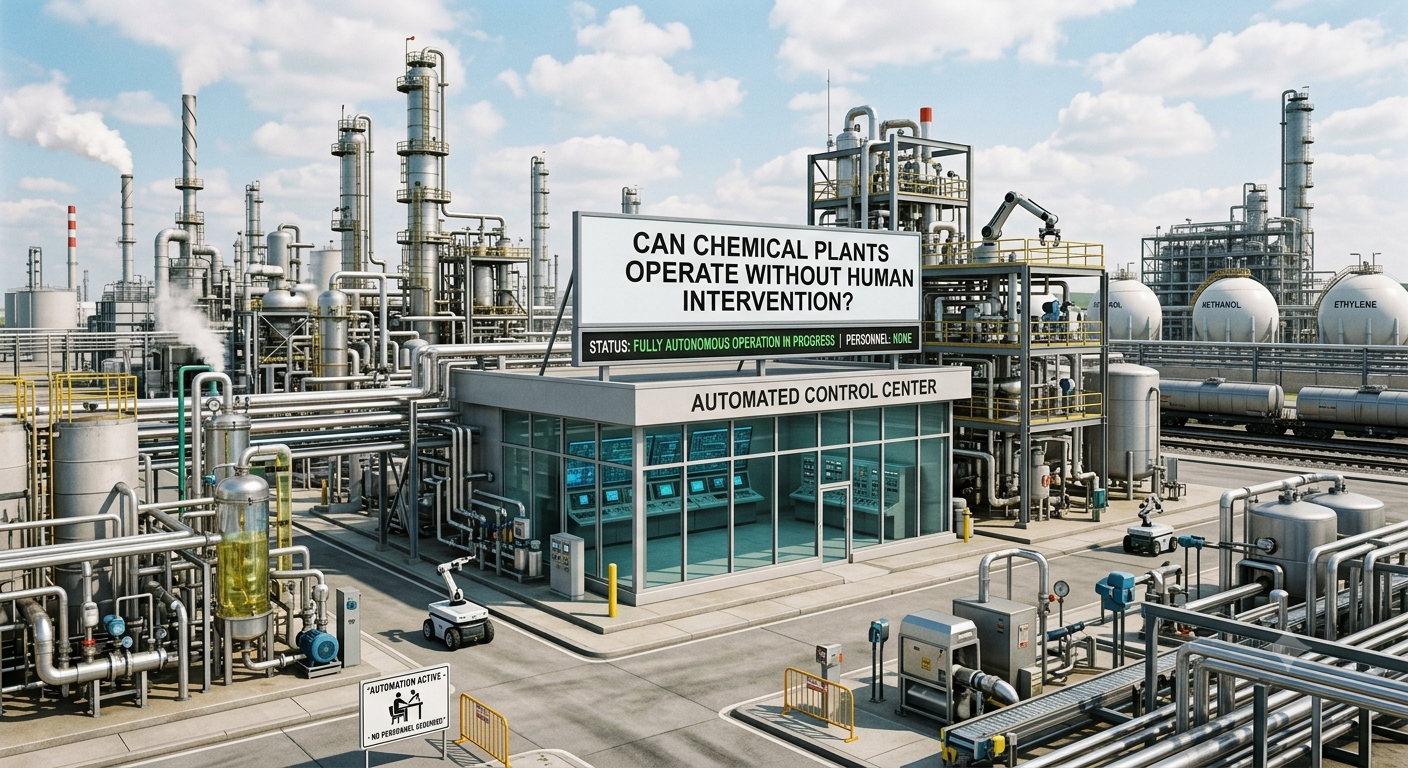
The rapid advancement of automation, artificial intelligence (AI), robotics, and digital technologies has transformed industries across the globe. Manufacturing facilities, warehouses, transportation systems, and even customer service operations are increasingly relying on intelligent machines to perform tasks that once required human labor. Among the industries experiencing this transformation is the chemical processing sector. As technology continues to evolve, a significant question arises: Can chemical plants operate without human intervention?
The answer is both simple and complex. While modern chemical plants can function with minimal human involvement for extended periods, completely autonomous chemical plants remain largely a vision for the future. Current technologies enable high levels of automation, but human expertise continues to play a critical role in ensuring safety, reliability, efficiency, and regulatory compliance.
The Evolution of Automation in Chemical Plants
Chemical manufacturing has always been a technology-driven industry. Over the past several decades, chemical plants have evolved from manually operated facilities to highly automated production systems. Early plants relied heavily on operators who monitored equipment, adjusted valves, and controlled production processes directly from the field. Today, many of these tasks are managed through sophisticated computerized systems.
Modern chemical plants utilize Distributed Control Systems (DCS), Programmable Logic Controllers (PLCs), and Supervisory Control and Data Acquisition (SCADA) systems. These technologies continuously monitor process variables such as temperature, pressure, flow rate, and chemical composition. Sensors installed throughout the plant collect real-time data, which is analyzed and used to make automatic adjustments to maintain optimal operating conditions.
As a result, many routine operational tasks that once required constant human attention can now be performed automatically. Operators often supervise processes from centralized control rooms rather than directly interacting with equipment on the plant floor.
How Modern Automation Works
Automation in chemical plants is designed to maintain stable and efficient production while minimizing human error. Thousands of sensors throughout the facility collect information and transmit it to centralized control systems. These systems compare actual process conditions with predefined operating parameters and automatically make corrections when necessary.
For example, if the temperature inside a reactor begins to rise above its desired range, the control system can automatically adjust cooling systems or reduce reactant feed rates. Similarly, if a pressure increase is detected in a pipeline, valves can be adjusted without operator intervention.
Advanced Process Control (APC) systems further enhance automation by using mathematical models and predictive algorithms to optimize plant performance. These systems can anticipate process changes and make adjustments before deviations occur, improving efficiency and reducing waste.
The integration of machine learning and AI technologies has expanded these capabilities even further. Modern AI systems can analyze large volumes of historical and real-time data to identify patterns, predict equipment failures, and recommend operational improvements.
The Rise of Autonomous Operations
The concept of autonomous operations refers to facilities that can run with little or no direct human involvement. Several industries have already moved toward this model. Automated warehouses, autonomous mining equipment, and self-driving vehicles demonstrate the growing capabilities of intelligent systems.
In the chemical industry, certain facilities have achieved a high degree of autonomy. Remote gas processing plants, water treatment facilities, and pipeline stations can often operate unattended for extended periods. These sites rely on automated monitoring systems and remote supervision from centralized control centers.
Some chemical plants now use digital twins—virtual replicas of physical facilities that simulate plant behavior in real time. Digital twins enable operators and AI systems to test different scenarios, predict potential issues, and optimize performance without affecting actual production.
Combined with advanced sensors, predictive analytics, and robotic technologies, digital twins bring the industry closer to autonomous operation than ever before.
The Role of Artificial Intelligence
Artificial intelligence is increasingly becoming a key component of chemical plant automation. AI systems can analyze enormous amounts of process data much faster than humans. This capability allows them to detect subtle trends, identify inefficiencies, and predict equipment failures before they occur.
Predictive maintenance is one of the most valuable applications of AI in chemical plants. Traditionally, maintenance schedules were based on fixed intervals or equipment breakdowns. AI-driven systems continuously monitor equipment health and predict when maintenance will be needed. This approach reduces downtime, lowers maintenance costs, and improves reliability.
AI can also assist with process optimization by analyzing production variables and recommending adjustments that improve yield, reduce energy consumption, and minimize waste generation.
In the future, AI may play an even greater role in autonomous decision-making, allowing chemical plants to respond intelligently to changing operating conditions without requiring human input.
Why Human Intervention Is Still Necessary
Despite impressive technological advances, fully autonomous chemical plants remain uncommon. One of the primary reasons is the complexity of chemical processes. Chemical reactions often involve numerous variables that can interact in unpredictable ways.
While automation systems excel at handling routine operations, they may struggle when faced with unusual or unexpected situations. Equipment malfunctions, sudden changes in raw material quality, power outages, cyberattacks, or unforeseen process disturbances can create conditions that require human judgment and problem-solving skills.
Human operators possess experience and intuition that are difficult to replicate through software alone. They can assess complex situations, consider multiple factors simultaneously, and make decisions when information is incomplete or uncertain.
This ability remains critical in an industry where operational mistakes can have serious safety, environmental, and economic consequences.
Safety Considerations
Safety is perhaps the most significant barrier to completely human-free chemical plants. Chemical manufacturing often involves hazardous materials, high temperatures, high pressures, and potentially dangerous reactions.
Although modern plants incorporate extensive safety systems, emergency situations still require human oversight. Operators and emergency response teams are trained to manage incidents such as chemical leaks, fires, explosions, and equipment failures.
Automated emergency shutdown systems can quickly isolate hazards and stop production when dangerous conditions are detected. However, determining the root cause of an incident, coordinating emergency responses, and implementing corrective actions frequently require human expertise.
Regulatory authorities around the world also place strict safety requirements on chemical manufacturers. Most regulations assume some level of human supervision and accountability, making fully autonomous operations difficult to implement from both a practical and legal perspective.
Maintenance and Physical Repairs
Another major challenge for autonomous chemical plants is maintenance. Even the most advanced equipment experiences wear and tear over time. Pumps, compressors, valves, heat exchangers, and instrumentation require periodic inspection, servicing, and replacement.
Robotics has made significant progress in supporting maintenance activities. Inspection drones can access difficult-to-reach areas, while robotic systems can perform certain repetitive maintenance tasks. AI-powered monitoring systems can identify corrosion, leaks, and equipment degradation before failures occur.
However, many maintenance activities still require skilled technicians. Physical repairs often involve complex procedures, specialized tools, and situational judgment that robots cannot yet fully replicate.
As a result, human maintenance personnel remain essential to plant reliability and long-term operation.
Cybersecurity and Digital Risks
As chemical plants become increasingly connected and automated, cybersecurity has emerged as a critical concern. Autonomous facilities rely heavily on digital infrastructure, making them potential targets for cyberattacks.
A successful attack on control systems could disrupt production, compromise safety systems, or cause environmental damage. Human cybersecurity specialists are needed to monitor threats, respond to incidents, and continuously improve system defenses.
While AI can assist in detecting unusual network activity and identifying potential security risks, human expertise remains necessary for strategic decision-making and incident response.
The Future of Autonomous Chemical Plants
The future of chemical manufacturing will likely involve a gradual shift toward greater autonomy rather than complete elimination of human involvement. Emerging technologies such as advanced AI, autonomous robotics, edge computing, digital twins, and smart sensors will continue to reduce the need for direct human intervention.
Future plants may operate with significantly smaller workforces, relying on remote monitoring centers and AI-driven decision-making systems. Autonomous inspection robots could perform routine maintenance checks, while predictive analytics could optimize production continuously.
However, even in highly autonomous facilities, humans will likely remain responsible for strategic planning, regulatory compliance, safety oversight, emergency management, and complex problem-solving.
Rather than replacing humans entirely, automation is more likely to change the nature of their roles. Engineers and operators will increasingly focus on supervision, optimization, and decision-making while machines handle routine operational tasks.
Conclusion
Chemical plants have already achieved remarkable levels of automation, enabling them to operate with minimal human intervention under normal conditions. Technologies such as distributed control systems, artificial intelligence, predictive maintenance, robotics, and digital twins have significantly improved efficiency, safety, and reliability.
Nevertheless, completely autonomous chemical plants remain largely a future aspiration. The complexity of chemical processes, safety requirements, maintenance needs, cybersecurity risks, and regulatory obligations continue to necessitate human involvement.
As technology advances, the industry will move closer to autonomous operations, but human expertise will remain an essential component of chemical manufacturing for the foreseeable future. The future is not one of machines replacing people entirely, but rather one in which humans and intelligent systems work together to create safer, more efficient, and more productive chemical plants.