
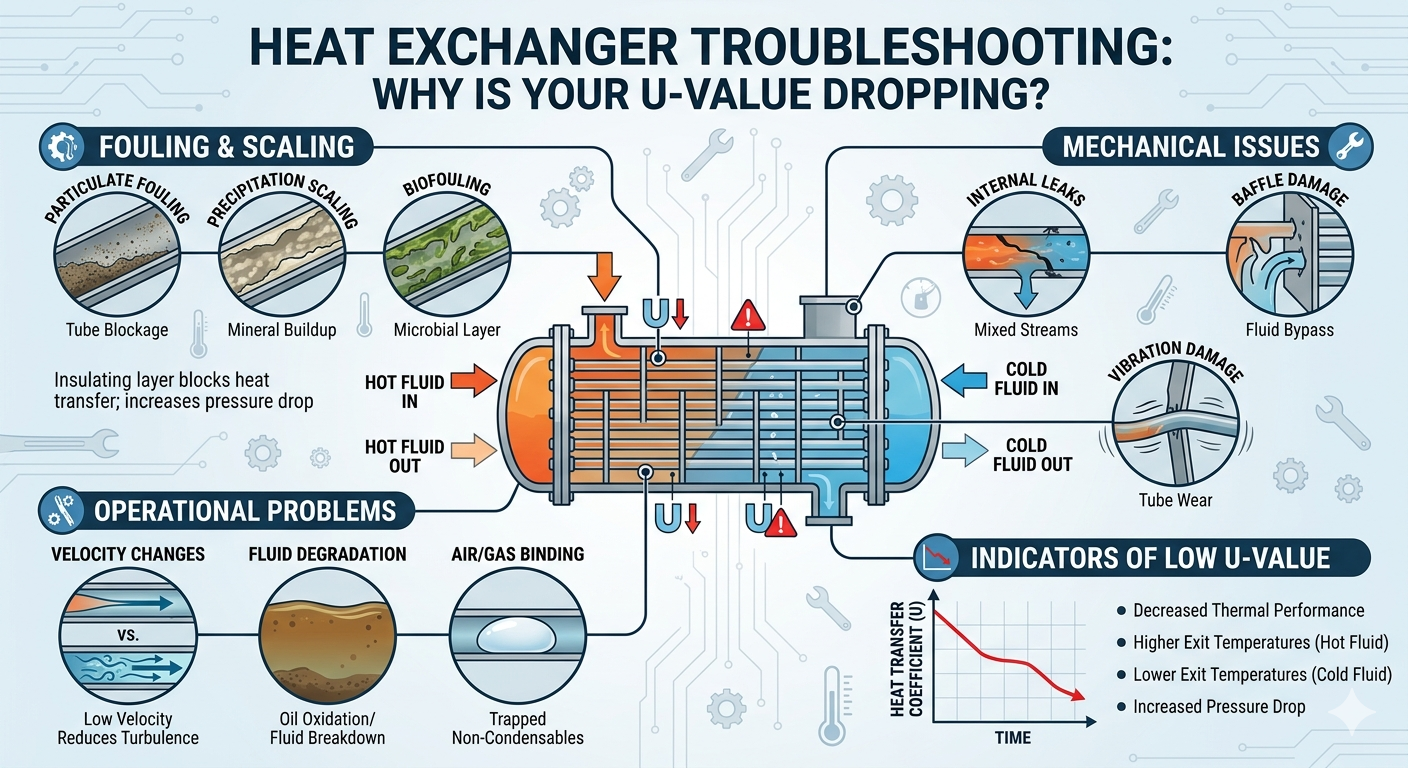
Heat exchangers are the quiet workhorses of industrial systems—moving thermal energy efficiently between fluids to keep processes running smoothly. Whether in power plants, chemical processing units, HVAC systems, or food industries, their performance is critical. One of the most important indicators of a heat exchanger’s effectiveness is the overall heat transfer coefficient, commonly known as the U-value.
When the U-value begins to drop, it signals a degradation in heat transfer performance. This is not just a minor efficiency issue—it can lead to increased energy consumption, reduced output, higher operating costs, and even unplanned shutdowns. Understanding why this happens and how to address it is essential for engineers and operators alike.
Understanding the U-Value
At its core, the U-value represents how easily heat passes from one fluid to another across a heat exchanger surface. A higher U-value means better heat transfer; a lower U-value indicates increasing resistance.
1/U=1/hi+Rf+1/ho
This relationship shows that the total resistance to heat transfer is made up of three primary components:
- Internal convective resistance (1/hi): Resistance from the fluid inside the tubes
- Fouling resistance (Rf): Resistance caused by deposits on heat transfer surfaces
- External convective resistance (1/ho): Resistance from the fluid outside the tubes
As any of these resistances increase, the overall U-value decreases. Among these, fouling resistance (Rf) is the most dynamic and problematic factor in real-world operations.
The Primary Cause: Fouling and Scaling
In most cases, a declining U-value is not due to design flaws but rather accumulation of unwanted materials on heat transfer surfaces. These deposits create an insulating barrier, reducing the efficiency of heat exchange.
1. Scaling: The Silent Insulator
Scaling refers to the buildup of inorganic mineral deposits, typically from water containing dissolved salts such as calcium carbonate, magnesium hydroxide, or silica.
When water is heated, these dissolved minerals precipitate and adhere to surfaces, forming hard, crystalline layers. These layers are particularly troublesome because:
- They have low thermal conductivity, acting as insulation
- They adhere strongly to surfaces, making removal difficult
- They tend to worsen over time if untreated
Scaling is especially common in:
- Boilers
- Condensers
- Cooling towers
- Heat exchangers using untreated or poorly treated water
Even a thin layer of scale can significantly reduce heat transfer efficiency. For example, a deposit just a few millimeters thick can cut heat transfer rates by over 30%.
2. Fouling: More Than Just Dirt
Fouling is a broader term that includes a variety of deposits beyond mineral scaling. These can be organic, biological, or particulate in nature.
Common types of fouling include:
- Biofouling: Growth of microorganisms such as algae, bacteria, and biofilms
- Particulate fouling: Accumulation of suspended solids like sand, silt, or dust
- Organic fouling: Deposits of oil, grease, or chemical residues
These deposits affect heat exchangers in several ways:
- Increase thermal resistance
- Reduce effective surface area
- Alter fluid flow patterns, reducing turbulence
In systems where fluids are not properly filtered or treated, fouling can occur rapidly and unpredictably.
3. Corrosion and Its Byproducts
Corrosion is another contributor to declining U-values. When metal surfaces react chemically with their environment, they form oxides or other compounds that accumulate on surfaces.
These corrosion products:
- Add another layer of resistance to heat flow
- May flake off and contribute to particulate fouling elsewhere
- Indicate deeper material compatibility or chemical imbalance issues
Unlike scaling, corrosion is often a sign of long-term system degradation and may require more than just cleaning—it may require material upgrades or process changes.
Flow-Related Factors That Affect U-Value
Not all drops in U-value are caused by deposits. Sometimes, the issue lies in how fluids are moving through the heat exchanger.
Reduced Flow Rates
Heat transfer depends heavily on turbulence. When flow rates decrease:
- Turbulence reduces
- Fluid boundary layers thicken
- Heat transfer coefficients drop
This leads to a decrease in both internal and external heat transfer efficiency.
Maldistribution of Flow
In complex exchangers like shell-and-tube designs, improper flow distribution can cause:
- Some areas to receive less fluid
- Uneven heat transfer
- Localized fouling or overheating
This reduces overall system efficiency even if parts of the exchanger are functioning well.
Air Pockets and Vapor Locking
Entrapped air or vapor bubbles can:
- Block effective heat transfer surfaces
- Reduce contact between fluid and metal
- Cause erratic temperature profiles
These issues are particularly common during startup or in poorly vented systems.
The Role of Operating Conditions
Changes in operating conditions can also impact U-value, sometimes misleading operators into thinking fouling is the cause.
Temperature Variations
If the temperature difference between the hot and cold fluids decreases:
- Heat transfer rate drops
- Apparent U-value may seem lower
However, this is not always due to increased resistance—it may simply reflect changing process conditions.
Fluid Properties
Changes in fluid viscosity or composition can affect heat transfer:
- Higher viscosity reduces turbulence
- Lower thermal conductivity reduces heat flow
These factors can mimic fouling effects without any actual deposits present.
Diagnosing a Drop in U-Value
Identifying the root cause of declining performance requires systematic observation and analysis.
Key Indicators
- Gradual reduction in heat duty
- Increased temperature difference required to maintain output
- Rising pressure drop across the exchanger
- Uneven temperature distribution
Analytical Approach
Operators often compare:
- Current U-value vs design (clean) U-value
- Estimate the increase in fouling resistance (Rf)
If Rf has increased significantly, fouling or scaling is almost certainly the issue.
Solutions: Restoring Heat Transfer Efficiency
Once the cause is identified, corrective actions can be taken.
Short-Term Solutions
Mechanical Cleaning
- Tube brushing
- Pigging systems
- High-pressure water jets
These methods physically remove deposits and are effective for soft or loosely adhered fouling.
Chemical Cleaning
- Acid cleaning for mineral scale
- Alkaline or solvent cleaning for organic deposits
- Biocides for biological fouling
Chemical methods are often necessary for stubborn or chemically bonded deposits.
Long-Term Prevention Strategies
Fixing the problem is only part of the solution—preventing recurrence is equally important.
Water Treatment
Proper treatment of process water can significantly reduce fouling:
- Softening to remove hardness
- Use of anti-scalants
- pH control
- Biocide dosing to prevent microbial growth
Filtration Systems
Installing filters can remove suspended solids before they enter the heat exchanger, reducing particulate fouling.
Maintaining Optimal Flow Conditions
Ensuring proper flow rates helps maintain turbulence and minimize deposition:
- Avoid laminar flow regimes
- Regularly check pumps and valves
- Monitor flow distribution
Material Selection
Choosing the right materials for heat exchanger construction can:
- Reduce corrosion
- Improve resistance to fouling
- Extend equipment life
Practical Insight: What a Dropping U-Value Really Means
A declining U-value is not just a number—it’s a message from your system. It tells you that:
- Heat transfer is becoming more difficult
- Resistance is building up somewhere
- Efficiency is being lost
In most industrial settings, this is due to unwanted accumulation on heat transfer surfaces. Ignoring this signal can lead to higher energy costs, reduced productivity, and costly downtime.
Conclusion
Heat exchangers are designed for efficiency, but their performance naturally degrades over time due to fouling, scaling, corrosion, and operational issues. Among these, fouling and scaling are the most common and impactful causes of a declining U-value.
By understanding the underlying mechanisms, monitoring performance indicators, and implementing proper maintenance and prevention strategies, operators can maintain optimal heat transfer efficiency and extend the lifespan of their equipment.
Ultimately, troubleshooting a falling U-value is about recognizing that heat transfer resistance is increasing—and taking the right steps to remove or prevent the barriers causing it.