
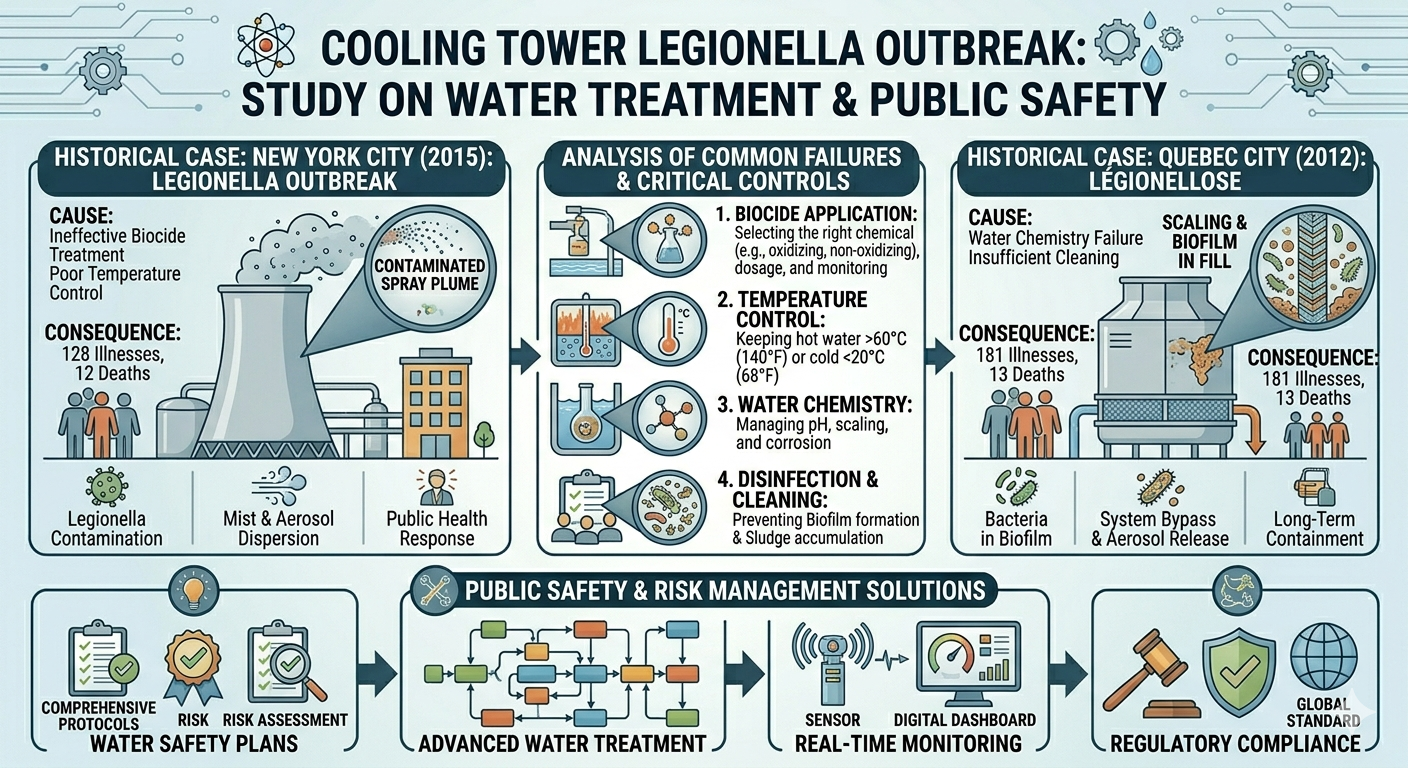
Cooling towers are a vital component of modern infrastructure, widely used in power plants, commercial buildings, and industrial facilities to dissipate heat. By enabling efficient thermal management, they support everything from electricity generation to air conditioning in large complexes. However, beneath their utility lies a significant public health risk: the potential growth and spread of Legionella bacteria, the cause of Legionnaires’ disease. When cooling towers are not properly maintained, they can become breeding grounds for this dangerous pathogen, leading to outbreaks that affect entire communities.
Understanding how these outbreaks occur requires a closer look at water treatment chemistry, system design, and operating conditions. From temperature control to the use of biocides, every aspect of cooling tower management plays a role in preventing microbial growth and ensuring public safety.
The Nature of Legionella and Its Risk
Legionella bacteria are naturally present in freshwater environments such as lakes and rivers. In these settings, they exist in low concentrations and rarely pose a threat to human health. Problems arise when the bacteria enter artificial water systems, where conditions can favor rapid multiplication.
Cooling towers are particularly susceptible because they operate by circulating warm water and exposing it to air, creating fine droplets or aerosols. These aerosols can carry bacteria over long distances. When inhaled, contaminated droplets can infect individuals, leading to Legionnaires’ disease, a severe form of pneumonia that can be fatal, especially in vulnerable populations such as the elderly or immunocompromised.
Temperature: The Key Driver of Bacterial Growth
One of the most critical factors influencing Legionella growth is temperature. The bacteria thrive in a range of approximately 20°C to 45°C, with optimal growth occurring near 35°C. Unfortunately, this range overlaps with the typical operating temperatures of cooling towers, making them ideal environments for bacterial proliferation.
At temperatures above 50°C, bacterial growth begins to decline, and at around 60°C, Legionella is rapidly inactivated. However, maintaining such high temperatures in cooling towers is not practical due to their primary function of heat removal. This creates a challenging balance: systems must operate efficiently while avoiding conditions that promote microbial growth.
Temperature fluctuations within the system can also create localized zones where bacteria thrive. For example, stagnant areas or poorly circulated sections may remain within the optimal growth range even if the overall system temperature is controlled. This highlights the importance of uniform flow and proper system design.
Water Chemistry and Biofilm Formation
Cooling tower water is a complex mixture containing dissolved minerals, organic matter, and microorganisms. These components interact to create conditions conducive to the formation of biofilms, which are slimy layers of microorganisms that adhere to surfaces.
Biofilms play a crucial role in Legionella outbreaks. They provide a protective environment where bacteria can grow and multiply, shielded from disinfectants and environmental stresses. Within these structures, Legionella can coexist with other microorganisms, including protozoa, which can further enhance their survival.
From a chemical engineering perspective, biofilm formation is influenced by factors such as nutrient availability, surface properties, and flow conditions. Once established, biofilms are difficult to remove and require targeted strategies for control, including mechanical cleaning and chemical treatment.
The Role of Biocides in Microbial Control
To prevent microbial growth, cooling towers rely on biocides, which are chemical agents designed to kill or inhibit microorganisms. These are a cornerstone of water treatment programs and must be carefully selected and managed to ensure effectiveness.
Biocides can be broadly classified into two categories: oxidizing and non-oxidizing.
Oxidizing Biocides
Oxidizing biocides, such as chlorine and bromine, work by disrupting cellular components through oxidation. They are fast-acting and relatively cost-effective, making them widely used in cooling tower systems. However, their effectiveness can be influenced by factors such as pH and the presence of organic matter, which can consume the active chemical and reduce its availability.
Non-Oxidizing Biocides
Non-oxidizing biocides, including compounds like glutaraldehyde and isothiazolinones, target specific biological processes within microorganisms. They are often more effective against resistant organisms and can penetrate biofilms more effectively than oxidizing agents. However, they tend to act more slowly and are generally more expensive.
Importance of Biocide Management
A critical aspect of biocide use is preventing microbial resistance. Continuous use of a single type of biocide can lead to adaptation, reducing its effectiveness over time. To address this, operators often alternate between different biocides or use them in combination.
Proper dosing is equally important. Insufficient concentrations may fail to eliminate bacteria, while excessive dosing can lead to environmental concerns and increased costs. Monitoring residual levels ensures that biocides remain within the effective range.
Engineering Principles Behind Cooling Tower Safety
Cooling tower operation involves several key chemical engineering principles that directly impact microbial control.
Mass Transfer
Cooling towers rely on air-water interaction to facilitate heat removal through evaporation. This process enhances mass transfer but also creates aerosols, which can carry bacteria into the surrounding environment. Balancing efficient cooling with minimized aerosol release is a critical design consideration.
Reaction Kinetics
The effectiveness of biocides depends on reaction kinetics, including concentration, contact time, and environmental conditions. Understanding these factors allows engineers to design treatment programs that achieve reliable disinfection.
Scaling and Fouling
Mineral deposits, or scale, can accumulate on surfaces, reducing heat transfer efficiency and providing sites for biofilm formation. Controlling water chemistry—particularly pH and hardness—is essential to prevent scaling and maintain system performance.
Fluid Dynamics
Proper circulation ensures that biocides are evenly distributed throughout the system. Dead zones or areas of low flow can become hotspots for microbial growth. Designing systems to minimize stagnation is therefore a key aspect of safety.
Causes of Legionella Outbreaks
Outbreaks associated with cooling towers typically result from a combination of failures rather than a single issue. Common contributing factors include:
- Inadequate or inconsistent biocide dosing
- Poor monitoring of water quality
- Accumulation of scale and biofilm
- Temperature conditions favorable to bacterial growth
- Lack of regular maintenance and cleaning
These issues allow Legionella to multiply undetected, increasing the risk of exposure.
Prevention and Control Strategies
Preventing Legionella outbreaks requires a comprehensive approach that integrates chemical treatment, system design, and operational practices.
Water Treatment Programs
Effective water treatment includes maintaining appropriate biocide levels, controlling pH, and minimizing nutrient availability. Regular testing ensures that treatment goals are met.
Temperature Management
While complete avoidance of the growth range may not be feasible, systems can be designed to minimize time spent in optimal conditions for bacterial growth. Periodic thermal disinfection may also be used.
Biofilm Control
Mechanical cleaning and the use of dispersants help remove biofilms and prevent their formation. This reduces the protective environment available to bacteria.
System Maintenance
Routine inspection and maintenance are essential to identify and address issues such as fouling, corrosion, and equipment malfunction.
Monitoring and Compliance
Regular microbial testing, including checks for Legionella, provides early warning of potential problems. Adherence to guidelines and regulations ensures that systems are managed responsibly.
Public Health Implications
Cooling tower-related outbreaks can have widespread consequences because aerosols can travel beyond the immediate vicinity of the system. This makes proper management not only an industrial responsibility but also a public health priority.
Outbreaks can lead to significant illness, loss of life, and economic disruption. They also damage public trust and highlight the need for rigorous oversight and accountability.
Conclusion
Cooling towers are indispensable in modern industry, but they must be managed with care to prevent them from becoming sources of disease. The growth of Legionella bacteria is closely linked to water temperature, chemistry, and system conditions, making effective control a multidisciplinary challenge.
By applying principles of chemical engineering—such as mass transfer, reaction kinetics, and system design—engineers can develop strategies to minimize risk. The use of biocides, combined with temperature management and regular maintenance, forms the foundation of a robust prevention program.
Ultimately, Legionella outbreaks are preventable. Achieving this requires not only technical expertise but also a commitment to safety and public health. Through disciplined operation and continuous monitoring, cooling towers can fulfill their intended purpose without posing a threat to the communities they serve.