
Introduction
The chemical manufacturing industry is one of the most complex and quality-sensitive sectors in the world. Every stage of production—from raw material handling and chemical reactions to separation, purification, and packaging—requires precise control of process parameters. Small variations in temperature, pressure, flow rate, pH, concentration, or reaction time can significantly affect product quality, production efficiency, safety, and profitability. In such an environment, maintaining consistent operations while minimizing waste and maximizing yield is a continuous challenge.
To overcome these challenges, many leading chemical manufacturers have adopted Six Sigma, a globally recognized methodology for process improvement and quality management. Developed by Motorola in the 1980s and later popularized by General Electric, Six Sigma uses statistical analysis and structured problem-solving techniques to reduce process variation, eliminate defects, and improve overall operational performance. Rather than relying on assumptions or trial-and-error methods, Six Sigma focuses on making decisions based on measurable data and scientific analysis.
Today, Six Sigma is widely implemented in fertilizer plants, petrochemical complexes, pharmaceutical manufacturing, specialty chemical production, refineries, and phosphoric acid plants. It enables organizations to improve product consistency, reduce production costs, optimize resource utilization, and strengthen customer satisfaction. This article explores the applications of Six Sigma in chemical manufacturing, the DMAIC improvement methodology, practical implementation examples, and the significant benefits it offers to modern process industries.
Understanding Six Sigma
Six Sigma is a disciplined, data-driven methodology designed to improve process performance by identifying and eliminating the root causes of defects and process variations. The ultimate goal of Six Sigma is to achieve a process capable of producing only 3.4 defects per million opportunities (DPMO), representing an exceptionally high level of quality.
Unlike conventional quality control methods that primarily detect defects after production, Six Sigma emphasizes preventing defects before they occur. It combines statistical tools, process mapping, root cause analysis, and continuous monitoring to improve both manufacturing processes and business performance.
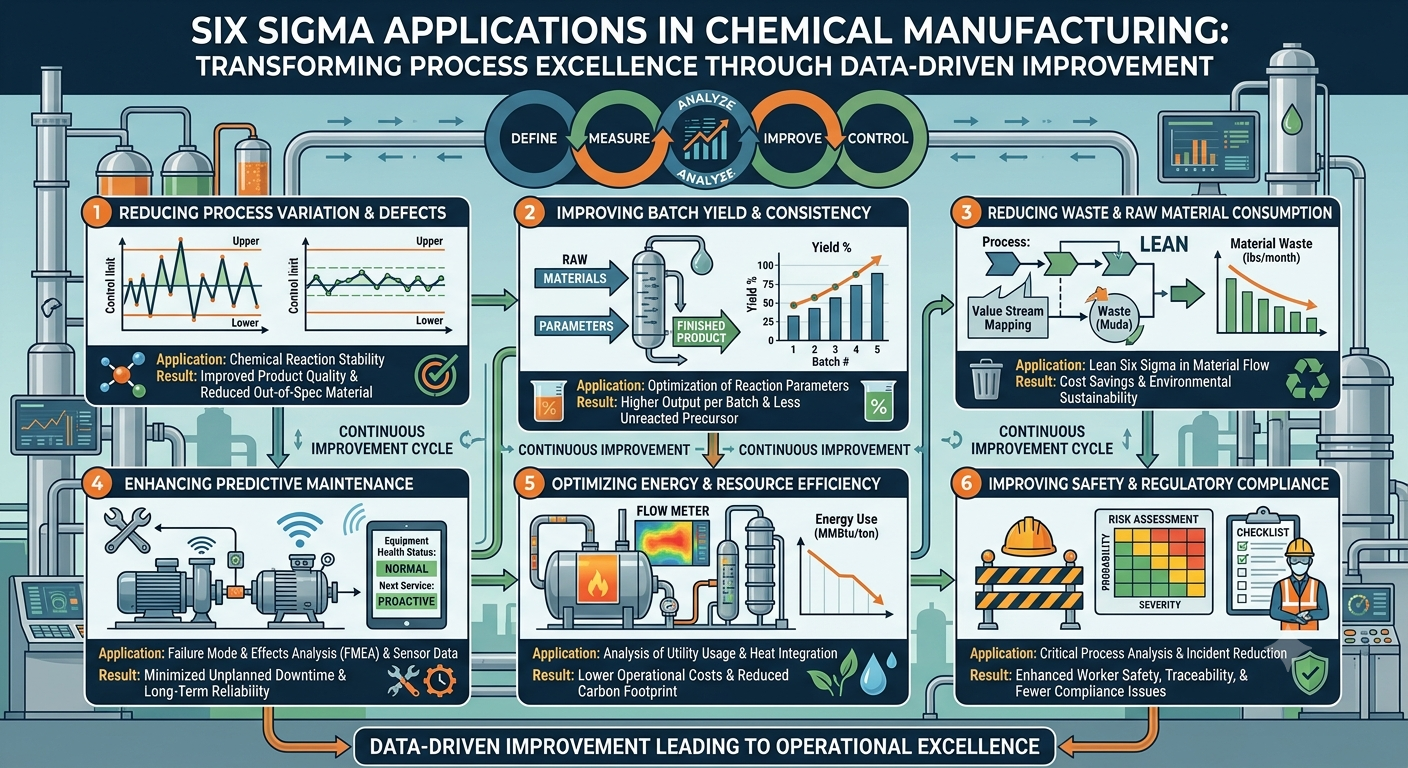
In chemical manufacturing, Six Sigma helps engineers optimize reaction conditions, improve raw material utilization, stabilize product quality, reduce energy consumption, minimize environmental impact, and enhance equipment reliability.
The DMAIC Methodology
The foundation of Six Sigma implementation is the DMAIC methodology, which consists of five structured phases.
Define
The first step is identifying and clearly defining the problem. This includes understanding customer requirements, determining project objectives, defining project scope, and estimating the expected business impact.
Typical chemical manufacturing projects include reducing sulfuric acid consumption, minimizing phosphoric acid losses, improving filtration efficiency, lowering steam consumption, or reducing off-spec product generation.
Measure
After defining the problem, accurate data must be collected to understand current process performance. Engineers measure critical operating parameters such as reactor temperature, pressure, acid concentration, flow rates, pH, density, filtration rates, steam usage, cooling water consumption, equipment downtime, and product quality.
Reliable data collection is essential because poor-quality data can lead to incorrect conclusions and ineffective improvement efforts.
Analyze
The Analyze phase focuses on identifying the true root causes of process variation using statistical techniques and engineering analysis. Instead of relying on experience or assumptions, Six Sigma encourages evidence-based decision-making.
Common analytical tools include Pareto analysis, Fishbone (Ishikawa) diagrams, regression analysis, hypothesis testing, process capability studies (Cp and Cpk), and Failure Mode and Effects Analysis (FMEA).
Improve
Once the root causes have been identified, targeted improvements are implemented. These may include optimizing reaction temperatures, modifying operating procedures, improving instrumentation, upgrading equipment, optimizing chemical dosing, or redesigning process controls.
Many organizations first conduct pilot trials before implementing improvements across the entire plant.
Control
The final phase ensures that improvements are sustained over time. Statistical Process Control (SPC), control charts, preventive maintenance schedules, operator training, standard operating procedures (SOPs), and performance dashboards help maintain stable operations and prevent the recurrence of previous problems.
Applications of Six Sigma in Chemical Manufacturing
Improving Process Yield
Yield improvement is one of the most valuable applications of Six Sigma. Even a small increase in product recovery can generate significant annual savings.
Six Sigma projects focus on increasing reaction conversion, reducing side reactions, improving crystallization efficiency, enhancing filtration recovery, minimizing product losses during transfer, and reducing waste generation. Improved yield not only lowers production costs but also increases plant profitability without requiring major capital investment.
Optimizing Raw Material Consumption
Raw materials account for a significant portion of chemical manufacturing costs. Excess consumption of acids, alkalis, catalysts, solvents, and process chemicals directly affects production economics.
Using Six Sigma, engineers analyze consumption patterns, process variations, and dosing strategies to determine the optimum operating conditions. Statistical analysis often reveals opportunities to reduce chemical consumption while maintaining or even improving product quality.
Reducing Energy Consumption
Energy represents one of the largest operating expenses in chemical plants. Steam, electricity, compressed air, fuel gas, and cooling water systems require continuous optimization.
Six Sigma projects commonly target steam consumption in evaporators, heat exchanger performance, cooling tower efficiency, compressor operation, and boiler performance. Eliminating process variability often leads to substantial reductions in utility costs and greenhouse gas emissions.
Enhancing Product Quality
Consistent product quality is essential for maintaining customer confidence and meeting regulatory requirements.
Six Sigma improves quality by reducing variation in critical product characteristics such as purity, concentration, moisture content, particle size distribution, density, viscosity, color, and chemical composition. Statistical process monitoring allows manufacturers to identify deviations before products move outside specification limits.
Minimizing Waste and Environmental Impact
Environmental sustainability has become a major priority for chemical manufacturers. Six Sigma contributes significantly by reducing off-spec production, lowering wastewater generation, minimizing sludge formation, decreasing chemical discharge, and reducing emissions.
These improvements not only lower disposal costs but also help organizations comply with increasingly stringent environmental regulations.
Improving Equipment Reliability
Unexpected equipment failures can disrupt production schedules and increase maintenance costs.
Six Sigma projects frequently improve the reliability of pumps, compressors, reactors, heat exchangers, cooling towers, vacuum systems, filters, and agitators. By analyzing failure patterns and identifying root causes, organizations can significantly reduce unplanned downtime and improve equipment availability.
Optimizing Maintenance Practices
Maintenance departments benefit greatly from Six Sigma by identifying recurring equipment failures and optimizing preventive maintenance programs.
Performance indicators such as Mean Time Between Failures (MTBF), Mean Time to Repair (MTTR), spare parts availability, and maintenance response time are analyzed to improve maintenance effectiveness and extend equipment life.
Enhancing Process Safety
Safety remains the highest priority in chemical manufacturing. Many safety incidents result from uncontrolled process variation, equipment malfunction, or human error.
Six Sigma reduces safety risks by improving process stability, strengthening operating procedures, enhancing instrument reliability, and reducing abnormal operating conditions. Stable processes are inherently safer and easier to control.
Six Sigma in Phosphoric Acid Manufacturing
Phosphoric acid plants present numerous opportunities for Six Sigma implementation due to the complexity of wet-process operations. Engineers can use Six Sigma to improve reactor conversion efficiency, optimize sulfuric acid dosing, reduce P₂O₅ losses in gypsum, improve filtration performance, minimize gypsum moisture, optimize rock grinding efficiency, reduce evaporator scaling, improve vacuum stability, and optimize cooling tower performance.
For example, a Six Sigma project may identify that excessive gypsum moisture is caused by inconsistent vacuum levels and improper filter cloth cleaning. By correcting these issues, gypsum moisture decreases, phosphoric acid recovery improves, and overall production costs are reduced.
Similarly, statistical analysis of reactor operating conditions may reveal the optimum temperature and acid concentration that maximize phosphate rock conversion while minimizing unreacted material losses.
Common Six Sigma Tools
Several analytical tools support Six Sigma implementation in chemical manufacturing:
- Pareto Analysis identifies the few major causes responsible for most process problems.
- Fishbone Diagrams organize potential root causes into categories such as equipment, materials, methods, manpower, measurement, and environment.
- Failure Mode and Effects Analysis (FMEA) prioritizes risks based on severity, occurrence, and detectability.
- Control Charts continuously monitor process stability and detect abnormal variations.
- Histograms visualize process data distribution.
- Scatter Plots identify relationships between process variables.
- Regression Analysis predicts process performance and supports optimization.
- Process Capability Analysis (Cp/Cpk) evaluates whether a process consistently meets specification limits.
- SIPOC Diagrams map suppliers, inputs, processes, outputs, and customers to understand process flow.
- Value Stream Mapping identifies non-value-added activities and opportunities to eliminate waste.
Practical Example
Consider a phosphoric acid concentration unit experiencing excessive steam consumption.
Using DMAIC, engineers first define the problem by quantifying additional steam costs. They then measure feed concentration, product concentration, steam flow, vacuum level, feed temperature, and acid circulation rate.
Statistical analysis reveals that unstable feed concentration and fouled heat exchanger surfaces are the primary causes of increased steam usage.
Corrective actions include stabilizing feed concentration, improving condensate recovery, cleaning heat exchangers, and optimizing vacuum operation. After implementation, Statistical Process Control charts monitor steam consumption to ensure sustained improvement.
The result is lower energy costs, improved production capacity, and increased process efficiency.
Benefits of Six Sigma
Successful Six Sigma implementation provides numerous benefits for chemical manufacturers, including:
- Improved product quality and consistency
- Higher production yield
- Lower raw material consumption
- Reduced utility costs
- Increased equipment reliability
- Reduced maintenance expenses
- Improved environmental performance
- Enhanced workplace safety
- Greater customer satisfaction
- Higher profitability and competitiveness
Many organizations also experience improved employee engagement because Six Sigma encourages teamwork, structured problem-solving, and continuous learning.
Challenges in Implementation
Despite its advantages, implementing Six Sigma is not without challenges. Organizations may face resistance to change, insufficient management commitment, inaccurate data collection systems, inadequate employee training, limited statistical expertise, and poor cross-functional communication.
To overcome these obstacles, companies should establish strong leadership support, invest in employee training, develop accurate measurement systems, encourage collaboration between departments, and continuously monitor improvement projects after implementation.
Conclusion
Six Sigma has become one of the most effective methodologies for achieving operational excellence in chemical manufacturing. Its structured DMAIC approach enables organizations to identify process inefficiencies, eliminate root causes of variation, optimize resource utilization, and consistently deliver high-quality products.
Whether improving process yield, reducing energy consumption, enhancing equipment reliability, optimizing phosphoric acid production, or strengthening environmental compliance, Six Sigma provides measurable and sustainable business benefits. As chemical manufacturers continue embracing digital technologies, automation, artificial intelligence, and advanced process analytics, Six Sigma remains an essential framework for transforming operational data into continuous improvement and long-term competitive advantage.
Organizations that integrate Six Sigma into their operational culture are better equipped to achieve higher productivity, lower manufacturing costs, improved safety, enhanced sustainability, and superior customer satisfaction—making it a cornerstone of modern chemical manufacturing excellence.