
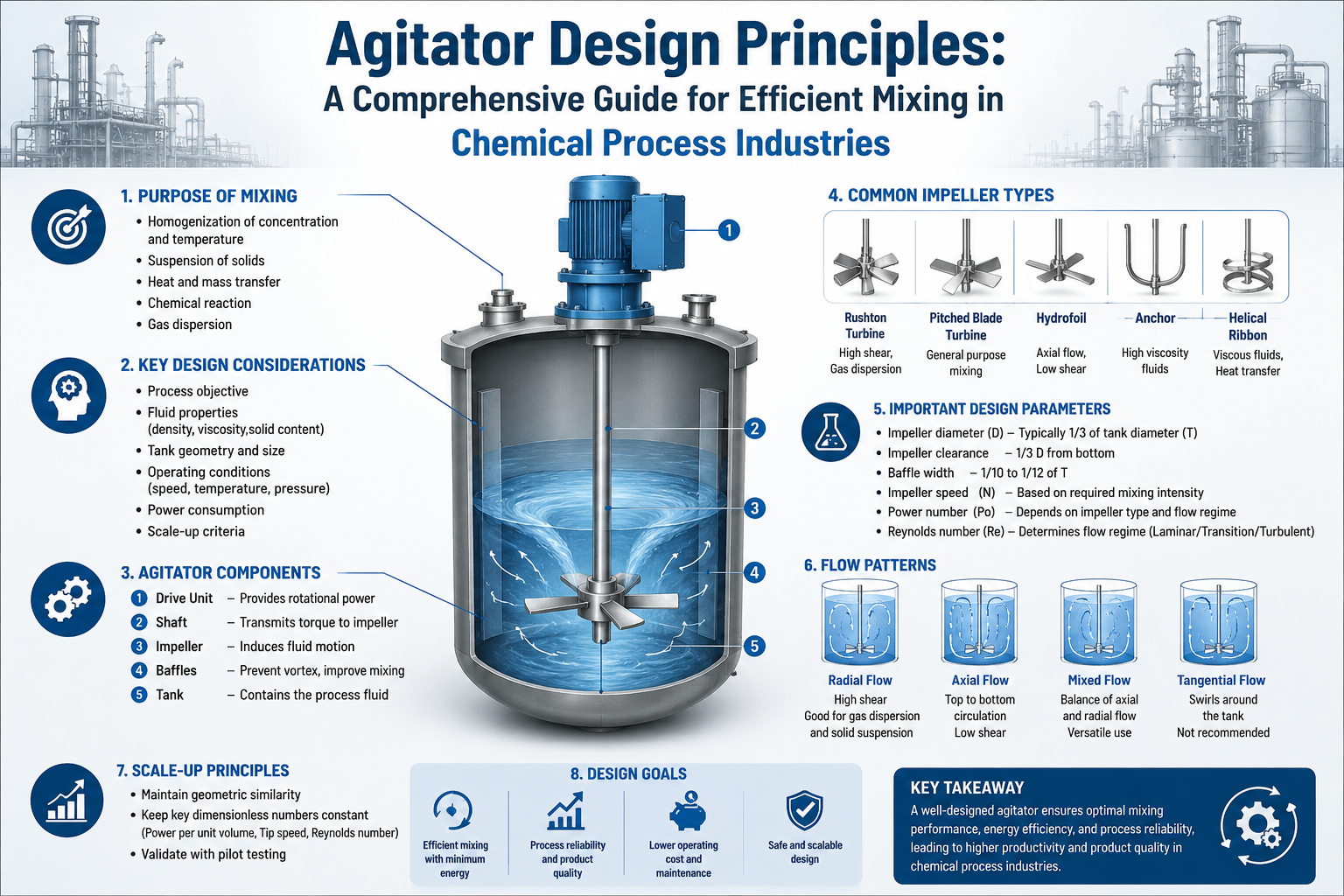
Efficient mixing is one of the most fundamental operations in the chemical process industry. Whether producing fertilizers, pharmaceuticals, petrochemicals, specialty chemicals, food products, or water treatment chemicals, the quality of mixing directly influences product consistency, reaction efficiency, heat transfer, and overall plant productivity. At the heart of every effective mixing system is the agitator—a mechanical device designed to generate controlled fluid motion within a vessel.
Although an agitator may appear to be a simple rotating shaft with an impeller, its design involves a careful balance of fluid dynamics, mechanical engineering, process requirements, and energy optimization. A poorly designed agitator can lead to inadequate mixing, excessive power consumption, dead zones, sedimentation, equipment failure, and inconsistent product quality. Conversely, a properly engineered agitator improves process performance, reduces operating costs, and enhances equipment reliability.
This article explores the fundamental principles of agitator design, the key factors influencing performance, common impeller types, and best practices for selecting the right agitator for industrial applications.
Understanding the Role of an Agitator
An agitator is a mechanical mixing device installed inside a tank, reactor, or process vessel to create fluid movement. Driven by an electric motor through a gearbox, the agitator rotates an impeller mounted on a shaft, producing circulation patterns that promote mixing.
Depending on the process, agitators perform several important functions, including:
- Blending two or more liquids into a homogeneous mixture.
- Suspending solid particles in liquids to prevent settling.
- Dispersing gases into liquids for improved mass transfer.
- Enhancing heat transfer by maintaining uniform temperature.
- Promoting chemical reactions through better contact between reactants.
- Dissolving powders, salts, and other solid materials.
- Supporting crystallization and neutralization processes.
- Maintaining slurry uniformity during storage and processing.
Because every application has unique process requirements, no single agitator design is suitable for all situations.
Defining the Mixing Objective
The first step in agitator design is identifying the primary objective of mixing. Different processes require different flow characteristics and energy inputs.
For example, blending low-viscosity liquids requires high circulation with moderate shear, while gas-liquid reactions demand intense turbulence to disperse gas bubbles effectively. Similarly, slurry mixing requires sufficient axial flow to keep solid particles suspended without causing excessive wear.
Clearly defining the mixing objective helps engineers determine the appropriate impeller type, rotational speed, power requirement, and vessel configuration.
Fluid Properties: The Foundation of Agitator Selection
The physical properties of the process fluid have the greatest influence on agitator design.
Density
Fluid density directly affects torque and power requirements. Dense slurries, such as phosphate rock suspensions or mineral processing slurries, require stronger shafts, larger gearboxes, and higher motor capacities than light liquids.
Viscosity
Viscosity determines how easily fluids flow and significantly influences mixing performance.
Low-viscosity fluids such as water, dilute acids, and solvents are relatively easy to mix and typically use high-speed impellers like propellers or turbines.
Medium-viscosity liquids, including concentrated phosphoric acid and syrups, require greater pumping capacity and often utilize pitched blade turbines or hydrofoil impellers.
Highly viscous materials such as polymers, resins, adhesives, and pastes require slow-speed agitators equipped with anchor or helical ribbon impellers capable of moving thick fluids efficiently.
Understanding viscosity is essential because it determines whether the flow will be laminar, transitional, or turbulent, each requiring different design approaches.
Importance of Tank Geometry
Even the best agitator cannot perform efficiently in a poorly designed vessel. Tank dimensions influence circulation patterns, mixing time, and energy efficiency.
Most industrial mixing tanks are vertical cylindrical vessels with a liquid height approximately equal to or slightly greater than the tank diameter. This geometry promotes balanced circulation and minimizes stagnant regions.
The shape of the vessel bottom also plays a role. Flat-bottom tanks are suitable for many storage applications, while dished or conical bottoms improve drainage and reduce solids accumulation.
Proper placement of the agitator within the vessel ensures uniform mixing throughout the tank volume.
Selecting the Right Impeller
The impeller is the most important component of an agitator because it determines the flow pattern generated within the vessel.
Propeller impellers are commonly used for low-viscosity liquids requiring rapid circulation and blending. Their axial flow pattern makes them ideal for storage tanks and water treatment systems.
Pitched blade turbines are among the most versatile impellers in the process industry. They generate strong axial flow while providing moderate shear, making them suitable for slurry mixing, neutralization, crystallization, and general chemical processing.
Rushton turbines produce radial flow and high turbulence, making them the preferred choice for gas dispersion, fermentation, and aeration applications where efficient gas-liquid contact is essential.
Hydrofoil impellers are designed for high pumping efficiency with low power consumption. They are widely used in large process vessels where energy savings and gentle mixing are important.
For highly viscous fluids, anchor and helical ribbon agitators provide slow, continuous movement while maintaining effective heat transfer and minimizing dead zones.
Selecting the correct impeller significantly improves process efficiency while reducing operating costs.
Flow Patterns and Mixing Efficiency
The flow pattern generated by an agitator largely determines mixing performance.
Axial flow moves liquid parallel to the agitator shaft, producing top-to-bottom circulation. This pattern is highly effective for solid suspension, blending, and heat transfer.
Radial flow directs liquid outward from the impeller toward the tank walls. It creates high turbulence and shear, making it ideal for gas dispersion and emulsification.
Tangential flow causes liquid to rotate around the vessel, often creating vortices and reducing mixing efficiency. This undesirable flow pattern can be minimized through proper vessel design.
Understanding these circulation patterns allows engineers to optimize mixing performance for specific applications.
Why Baffles Are Essential
One of the most overlooked aspects of agitator design is the use of baffles.
Without baffles, rotating liquid forms a vortex that reduces turbulence and causes poor mixing. Air may also become entrained, leading to foaming or oxidation in sensitive processes.
Installing four equally spaced vertical baffles along the vessel wall disrupts rotational flow and converts it into useful turbulence. This simple design feature significantly improves circulation, reduces mixing time, and enhances process efficiency.
In most industrial applications, baffles are considered essential unless the process specifically requires vortex formation.
Power Requirement and Energy Efficiency
Agitators consume a considerable amount of electrical energy over their operating life. Therefore, optimizing power consumption is an important design objective.
Power requirements depend on several factors, including fluid density, viscosity, impeller diameter, rotational speed, and impeller design.
Since power increases rapidly with impeller size and rotational speed, selecting the appropriate combination is critical. Oversized agitators waste energy, while undersized units fail to achieve adequate mixing.
Modern computational tools and mixing simulations help engineers estimate power requirements more accurately before equipment is manufactured.
Mechanical Design Considerations
Beyond process performance, an agitator must also withstand continuous mechanical loading under demanding operating conditions.
The shaft must be designed to resist bending and torsional stresses generated during mixing. Critical speed analysis ensures that operating speeds remain well below resonance frequencies, preventing vibration and fatigue failure.
Bearings, couplings, gearboxes, and mechanical seals must also be selected according to process conditions, operating temperature, corrosion potential, and maintenance requirements.
Proper dynamic balancing minimizes vibration, extends bearing life, and improves equipment reliability.
Mechanical integrity is particularly important in large industrial reactors where agitators operate continuously for years with minimal downtime.
Material Selection for Corrosive Applications
Choosing the correct material of construction is essential for long-term reliability.
Stainless steel grades such as SS304 and SS316 are widely used for water, food processing, and mild chemical services.
However, highly corrosive chemicals require specialized materials.
Phosphoric acid plants often use rubber-lined steel, Alloy 20, duplex stainless steels, or other corrosion-resistant alloys depending on acid concentration and operating temperature.
Hydrochloric acid systems typically require FRP, titanium, rubber-lined steel, or advanced nickel-based alloys because conventional stainless steels suffer rapid corrosion.
Material selection should always consider corrosion resistance, erosion from suspended solids, operating temperature, mechanical strength, and total life-cycle cost.
Agitator Design in Phosphoric Acid Plants
Wet-process phosphoric acid production presents unique mixing challenges because the process involves highly abrasive and corrosive phosphate rock slurry reacting with sulfuric acid.
The agitator must provide sufficient circulation to keep gypsum crystals suspended while ensuring intimate contact between reactants for maximum P₂O₅ recovery.
Most phosphoric acid reactors use large-diameter pitched blade or hydrofoil impellers operating at moderate rotational speeds to generate strong axial flow.
The design must account for slurry density, solids concentration, reactor dimensions, corrosion resistance, power requirements, and maintenance accessibility.
A properly designed agitator not only improves reaction efficiency but also minimizes gypsum settling, reduces scaling, and enhances overall plant productivity.
Best Practices for Successful Agitator Design
Successful agitator design requires more than selecting a motor and impeller. Engineers should evaluate process objectives, fluid properties, vessel geometry, operating conditions, and maintenance requirements together.
Whenever possible, Computational Fluid Dynamics (CFD) analysis and pilot-scale testing should be used to validate circulation patterns and optimize energy consumption before full-scale installation.
Routine inspection of shafts, bearings, seals, gearboxes, and impellers also ensures reliable long-term operation while reducing the risk of unexpected shutdowns.
Conclusion
Agitators are indispensable components of modern process plants, influencing everything from product quality and reaction efficiency to energy consumption and equipment reliability. Their design requires a multidisciplinary approach that combines fluid mechanics, mechanical engineering, process chemistry, and operational experience.
By carefully considering fluid properties, tank geometry, impeller selection, flow patterns, baffle configuration, power requirements, and material compatibility, engineers can design mixing systems that deliver consistent performance while minimizing operating costs.
As industries continue to adopt digital engineering tools, advanced materials, and energy-efficient technologies, agitator design is evolving into a highly optimized discipline. Plants that invest in well-engineered mixing systems benefit from improved productivity, enhanced process stability, reduced maintenance costs, and greater long-term operational excellence, making effective agitator design a cornerstone of successful chemical manufacturing.