



Material selection is one of the most important engineering decisions in chemical process industries. Equipment used for handling corrosive chemicals, acids, alkalis, solvents, and abrasive slurries must provide long-term reliability, minimize maintenance requirements, and ensure safe plant operation. Failure of process equipment due to corrosion can result in production losses, environmental risks, costly repairs, and unplanned shutdowns.
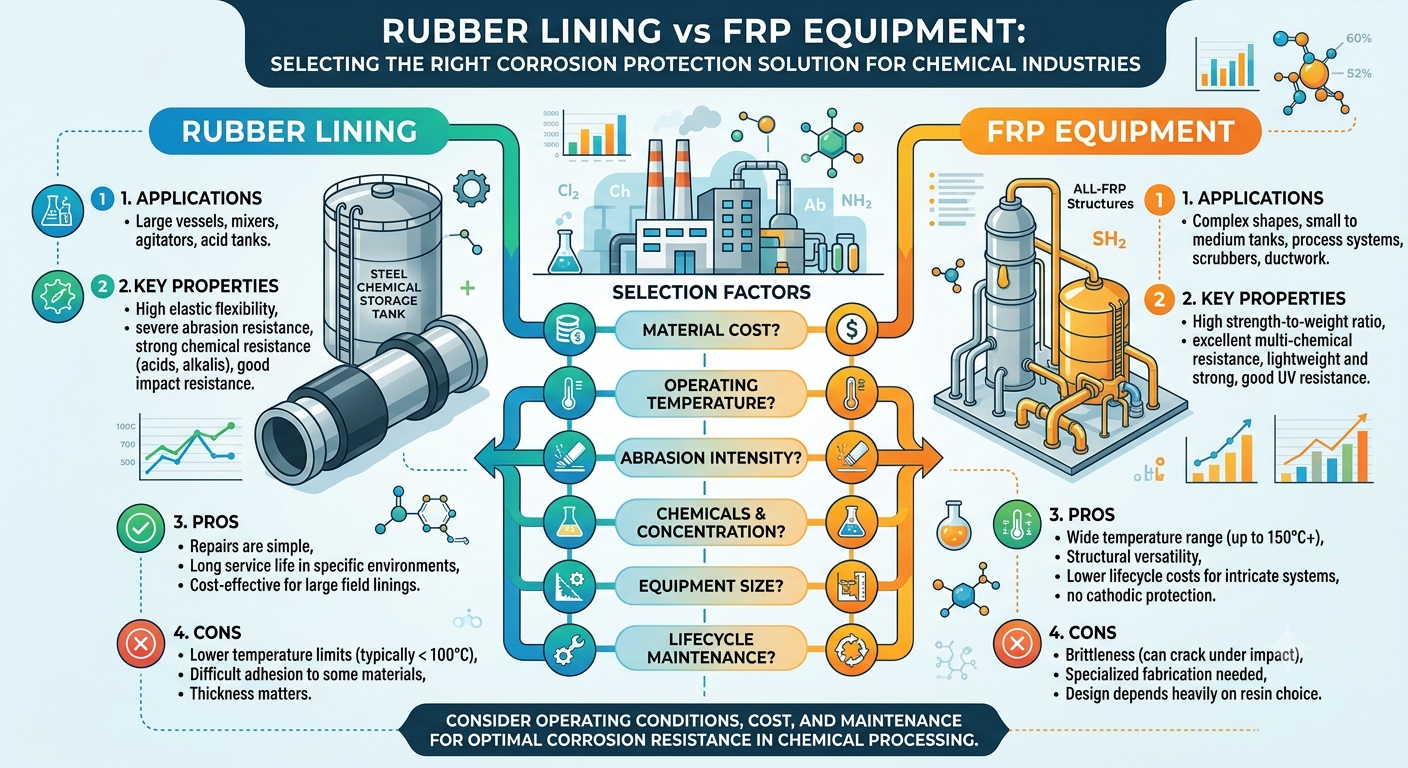
Two of the most widely used corrosion protection technologies in chemical industries are rubber-lined equipment and FRP (Fiber Reinforced Plastic) equipment. Both materials provide excellent resistance against chemical attack, but their performance differs significantly depending on operating conditions such as temperature, abrasion, mechanical loading, pressure, and chemical concentration.
Selecting between rubber lining and FRP requires a detailed understanding of process requirements, equipment application, and lifecycle cost. This article explains the differences between rubber-lined and FRP equipment and provides guidance for selecting the most suitable option for chemical process applications.
Understanding Rubber-Lined Equipment
Rubber lining is a corrosion protection method where a layer of chemically resistant rubber is bonded internally to a carbon steel or metal substrate. The steel structure provides mechanical strength, while the rubber lining acts as a protective barrier against corrosive process fluids.
The basic construction of rubber-lined equipment consists of:
- Carbon steel shell for structural support
- Adhesive bonding layer
- Rubber lining for corrosion resistance
Different rubber materials are selected according to chemical compatibility and operating conditions.
Common rubber types include:
- Natural rubber
- Neoprene rubber
- Butyl rubber
- Bromobutyl rubber
- EPDM rubber
Natural rubber is widely used for abrasive slurry applications due to its excellent elasticity and wear resistance. Butyl rubber is preferred for certain chemical services requiring improved resistance to acids and gases.
Rubber-lined equipment is commonly used in:
- Acid storage tanks
- Chemical reactors
- Slurry tanks
- Pipelines
- Pumps
- Agitated vessels
- Fertilizer plants
- Mineral processing equipment
Understanding FRP Equipment
FRP (Fiber Reinforced Plastic) is a composite material made by combining polymer resin with reinforcing fibers. The resin provides chemical resistance, while the fibers provide mechanical strength and structural stability.
FRP equipment is manufactured as a complete corrosion-resistant structure rather than as a coating over another material.
The main components of FRP include:
- Resin matrix
- Glass fiber reinforcement
- Corrosion-resistant inner liner
Common resin systems include:
- Polyester resin
- Vinyl ester resin
- Epoxy resin
- Phenolic resin
The selection of resin depends on chemical compatibility, temperature, and mechanical requirements.
FRP equipment is widely used for:
- Chemical storage tanks
- Scrubbers
- Ventilation ducts
- Chemical pipelines
- Water treatment equipment
- Fume handling systems
Because FRP is lightweight and corrosion-resistant, it has become an attractive alternative to traditional metallic equipment.
Corrosion Resistance Comparison
Both rubber lining and FRP provide excellent corrosion protection, but their performance depends on the chemical environment.
Acid Service
Sulfuric Acid Applications
Rubber-lined equipment has been successfully used in sulfuric acid applications for decades. It provides excellent resistance against acid attack at suitable temperatures and concentrations.
Typical applications include:
- Sulfuric acid storage tanks
- Acid transfer pipelines
- Reaction vessels
FRP equipment can also handle sulfuric acid when the correct resin system is selected. Vinyl ester and specialty resins provide improved chemical resistance compared with standard polyester resins.
However, temperature and concentration limits must always be evaluated before selecting FRP.
Hydrochloric Acid Applications
Hydrochloric acid is highly corrosive to conventional metals. FRP is commonly used for hydrochloric acid storage tanks, scrubbers, and piping systems because of its excellent corrosion resistance.
Rubber-lined equipment can also perform well in hydrochloric acid service when the correct rubber grade is selected.
Phosphoric Acid Applications
Phosphoric acid plants present unique challenges because they involve both corrosion and abrasion.
Wet-process phosphoric acid production involves:
- Phosphate rock particles
- Sulfuric acid reaction
- Gypsum crystals
- Acidic slurry circulation
Rubber-lined equipment is widely preferred in these applications because it combines corrosion resistance with excellent abrasion resistance.
Applications include:
- Reactor vessels
- Slurry tanks
- Gypsum slurry pipelines
- Filter feed tanks
FRP may be suitable for clean phosphoric acid storage but is generally less preferred for highly abrasive slurry service.
Abrasion Resistance: A Critical Factor
Abrasion resistance is one of the biggest differences between rubber lining and FRP.
In industries such as fertilizers, mining, and mineral processing, equipment often handles solid particles suspended in corrosive liquids. These particles can gradually wear away protective surfaces.
Rubber lining performs exceptionally well because rubber is flexible and absorbs impact energy from solid particles. Instead of cracking under impact, the rubber surface deforms and returns to its original shape.
FRP is more rigid. Continuous exposure to abrasive particles may damage the resin surface and eventually expose the fiberglass reinforcement.
Therefore:
For abrasive slurry applications, rubber lining generally provides better service life than FRP.
Temperature Capability
Temperature resistance is another important design consideration.
Rubber Lining
Rubber performance decreases at elevated temperatures. Depending on the rubber type, typical operating temperatures are:
- Natural rubber: approximately 70–80°C
- Butyl rubber: approximately 90–100°C
- Specialty rubber compounds: higher depending on application
Excessive temperature can cause:
- Softening
- Swelling
- Loss of adhesion
- Reduced mechanical strength
FRP Equipment
FRP temperature capability depends mainly on the resin system.
Typical ranges are:
- Polyester resin: 60–90°C
- Vinyl ester resin: 100–120°C
- Epoxy resin: 120–150°C
For higher-temperature applications, FRP with advanced resin systems may provide better performance than conventional rubber lining.
Mechanical Strength and Structural Performance
Rubber lining itself does not provide structural strength. The underlying steel shell supports mechanical loads.
Advantages of rubber-lined steel equipment include:
- High mechanical strength
- Excellent impact resistance
- Ability to withstand vacuum conditions
- Suitable for heavy-duty applications
FRP equipment is self-supporting, but the design must consider:
- Wall thickness
- Fiber orientation
- External pressure
- Reinforcement requirements
Large FRP vessels require careful engineering to prevent deformation or structural failure.
Maintenance and Repair Considerations
Maintenance requirements significantly influence equipment selection.
Rubber-Lined Equipment Maintenance
Advantages include:
- Local repair capability
- Patch repair options
- Reuse of steel structure
Common failure mechanisms include:
- Rubber blistering
- Poor bonding
- Mechanical damage
- Chemical degradation
Proper surface preparation and skilled installation are essential for achieving long service life.
FRP Equipment Maintenance
FRP repairs involve rebuilding damaged areas using resin and fiberglass layers.
Common failure modes include:
- Cracking
- Delamination
- Fiber exposure
- Resin degradation
Repair quality depends heavily on technician experience and environmental conditions during repair.
Cost Comparison
Initial purchase cost should not be the only factor considered during material selection.
A complete lifecycle cost evaluation should include:
- Equipment purchase cost
- Installation cost
- Maintenance requirements
- Repair frequency
- Downtime losses
- Expected operating life
FRP equipment may have lower installation costs due to lightweight construction, while rubber-lined steel equipment may provide better long-term value in severe slurry applications.
The correct selection depends on total ownership cost rather than only initial investment.
Application-Based Selection Guide
Rubber Lining is Preferred When:
- Abrasive slurry is present
- Mechanical impact is expected
- Heavy-duty service is required
- Vacuum operation is involved
- Long mechanical life is required
Typical industries:
- Phosphoric acid plants
- Fertilizer manufacturing
- Mining operations
- Chemical processing plants
FRP is Preferred When:
- Lightweight construction is required
- Corrosion resistance is the primary concern
- Large storage tanks are needed
- Abrasion is minimal
- Chemical exposure is moderate
Typical industries:
- Water treatment
- Chemical storage
- Pollution control systems
- Scrubber systems
Rubber Lining vs FRP in Phosphoric Acid Plants
Phosphoric acid manufacturing plants require special consideration due to the combination of corrosion and abrasion.
Equipment experiences:
- Acid attack
- Gypsum crystal erosion
- Continuous slurry movement
- High operating hours
For reactors, slurry tanks, and transfer pipelines, rubber-lined carbon steel is often the preferred solution because it provides:
- Excellent corrosion protection
- High abrasion resistance
- Mechanical durability
- Easy maintenance
For acid storage tanks, ventilation systems, and clean chemical handling applications, FRP can provide an economical and reliable solution.
Conclusion
Both rubber-lined equipment and FRP equipment play important roles in modern chemical industries. The selection between these two technologies depends on process conditions, not simply material cost.
Rubber lining provides superior abrasion resistance, impact resistance, and mechanical durability, making it ideal for aggressive slurry applications such as phosphoric acid and fertilizer plants.
FRP offers excellent corrosion resistance, lightweight construction, and flexibility, making it suitable for chemical storage, scrubbers, and corrosion-control applications where abrasion is limited.
A successful material selection strategy considers chemical compatibility, temperature, mechanical conditions, maintenance requirements, and lifecycle cost. By selecting the correct corrosion protection system, chemical plants can improve equipment reliability, reduce downtime, enhance safety, and achieve long-term operational excellence.