

Introduction
Process safety is one of the most important aspects of chemical plant design, operation, and maintenance. Chemical industries handle hazardous materials, high-pressure equipment, elevated temperatures, and complex chemical reactions that can lead to serious accidents if risks are not properly identified and controlled.
To minimize industrial hazards, chemical engineers use systematic risk assessment techniques such as Hazard and Operability Study (HAZOP), Hazard Identification (HAZID), and What-If Analysis.
Although these techniques share the objective of identifying hazards and improving safety, they differ significantly in methodology, level of detail, team requirements, and applications.
Understanding HAZOP vs HAZID vs What-If Analysis helps engineers select appropriate techniques during process design, commissioning, plant operation, and modification projects.
This article explains their working principles, methodologies, practical examples, advantages, limitations, and industrial applications.
1. What Is HAZOP Analysis?
HAZOP stands for Hazard and Operability Study. It is a structured and systematic technique used to identify process hazards and operational problems by examining deviations from intended operating conditions.
HAZOP studies are commonly conducted during detailed engineering, before commissioning, and when significant modifications are proposed.
The methodology uses predefined guidewords combined with process parameters to identify possible deviations.
Common HAZOP guidewords include:
No or Not
More
Less
Reverse
As Well As
Other Than
Early or Late, where applicable
These guidewords are applied to parameters such as flow, pressure, temperature, level, concentration, and composition.
For example, combining the guideword “No” with the parameter “Flow” produces the deviation “No Flow.”
The study team then evaluates possible causes, consequences, existing safeguards, and recommendations.
2. HAZOP Methodology and Procedure
A typical HAZOP study follows a structured sequence.
Step 1: Define the study scope
Identify the process units, equipment, operating conditions, and boundaries to be evaluated.
Step 2: Collect technical documents
Review Process Flow Diagrams (PFDs), Piping and Instrumentation Diagrams (P&IDs), equipment datasheets, operating procedures, and control philosophies.
Step 3: Divide the process into nodes
A node represents a specific section of the process, such as a reactor feed line, heat exchanger, or storage tank.
Step 4: Apply guidewords
Combine guidewords with relevant process parameters to identify deviations.
Step 5: Evaluate consequences
Determine potential impacts on personnel, equipment, the environment, and production.
Step 6: Review safeguards
Identify existing alarms, interlocks, relief devices, operating procedures, and protective systems.
Step 7: Record recommendations
Document actions required to address identified risks and assign responsibility for implementation.
3. Practical HAZOP Example in a Chemical Reactor
Consider a continuous chemical reactor receiving raw materials through a feed pump.
The reactor operates under controlled temperature, pressure, and liquid level.
A HAZOP study may identify the following deviations.
Deviation: No Flow
Possible causes include feed pump failure, closed isolation valves, pipeline blockage, or electrical power failure.
Potential consequences include reduced production, abnormal reaction conditions, and overheating where feed interruption affects cooling or reaction stability.
Existing safeguards may include low-flow alarms, pump monitoring, and automatic shutdown systems.
Deviation: High Temperature
Possible causes include excessive reaction rate, cooling system failure, or incorrect feed composition.
Consequences may include accelerated reactions, pressure increase, equipment damage, or thermal runaway.
Safeguards may include temperature alarms, independent protective systems, emergency cooling, and suitable pressure relief arrangements.
HAZOP provides a detailed evaluation of such process deviations.
4. What Is HAZID Analysis?
HAZID stands for Hazard Identification. It is a structured technique used to identify potential hazards associated with a facility, process, project, or operation.
HAZID is generally broader and less detailed than HAZOP.
It is frequently conducted during conceptual design, feasibility studies, site selection, and early project development.
The main objective is to recognize major hazards before detailed engineering decisions are finalized.
HAZID typically considers fire and explosion hazards, toxic releases, chemical exposure, environmental incidents, transportation risks, natural disasters, and external threats.
It also examines hazards related to plant layout, equipment accessibility, emergency response, and neighboring facilities.
5. HAZID Methodology and Procedure
A HAZID study generally uses structured brainstorming supported by hazard checklists and previous industrial experience.
The study team first defines the project scope and identifies major process activities.
Potential hazards are then grouped into categories such as chemical, mechanical, electrical, environmental, and operational hazards.
For each hazard, the team evaluates credible consequences, existing or proposed safeguards, and additional risk reduction measures.
Risk ranking may be performed using a qualitative risk matrix.
The findings are documented in a hazard register, along with recommendations and responsible personnel.
Unlike HAZOP, HAZID does not normally require a detailed guideword-by-guideword examination of every process line.
6. Practical HAZID Example in a Chemical Plant
Consider a proposed sulphuric acid storage and handling facility.
During the conceptual design stage, a HAZID team may identify hazards associated with corrosive chemical leakage, tank overfilling, vehicle movement, incompatible material contact, and inadequate emergency access.
The team may recommend suitable containment systems, corrosion-resistant materials, emergency showers, vehicle segregation, and safe unloading arrangements.
These recommendations can influence plant layout and equipment selection before construction begins.
HAZID is particularly valuable because identifying hazards early can prevent expensive modifications during later project stages.
7. What Is What-If Analysis?
What-If Analysis is a qualitative hazard assessment technique that uses structured questions to identify possible equipment failures, operating errors, and abnormal process conditions.
The methodology is based on asking questions beginning with “What if?”
Examples include:
What if the cooling water supply fails?
What if the operator opens the wrong valve?
What if the feed pump stops unexpectedly?
What if the storage tank overfills?
What if electrical power is interrupted?
The team evaluates potential consequences and determines whether existing safeguards are adequate.
What-If Analysis is generally more flexible than HAZOP and can be performed with fewer formal procedural requirements.
However, its effectiveness depends strongly on team experience and the completeness of the questions considered.
8. Practical What-If Analysis Example
Consider a heat exchanger used to heat process liquid using steam.
A What-If study might ask:
What if the steam control valve fails open?
Possible consequences include excessive process temperature, downstream equipment overheating, and potential overpressure.
Existing safeguards may include high-temperature alarms, pressure protection, and independent steam isolation systems.
What if cooling or process liquid flow stops?
Potential consequences include overheating, product degradation, and thermal damage.
Recommended safeguards may include low-flow interlocks, temperature monitoring, and appropriate shutdown procedures.
The What-If approach helps engineers identify credible failure scenarios without conducting a complete guideword-based HAZOP.
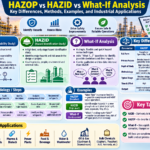
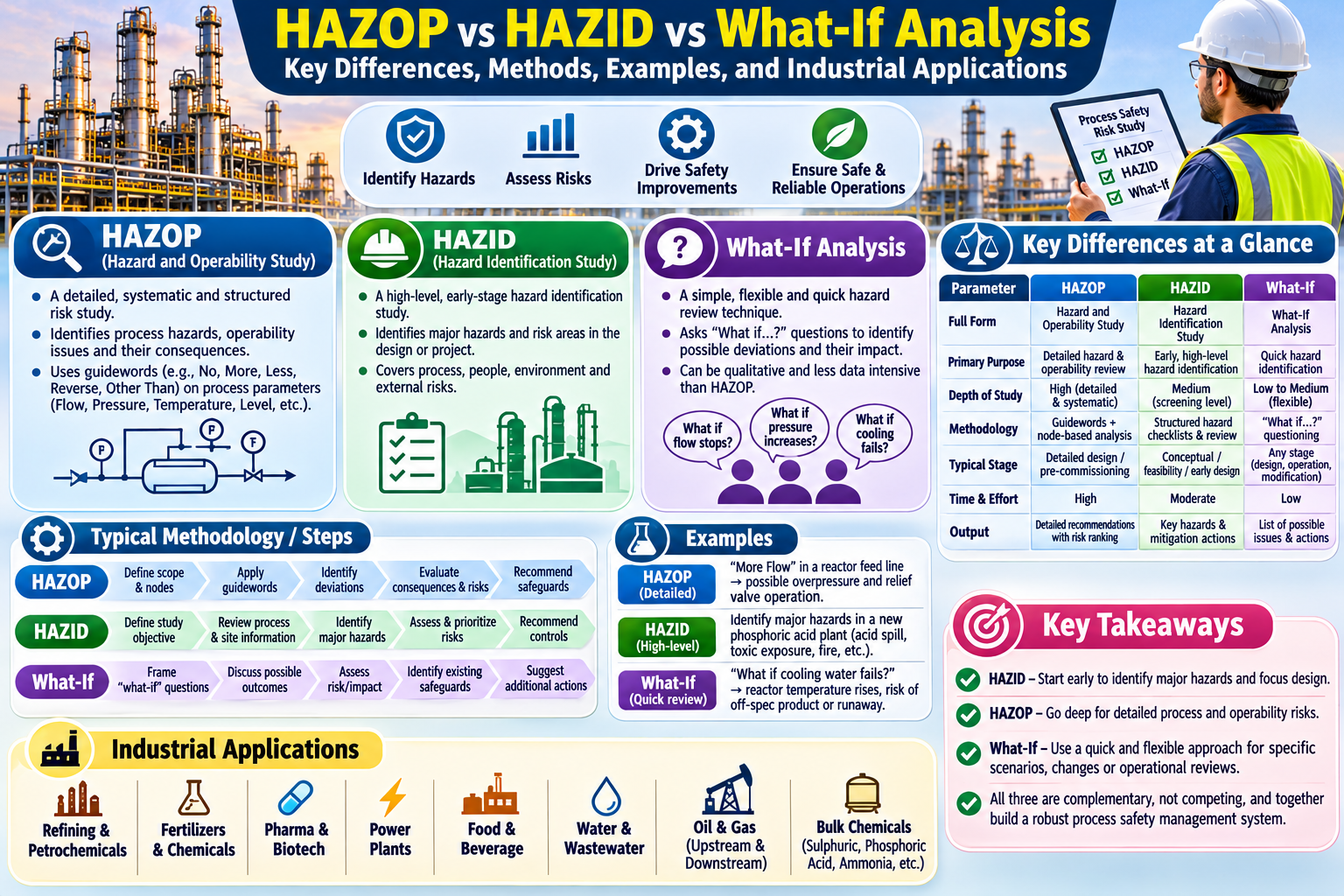
9. HAZOP vs HAZID vs What-If Analysis: Key Differences
Parameter | HAZOP | HAZID | What-If |
|---|---|---|---|
Primary objective | Identify process deviations | Identify broad hazards | Evaluate hypothetical failures |
Methodology | Guidewords and parameters | Checklists and brainstorming | Structured questions |
Typical project stage | Detailed design and modifications | Conceptual and early design | Various project stages |
Level of detail | High | Broad screening | Variable |
Documentation | Detailed worksheets | Hazard register | Question-based worksheets |
Main advantage | Systematic process examination | Early hazard identification | Flexible and practical |
Main limitation | Resource-intensive | May miss detailed deviations | Depends on team experience |
These are typical applications rather than strict limitations. Each technique can be used at different project stages when appropriate.
10. Which Hazard Assessment Method Should Be Used?
Selecting the appropriate technique depends on process complexity, available engineering information, project stage, and regulatory requirements.
HAZID is particularly useful during early project development when detailed process drawings may not be available.
HAZOP is preferable when engineers need systematic evaluation of process deviations using sufficiently developed P&IDs and design information.
What-If Analysis is useful for focused assessments, operational changes, maintenance activities, and less complex systems where its level of rigor is appropriate.
For high-hazard facilities, a combination of methods may be necessary.
The selected methodology should satisfy applicable process safety requirements and provide sufficient coverage of credible accident scenarios.
11. Role of Chemical Engineers in Hazard Studies
Chemical engineers contribute technical knowledge about reaction chemistry, process conditions, equipment limitations, and operating behavior.
During HAZOP studies, they help identify causes and consequences of deviations in temperature, pressure, flow, and composition.
During HAZID studies, they evaluate major chemical and process hazards associated with facility design.
In What-If sessions, they contribute practical operating scenarios and identify potential failure mechanisms.
Operations engineers provide valuable information about actual plant behavior, while maintenance and instrumentation specialists contribute equipment reliability and control system expertise.
Effective hazard studies require multidisciplinary participation, accurate documentation, and proper follow-up.
12. Common Mistakes in Process Hazard Analysis
One common mistake is conducting hazard studies without sufficient technical information.
Incomplete P&IDs, incorrect operating data, and outdated equipment specifications can reduce assessment quality.
Another mistake is treating alarms or operating procedures as automatically sufficient safeguards without evaluating their reliability and effectiveness.
Hazard studies may also become ineffective when recommendations are documented but never implemented.
Engineers should ensure that action items are assigned, tracked, verified, and formally closed.
Studies must also be reviewed when significant process changes introduce new hazards.
13. Importance of HAZOP, HAZID, and What-If Analysis
These hazard assessment techniques help organizations identify dangerous conditions before accidents occur.
Their benefits include improved personnel safety, reduced equipment damage, better emergency preparedness, and stronger regulatory compliance.
They also support safer plant design, more reliable operations, and improved management of process modifications.
However, hazard identification alone does not guarantee safety.
Effective risk management also requires engineered safeguards, operating discipline, mechanical integrity, training, emergency planning, and continuous monitoring.
Conclusion
Understanding HAZOP vs HAZID vs What-If Analysis is essential for chemical engineers and industrial safety professionals.
HAZOP provides a systematic examination of process deviations, HAZID identifies broader hazards during project development, and What-If Analysis evaluates credible failure scenarios through structured questioning.
Each methodology offers unique advantages and limitations.
For complex chemical plants, these techniques are often complementary rather than competing approaches.
Selecting the appropriate method, involving experienced multidisciplinary teams, and implementing identified recommendations can significantly improve process safety performance.
Ultimately, successful hazard assessment depends not only on identifying risks but also on translating findings into effective preventive and protective measures.