


Introduction
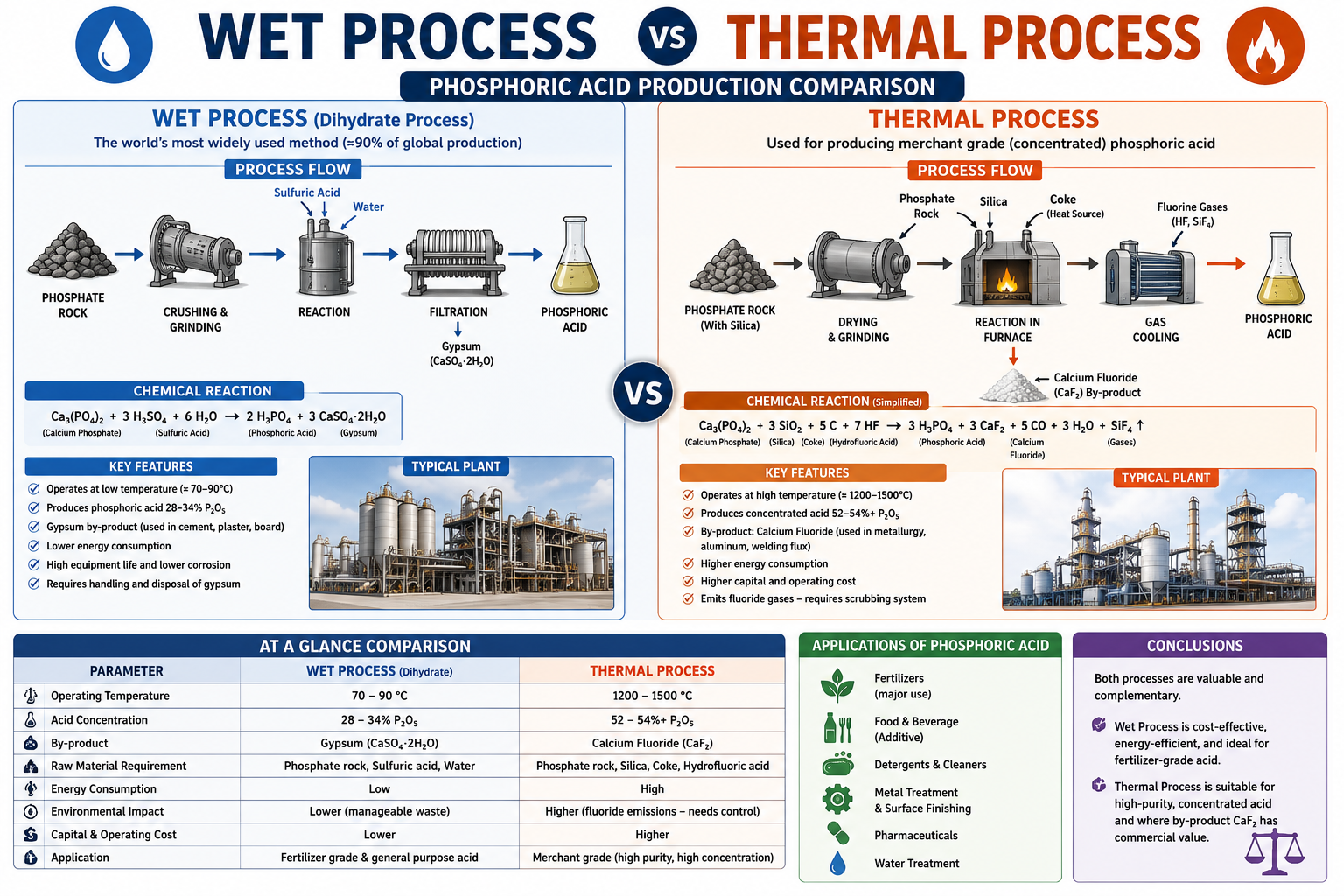
Phosphoric acid (H₃PO₄) is one of the most important inorganic chemicals used worldwide. It plays a vital role in fertilizer manufacturing, food processing, pharmaceuticals, water treatment, metal finishing, detergents, and advanced materials such as lithium iron phosphate (LFP) batteries. Due to its wide range of applications, phosphoric acid is produced through different manufacturing technologies depending on the required purity, production capacity, and economic considerations.
The two major industrial routes for phosphoric acid production are:
- Wet Process Phosphoric Acid (WPA)
- Thermal Process Phosphoric Acid (TPA)
The wet process is the dominant technology, contributing more than 90% of global phosphoric acid production, mainly because of its suitability for fertilizer manufacturing and lower production cost. The thermal process, although more expensive, produces extremely high-purity phosphoric acid required for food-grade, pharmaceutical, and electronic applications.
Understanding the differences between these two processes is essential for chemical engineers, plant designers, and industry professionals involved in phosphoric acid production.
Wet Process Phosphoric Acid
Principle of Wet Process
The wet process involves the reaction of phosphate rock with sulfuric acid to produce phosphoric acid and calcium sulfate (gypsum) as a by-product.
The main chemical reaction is:
Ca₁₀(PO₄)₆F₂ + 10H₂SO₄ + 20H₂O → 6H₃PO₄ + 10CaSO₄·2H₂O + 2HF
In this process, phosphate rock is directly converted into phosphoric acid without producing elemental phosphorus.
The quality of wet-process acid depends strongly on the quality of phosphate rock used. Different impurities present in the rock dissolve into the acid, affecting the final product quality.
Wet Process Manufacturing Steps
1. Phosphate Rock Grinding
The first step is preparation of phosphate rock. The rock is crushed and finely ground to increase surface area and improve reaction efficiency.
Typical grinding requirements:
- Particle size: 90% passing 160–200 mesh
- Moisture control to improve grinding performance
- Uniform particle size distribution
Fine grinding improves phosphate recovery and reduces unreacted phosphate losses.
2. Acidulation Reaction
The ground phosphate rock is mixed with sulfuric acid inside a reactor.
Important operating parameters include:
| Parameter | Typical Range |
|---|---|
| Temperature | 70–80°C |
| Sulfuric Acid Concentration | 93–98% |
| Reactor Residence Time | 4–8 hours |
| Slurry P₂O₅ Concentration | 20–30% |
During acidulation, phosphate minerals dissolve and calcium sulfate crystals are formed.
The process can operate in different modes:
- Dihydrate process (DH)
- Hemihydrate process (HH)
- Hemihydrate-Dihydrate process (HDH)
The selected technology influences P₂O₅ recovery, gypsum quality, and filtration performance.
3. Gypsum Crystallization
During reaction, calcium sulfate crystals form and grow. Proper crystal control is extremely important because it affects:
- Filtration rate
- P₂O₅ losses
- Moisture content of gypsum cake
- Plant productivity
Poor crystal formation can lead to:
- Difficult filtration
- High phosphate losses
- Increased operating costs
4. Filtration
The reaction slurry is sent to a vacuum belt filter where phosphoric acid is separated from gypsum.
Products obtained:
Liquid phase:
- Weak phosphoric acid
Solid phase:
- Phosphogypsum
Modern plants use advanced horizontal belt filters to achieve high recovery and low moisture gypsum.
5. Acid Concentration
The filtered acid usually contains approximately:
- 26–32% P₂O₅
It is concentrated through evaporation using steam.
Typical product concentration:
- 40–54% P₂O₅
Multiple-effect evaporators or forced circulation evaporators are commonly used for efficient concentration.
Advantages of Wet Process Phosphoric Acid
1. Low Production Cost
The biggest advantage of the wet process is economical production. It uses directly available phosphate rock and sulfuric acid, making it suitable for large-scale fertilizer plants.
2. High Production Capacity
Wet-process plants can produce thousands of tonnes per day.
Typical industrial capacities:
- 500 TPD
- 1,000 TPD
- 2,000 TPD
- 5,000 TPD+
3. Lower Energy Requirement
Unlike the thermal process, wet processing does not require an electric furnace. Therefore, energy consumption is significantly lower.
4. Suitable for Fertilizer Manufacturing
Wet-process acid is the preferred raw material for:
- DAP
- MAP
- NPK fertilizers
- SSP
- TSP
Limitations of Wet Process
The main disadvantage is impurity contamination.
Phosphate rock contains minerals that dissolve during acidulation, including:
- Iron
- Aluminum
- Magnesium
- Fluoride
- Sulfate
- Heavy metals
- Organic compounds
These impurities affect acid quality and limit direct use in food or pharmaceutical industries.
Additional purification steps are required for high-purity applications.
Thermal Process Phosphoric Acid
Principle of Thermal Process
The thermal process produces phosphoric acid through elemental phosphorus combustion.
Unlike the wet process, phosphate rock is first converted into phosphorus, which is then oxidized and hydrated to form phosphoric acid.
The process produces very high-purity acid because most impurities remain separated during phosphorus production.
Thermal Process Manufacturing Steps
1. Electric Furnace Production of Phosphorus
Phosphate rock is mixed with:
- Silica
- Coke
and heated in an electric furnace.
The reaction occurs at approximately:
1,400–1,500°C
Chemical reaction:
Ca₃(PO₄)₂ + 3SiO₂ + 5C → 3CaSiO₃ + 5CO + 2P
Phosphorus vapor is generated and separated from furnace gases.
2. Phosphorus Condensation
The phosphorus vapor is cooled and collected under water.
The collected phosphorus is stored safely before combustion.
3. Phosphorus Combustion
Liquid phosphorus is burned with dry air.
Reaction:
P₄ + 5O₂ → P₄O₁₀
Phosphorus pentoxide is produced.
4. Hydration
Phosphorus pentoxide reacts with water to produce phosphoric acid.
Reaction:
P₄O₁₀ + 6H₂O → 4H₃PO₄
The resulting acid has extremely high purity.
Advantages of Thermal Process
1. Highest Purity
Thermal phosphoric acid contains very low levels of:
- Iron
- Aluminum
- Magnesium
- Sulfates
- Fluoride
- Heavy metals
This makes it suitable for critical applications.
2. Food and Pharmaceutical Grade Production
Thermal acid is used for:
- Carbonated beverages
- Food additives
- Pharmaceutical products
- Laboratory chemicals
3. Electronic and Battery Applications
The growing demand for high-purity phosphoric acid for semiconductor manufacturing and lithium iron phosphate batteries has increased interest in thermal technology.
Limitations of Thermal Process
1. High Energy Consumption
The biggest challenge is electricity consumption due to furnace operation at extremely high temperatures.
2. High Capital Investment
The process requires expensive equipment:
- Electric arc furnace
- Gas cleaning system
- Phosphorus condenser
- Combustion tower
- Hydration system
3. Higher Production Cost
Due to high energy consumption and complex operation, thermal phosphoric acid is significantly more expensive than wet-process acid.
Comparison Between Wet and Thermal Process
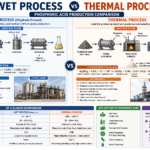
| Parameter | Wet Process | Thermal Process |
|---|---|---|
| Raw Material | Phosphate rock + Sulfuric acid | Elemental phosphorus |
| Main Reaction | Acidulation | Oxidation and hydration |
| Purity | Medium | Very High |
| Energy Consumption | Low | Very High |
| Production Cost | Low | High |
| Capital Investment | Moderate | Very High |
| Main Product Use | Fertilizers | Food, Pharma, Electronics |
| Impurities | Higher | Very Low |
| Production Scale | Very Large | Moderate |
| Environmental Issue | Phosphogypsum generation | High power consumption |
Environmental Considerations
Wet Process Challenges
Major environmental concerns include:
- Large phosphogypsum generation
- Fluoride emissions
- Acidic wastewater
- Heavy metal management
Modern plants reduce environmental impact through:
- Fluoride recovery systems
- Gypsum utilization
- Wastewater recycling
- Improved filtration technology
Thermal Process Challenges
The main environmental concern is energy consumption.
Important improvements include:
- Renewable electricity usage
- Waste heat recovery
- Improved furnace efficiency
Future Trends in Phosphoric Acid Production
The phosphoric acid industry is moving toward:
Advanced Wet Process Technologies
Technologies such as HDH processes improve:
- P₂O₅ recovery
- Gypsum filtration
- Energy efficiency
Purification of Wet-Process Acid
New technologies such as:
- Solvent extraction
- Ion exchange
- Membrane purification
are helping convert wet-process acid into higher-purity products.
Growth of Battery-Grade Phosphoric Acid
The expansion of lithium iron phosphate batteries is increasing demand for ultra-high-purity phosphoric acid.
Conclusion
Wet process and thermal process phosphoric acid technologies serve different industrial requirements. The wet process remains the backbone of global phosphoric acid production because of its low cost, scalability, and suitability for fertilizer manufacturing. It is the preferred technology for producing DAP, MAP, NPK, and other phosphate fertilizers.
The thermal process, despite its high energy consumption and operating cost, continues to be essential where superior purity is required. Food-grade phosphoric acid, pharmaceutical products, electronic chemicals, and battery materials depend on thermal technology or advanced purification methods.
The selection between wet and thermal processes depends on product requirements, economics, raw material availability, and market demand. Future developments will focus on improving sustainability, reducing environmental impact, and producing high-purity phosphoric acid efficiently for emerging industries.