
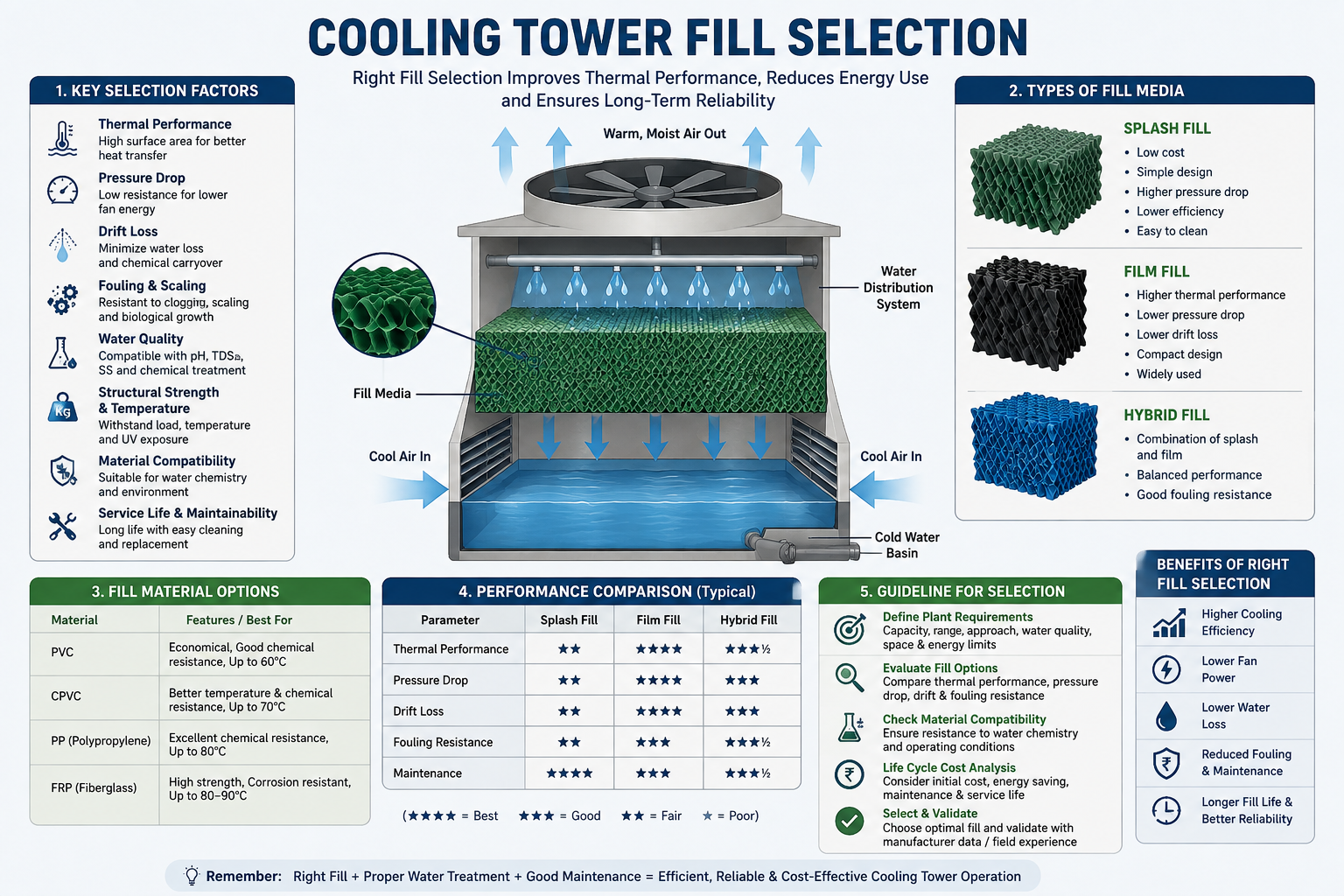
Cooling tower fill selection is one of the most important decisions in cooling tower design and performance optimization. The fill provides a large contact area between hot circulating water and atmospheric air, allowing heat to transfer from the water to the air through sensible and evaporative cooling. The correct fill can improve cooling efficiency, reduce tower size, control operating costs, and increase equipment life.
However, selecting cooling tower fill is not simply a matter of choosing the material with the highest heat-transfer efficiency. Water quality, temperature, suspended solids, scaling, biological growth, chemical contamination, and process conditions must also be considered. This becomes particularly important in chemical manufacturing plants, where cooling water may be exposed to acidic fumes or aggressive chemicals.
What Is Cooling Tower Fill?
Cooling tower fill is the internal packing installed inside a cooling tower. Its primary function is to increase the surface area available for contact between water and air.
Hot water enters the cooling tower through a distribution system and flows downward over or through the fill. At the same time, air moves upward or horizontally through the tower. The large surface area created by the fill promotes evaporation and heat transfer.
The effectiveness of a cooling tower therefore depends significantly on:
- Fill surface area
- Water distribution
- Airflow
- Water loading
- Air-to-water ratio
- Fill geometry
- Cooling-water quality
- Operating temperature
- Approach and range
A well-selected fill can significantly improve cooling tower thermal performance.
Types of Cooling Tower Fill
Cooling tower fill is broadly classified into film fill and splash fill.
1. Film Fill
Film fill consists of closely spaced sheets or corrugated surfaces. Water spreads into a thin film over the fill surface, creating a large area for air-water contact.
Film fill provides high heat-transfer performance because of its large specific surface area.
Advantages of Film Fill
- High heat-transfer efficiency
- Compact design
- Lower fill volume for a given duty
- Lower tower footprint
- Good performance with clean water
- Suitable for many HVAC and industrial applications
Disadvantages
The major limitation of film fill is its sensitivity to fouling.
Small passages between the sheets can become blocked by:
- Suspended solids
- Calcium carbonate scale
- Silica deposits
- Biological growth
- Process contamination
Once the passages become blocked, airflow and water distribution deteriorate, resulting in reduced cooling performance.
Therefore, film fill is generally preferred when cooling-water quality can be effectively controlled.
2. Splash Fill
Splash fill works differently. Instead of maintaining a continuous thin water film, the fill causes falling water to break into droplets repeatedly.
The repeated splashing increases the air-water contact and promotes evaporation.
Splash fill generally has larger passages than film fill, making it more resistant to fouling.
Advantages of Splash Fill
- Better resistance to suspended solids
- Lower tendency for plugging
- Suitable for poor-quality water
- Easier cleaning
- Good mechanical strength
- Suitable for industrial applications
Disadvantages
Compared with high-performance film fill, splash fill generally requires a greater volume to achieve equivalent thermal performance.
It can therefore result in a larger cooling tower or greater fill volume.
Film Fill vs Splash Fill
The selection should be based on the actual cooling-water conditions.
| Parameter | Film Fill | Splash Fill |
|---|---|---|
| Heat-transfer efficiency | High | Medium |
| Surface area | Very high | Moderate |
| Fouling resistance | Low–medium | High |
| Suspended solids tolerance | Low | High |
| Cleaning | More difficult | Easier |
| Water quality requirement | Good | Moderate/poor |
| Tower compactness | High | Moderate |
| Chemical-process applications | Selected cases | Often preferred |
For clean cooling water, film fill can provide excellent thermal performance. For contaminated or heavily fouling industrial water, splash fill may be the safer choice.
Cooling Tower Fill Materials
Common fill materials include:
- PVC
- PP
- FRP
- High-temperature polypropylene
- Other specialized polymeric materials
PVC Fill
PVC is widely used because of its relatively low cost, good mechanical properties, and satisfactory performance in many cooling-water applications.
However, PVC has temperature and chemical compatibility limitations. The actual cooling-water chemistry should always be checked against the manufacturer’s material compatibility data.
Polypropylene Fill
Polypropylene, commonly known as PP, is widely used in industrial cooling applications.
PP can be particularly attractive for chemical plants because it provides good resistance to many chemical environments and can be manufactured into both film and splash-fill designs.
For aggressive or contaminated water, PP grid or splash fill can be a strong candidate.
FRP Fill
FRP can be used in specialized applications requiring good corrosion resistance and mechanical strength. However, the actual resin system and manufacturing method must be considered when evaluating chemical compatibility.
Cooling Tower Fill Selection for Chemical Plants
Cooling towers installed in chemical plants require greater attention than conventional HVAC cooling towers.
Chemical plants can experience:
- Acidic fumes
- Fluoride contamination
- Process vapors
- High dissolved solids
- Suspended solids
- Scaling
- Corrosion
- Biological contamination
For this reason, selecting a fill solely on the basis of heat-transfer efficiency can lead to premature failure.
A cooling tower serving a chemical process should be evaluated based on both thermal performance and chemical resistance.
Example: 600 m³/hr Chemical Cooling Tower
Consider an industrial cooling tower with the following operating conditions:
- Circulating water flow: 600 m³/hr
- Hot water temperature: 42°C
- Cold water temperature: 32°C
- Cooling range: 10°C
- Wet-bulb temperature: 28°C
- Approach: 4°C
The cooling tower must remove a substantial quantity of heat from the circulating water.
The cooling duty can be estimated from:
Q = m × Cp × ΔT
where:
Q = heat removed
m = water mass flow rate
Cp = specific heat of water
ΔT = cooling range
The water flow of 600 m³/hr corresponds approximately to 600,000 kg/hr for water. With a 10°C temperature reduction, the heat-removal requirement is approximately:
Q ≈ 6,000,000 kcal/hr
This demonstrates why proper fill selection is important. Insufficient fill area, poor water distribution, or fouling can prevent the tower from achieving the required 32°C outlet temperature.
Why PP Splash Fill Can Be Attractive for Chemical Service
For a chemical plant cooling tower, PP splash or grid fill may be preferred when the circulating water has a high fouling potential.
The larger openings in splash fill help reduce plugging. This is particularly important where suspended solids or process contamination can enter the cooling-water circuit.
A wide-channel PP film fill can also be considered when the water is adequately filtered and maintained.
The final selection should therefore be based on actual water-quality data rather than a generic recommendation.
Importance of H₂SiF₆ and Fluoride
Special attention is required if the cooling tower is exposed to hydrofluorosilicic acid (H₂SiF₆) or fluoride-containing process fumes.
If H₂SiF₆ is present only as an atmospheric contaminant around the tower, the design considerations may differ from a system where it is actually present in the circulating cooling water.
If the circulating water contains a significant concentration of H₂SiF₆, the entire cooling tower system requires a detailed chemical compatibility review.
The review should include:
- H₂SiF₆ concentration
- Fluoride concentration
- pH
- Chloride concentration
- TDS
- Suspended solids
- Calcium
- Magnesium
- Silica
- Operating temperature
- Scaling tendency
The fill, nozzles, eliminators, piping, basin, supports, fasteners, and other wetted components should all be evaluated.
Does 904L Mean the Fill Should Also Be 904L?
Not necessarily.
A 904L requirement may be appropriate for metallic components exposed to an aggressive environment, but cooling-tower fill is normally manufactured from polymeric materials such as PVC or PP.
For example:
- Metallic wetted components: 904L where required
- Fasteners: 904L
- Fill: chemically compatible PP/PVC
- Drift eliminator: suitable polymer
- Nozzles: compatible polymer or specialty material
- Structural components: selected according to environmental conditions
The material selection should therefore be made component by component.
Key Parameters to Obtain From the Cooling Tower Fill Supplier
Before approving a fill, the supplier should provide technical information covering:
- Fill material and grade
- Fill thickness
- Fill geometry
- Specific surface area
- Fill volume
- Maximum operating temperature
- Chemical compatibility
- Suspended-solids limitation
- Scaling tolerance
- Water loading
- Air loading
- Fill pressure drop
- Thermal performance curves
- Cleaning requirements
- Expected service life
- Fill-support design
- Flame-retardant properties
- Manufacturer’s recommended operating conditions
These parameters allow the engineering team to compare different fill options objectively.
Best Practices for Cooling Tower Fill Selection
The following practices can improve reliability:
First, analyze the water quality. Do not select fill before understanding the circulating-water chemistry.
Second, determine fouling potential. If suspended solids are high, wide-channel or splash fill may be more appropriate.
Third, evaluate chemical compatibility. Consider both normal and upset operating conditions.
Fourth, check temperature limitations. Fill material must withstand the maximum operating and design temperature.
Fifth, verify thermal performance. Obtain manufacturer performance data for the exact water flow, air conditions, range, and approach.
Sixth, consider maintenance. A fill with slightly lower thermal efficiency may be preferable if it can be cleaned easily and provides longer service life.
Conclusion
Cooling tower fill selection directly affects thermal performance, energy consumption, maintenance requirements, reliability, and operating life.
Film fill is generally preferred where cooling water is clean and high thermal efficiency is required. Splash fill is often more suitable for industrial applications involving suspended solids, fouling, or variable water quality.
For chemical-process cooling towers, polypropylene splash/grid fill or wide-channel PP film fill can be considered depending on water chemistry and fouling conditions.
For a 600 m³/hr cooling tower operating from 42°C to 32°C with a 28°C wet-bulb temperature, the final fill selection should be based on the manufacturer’s thermal-performance calculations and a detailed analysis of the cooling-water chemistry.
Most importantly, if the system is exposed to H₂SiF₆ or fluoride-containing fumes, chemical compatibility must be evaluated before finalizing the fill. A technically correct selection balances heat-transfer efficiency, fouling resistance, chemical compatibility, pressure drop, maintenance requirements, and lifecycle cost rather than focusing on any single parameter.