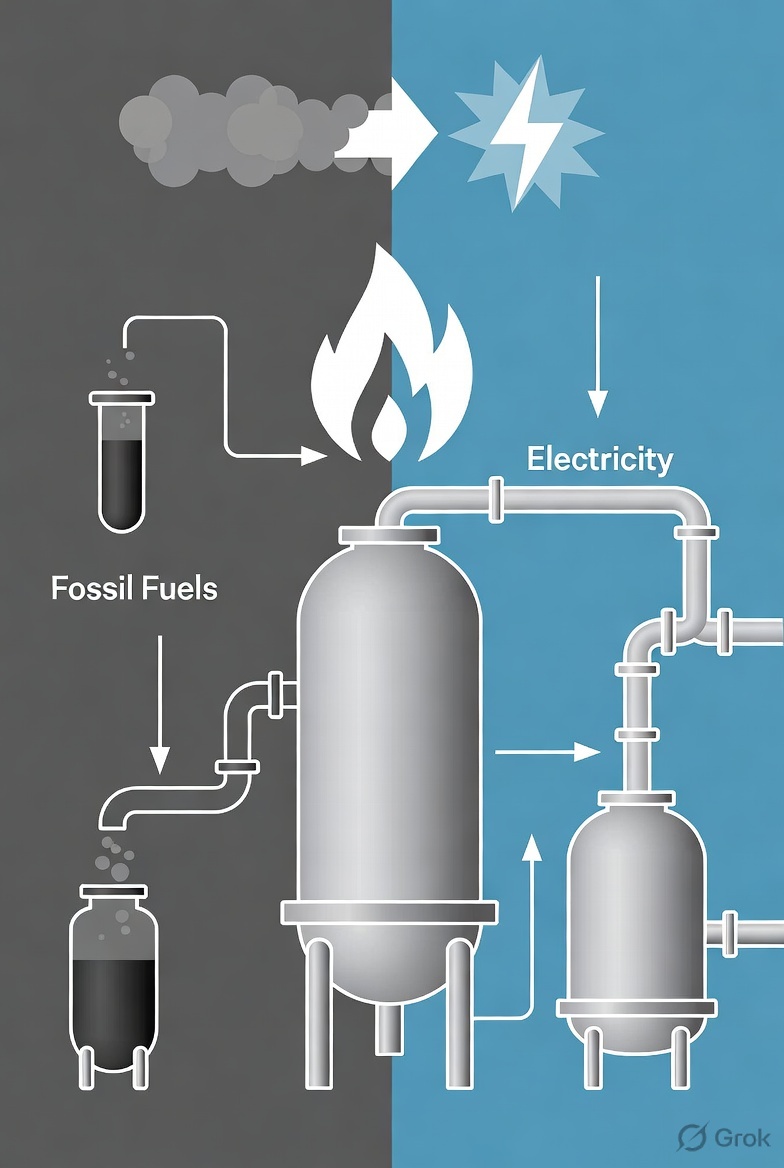
The global chemical industry stands at a pivotal moment in its evolution. For over a century, fossil fuels such as coal, oil, and natural gas have formed the backbone of chemical manufacturing, serving both as sources of energy and as raw materials. However, rising concerns over climate change, environmental degradation, and resource depletion are driving a fundamental shift toward more sustainable practices. Among the most promising solutions is the electrification of chemical processes—an approach that replaces fossil fuel-based systems with electricity, ideally sourced from renewable energy. This transition represents not only a technological transformation but also a rethinking of how chemicals are produced at the most fundamental level.
Traditionally, chemical processes depend heavily on combustion to generate the high temperatures required for reactions. For example, furnaces powered by natural gas are used in steam cracking to produce ethylene, a key building block for plastics. Similarly, hydrogen—an essential component in ammonia production and refining—is typically produced through steam methane reforming, a process that emits significant amounts of carbon dioxide. Electrification seeks to eliminate these emissions by substituting fossil fuel inputs with electricity, thereby decoupling chemical production from carbon-intensive energy sources.
One of the simplest and most immediate pathways to electrification is electric heating. Instead of burning fuels to generate heat, electric systems such as resistance heaters, induction heating, and microwave heating can be used to achieve the required temperatures. These technologies offer precise control, rapid response times, and improved energy efficiency. More importantly, when powered by renewable electricity from sources like solar or wind, electric heating can effectively eliminate direct greenhouse gas emissions. Industries such as petrochemicals and materials processing are actively exploring electrified alternatives to conventional furnaces, signaling a shift toward cleaner production methods.
Another critical component of electrification is electrolysis, particularly for hydrogen production. Hydrogen is widely used across the chemical sector, especially in ammonia synthesis and petroleum refining. Conventional hydrogen production relies on fossil fuels, resulting in what is often called “grey hydrogen.” In contrast, electrolysis uses electricity to split water into hydrogen and oxygen, producing “green hydrogen” when powered by renewable energy. This process has the potential to significantly reduce emissions associated with hydrogen use. As the cost of renewable electricity continues to decline, electrolysis is becoming increasingly viable at industrial scales, paving the way for cleaner chemical production pathways.
Electrochemical synthesis represents a more advanced and transformative approach. Unlike traditional thermochemical processes that rely on heat, electrochemical methods use electrical energy to directly drive chemical reactions. This enables the production of valuable chemicals under milder conditions, often at lower temperatures and pressures. For instance, carbon dioxide can be electrochemically converted into fuels such as methanol or ethanol, effectively turning a greenhouse gas into a useful resource. Similarly, researchers are exploring electrochemical routes for ammonia production that could eventually replace the energy-intensive Haber-Bosch process. These innovations highlight the potential of electrification to not only reduce emissions but also enable entirely new reaction pathways.
Plasma chemistry offers another intriguing avenue for electrification. In plasma systems, high-energy electrons are used to initiate chemical reactions, bypassing the need for high bulk temperatures. This allows reactions to occur under conditions that would otherwise be unattainable with conventional methods. Plasma technologies are being investigated for applications such as nitrogen fixation and waste conversion, where they could offer more efficient and environmentally friendly alternatives. Although still in the early stages of development, plasma-based processes hold significant promise for the future of chemical manufacturing.
Electrified catalysis further expands the possibilities of electricity-driven chemistry. By combining catalysts with electrical inputs, scientists can precisely control reaction pathways and improve selectivity. This level of control can lead to higher yields, reduced by-products, and lower energy consumption. Electrified catalytic systems are particularly valuable in processes involving complex molecules, where traditional methods often struggle to achieve desired outcomes efficiently.
The environmental benefits of electrification are substantial. By replacing fossil fuel combustion with electricity, direct carbon dioxide emissions can be dramatically reduced or even eliminated. When paired with renewable energy sources, electrified processes can achieve near-zero emissions, contributing significantly to global climate goals. Moreover, electrification enables the integration of carbon capture and utilization technologies, allowing industries to recycle carbon dioxide into useful products rather than releasing it into the atmosphere. This supports the development of a circular carbon economy, where waste emissions are transformed into valuable resources.
In addition to environmental advantages, electrification offers improvements in energy efficiency. Traditional combustion-based systems often suffer from significant energy losses, whereas electric systems can deliver energy more directly and efficiently to the reaction site. This can lead to lower overall energy consumption and reduced operating costs over time. Furthermore, electrified processes can be more easily integrated with renewable energy systems, enabling flexible operation that aligns with the availability of solar and wind power. This adaptability is particularly important as the energy landscape becomes increasingly decentralized and variable.
Despite its many benefits, the electrification of chemical processes faces several challenges. One of the most significant is the sheer scale of electricity required. Transitioning an entire industry from fossil fuels to electricity will demand a massive expansion of renewable energy infrastructure. This includes not only generation capacity but also transmission and storage systems to ensure reliable supply. In regions where electricity is still predominantly generated from fossil fuels, the environmental benefits of electrification may be limited unless the power sector itself undergoes a parallel transformation.
Cost is another major barrier. Many electrified technologies, such as electrolyzers and advanced reactors, are still relatively expensive compared to established fossil-based systems. Although costs are expected to decline with technological advancements and economies of scale, significant investment is needed to accelerate this transition. Governments, industries, and financial institutions must collaborate to provide the necessary funding and policy support to make electrification economically viable.
Infrastructure and legacy systems also pose challenges. Existing chemical plants are designed around thermal processes and fossil fuel inputs, making retrofitting complex and costly. In some cases, entirely new facilities may be required to accommodate electrified technologies. This raises questions about the pace of transition and the feasibility of large-scale implementation within existing industrial frameworks.
Another important consideration is the maturity of electrified technologies. While some methods, such as electric heating and electrolysis, are already commercially available, others remain at the research or pilot stage. Scaling up these technologies to industrial levels requires overcoming technical hurdles related to efficiency, durability, and integration. Continued research and development are essential to unlock the full potential of electrification.
Real-world applications of electrification are already emerging. Pilot projects for green ammonia production are demonstrating the feasibility of using renewable hydrogen in fertilizer manufacturing. Electrified steam crackers are being developed to reduce emissions in the production of plastics and other materials. Similarly, carbon dioxide conversion technologies are being tested to produce synthetic fuels and chemicals. These initiatives illustrate the growing momentum behind electrification and its potential to reshape the chemical industry.
Looking ahead, electrification is expected to play a central role in achieving net-zero emissions in the industrial sector. As renewable energy becomes more accessible and affordable, the economic case for electrification will continue to strengthen. Advances in digital technologies, such as process optimization and real-time monitoring, will further enhance the efficiency and reliability of electrified systems. In combination with other innovations like carbon capture and hydrogen economies, electrification will help create a more sustainable and resilient industrial landscape.
In conclusion, the electrification of chemical processes represents a transformative approach to replacing fossil fuels in one of the world’s most energy-intensive industries. By leveraging renewable electricity, advanced technologies, and innovative thinking, it is possible to significantly reduce emissions, improve efficiency, and enable new pathways for chemical production. While challenges remain, the progress made so far provides strong evidence that electrification is not only feasible but also essential for a sustainable future. As the world continues to confront the realities of climate change, the transition to electrified chemical processes will be a critical step toward a cleaner and more sustainable industrial system.