
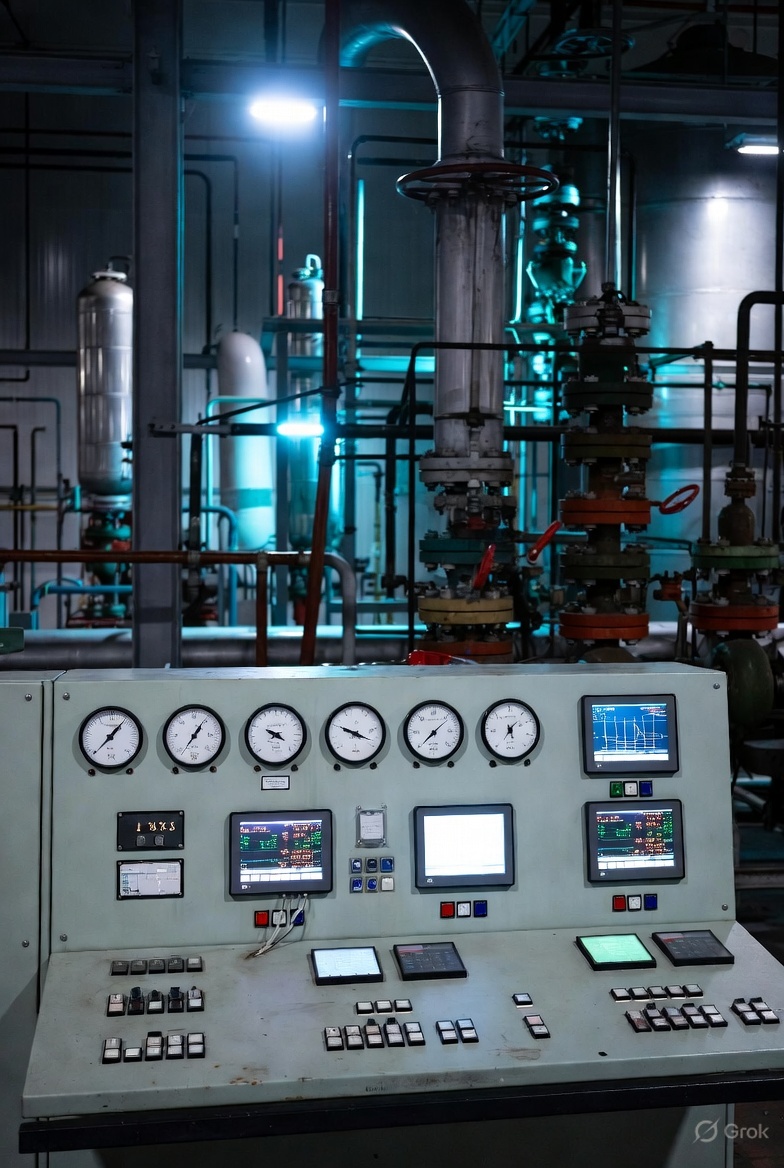
Process simulation is one of the most powerful tools in modern chemical engineering. Before steel is cut, before foundations are poured, and long before the first feedstock enters a reactor, engineers rely on simulation software to design, optimize, and validate entire production facilities. Distillation columns are sized, reactors are modeled, heat exchangers are rated, and utility loads are estimated—all inside a digital environment.
On screen, everything works perfectly.
Temperatures are stable. Conversions meet targets. Energy balances close neatly. Equipment performs exactly as designed.
But when the plant finally starts up, reality often tells a different story.
Columns do not achieve expected purity. Heat exchangers underperform. Reactors show lower conversion. Steam consumption exceeds projections. Control loops oscillate unpredictably.
This gap between simulated performance and plant reality is one of the most common—and misunderstood—challenges in industrial operations.
The problem is not that simulations are useless. The problem is that simulations are idealized representations of a far more complex world.
Understanding why the mismatch occurs is essential for better design, troubleshooting, and operational excellence.
The Nature of a Simulation: Assumptions First, Reality Later
Every simulation is built on assumptions. These include:
Steady-state operation
Constant feed composition
Accurate thermodynamic behavior
Ideal mixing
Clean heat transfer surfaces
Stable utilities
In the controlled environment of simulation software, these assumptions hold true. In the industrial world, they rarely do.
Plants operate under variability. Feedstock quality changes. Ambient temperatures fluctuate. Utilities vary in pressure and purity. Equipment ages. Operators intervene. Unexpected disturbances occur.
A simulation describes what should happen under defined conditions. A plant reveals what actually happens under dynamic and imperfect conditions.
The difference between the two begins here.
Thermodynamics: The Foundation with Limits
Thermodynamics drives most process simulations. Vapor–liquid equilibrium (VLE), enthalpy calculations, and phase behavior determine separation efficiency and energy demand.
However, thermodynamic models are approximations.
Equations of state and activity coefficient models rely on experimental data and fitted parameters. For simple systems, predictions can be highly accurate. For complex, highly non-ideal mixtures—especially those involving polar compounds, hydrogen bonding, or electrolytes—accuracy declines.
If interaction parameters are not properly regressed using plant-specific data, predictions of:
Relative volatility
Bubble points and dew points
Heat duties
Phase splits
may deviate from reality.
Even small thermodynamic inaccuracies can cascade through a process flowsheet, leading to noticeable performance gaps in distillation columns and flash systems.
Fouling: The Silent Performance Killer
Most simulations assume clean equipment. Heat exchangers are assigned nominal overall heat transfer coefficients. Pressure drops are calculated for ideal surfaces.
In actual plants, fouling begins almost immediately.
Deposits form due to scaling, corrosion byproducts, polymerization, or suspended solids. Fouling layers increase thermal resistance and reduce heat transfer efficiency. Pressure drop rises. Flow distribution changes.
As a result:
Outlet temperatures drift from predicted values
Energy consumption increases
Pumping requirements rise
Unless fouling factors are incorporated realistically, simulations will always predict more optimistic performance than the plant can sustain.
Hydrodynamics: More Complex Than Correlations
Distillation and absorption models depend on tray efficiencies or packing performance correlations. These correlations assume uniform liquid and vapor distribution.
In practice, columns experience:
Maldistribution of liquid
Channeling in packed beds
Entrainment
Weeping
Foaming
Flooding at lower-than-expected loads
Minor mechanical imperfections—such as poorly designed distributors—can reduce mass transfer efficiency dramatically.
Simulations assume perfect internals. Plants rarely achieve perfection.
Reaction Kinetics: Laboratory vs. Industrial Scale
Reaction modeling is another source of discrepancy.
Kinetic data is often derived from laboratory experiments under ideal mixing and temperature control. Industrial reactors operate under different hydrodynamic and thermal conditions.
Real systems may involve:
Side reactions
Catalyst deactivation
Mass transfer limitations
Diffusion resistance inside catalyst pores
Temperature gradients
If the simulation uses simplified global reaction rates without accounting for these complexities, predicted conversion and selectivity may not match plant results.
Scale-up introduces additional uncertainties. Mixing efficiency, residence time distribution, and heat removal characteristics change significantly at larger scales.
Heat Transfer Coefficient Uncertainty
Heat transfer correlations used in simulation are empirical. They assume certain flow regimes and surface conditions.
In industrial equipment:
Flow may not be fully turbulent
Multiphase flow may occur
Surface roughness changes over time
Partial vapor blanketing may develop
Even modest errors in heat transfer coefficient estimation can cause significant temperature profile differences, particularly in reactors and exchangers.
Because heat transfer directly affects reaction rate and separation efficiency, this uncertainty can amplify system-wide mismatches.
Instrumentation and Data Accuracy
When comparing plant performance to simulation, engineers rely on measured data. However, instrumentation itself introduces uncertainty.
Temperature transmitters drift. Flow meters may be miscalibrated. Pressure gauges may have offsets. Online analyzers may have time delays or sampling biases.
Sometimes the perceived simulation error is actually measurement error.
Without reliable plant data, meaningful model validation becomes difficult.
Control System Dynamics
Many simulations are performed under steady-state assumptions. Real plants are governed by dynamic control systems.
Control loops continuously adjust:
Reflux ratios
Steam flow rates
Feed rates
Pressure control valves
These adjustments introduce oscillations and transient behavior that steady-state models do not capture.
For example, a distillation column may meet purity targets in simulation but oscillate in practice due to interacting control loops.
Dynamic simulation tools can capture such behavior, but they are not always used in early design phases.
Startup and Transient Operations
Plants rarely operate at steady state all the time. Significant portions of operational life involve:
Startup
Shutdown
Grade changes
Feedstock transitions
During these periods, accumulation, temperature ramping, and composition swings occur.
Steady-state models cannot fully predict transient thermal expansion, holdup changes, or temporary reaction imbalances.
These transient discrepancies often shape operators’ perceptions of simulation accuracy.
Human Factors and Operational Reality
No simulation includes operator behavior.
In practice:
Operators may run equipment conservatively below design limits.
Maintenance may not restore equipment to original condition.
Temporary operating workarounds become permanent practices.
Human decisions influence plant performance in ways simulations cannot anticipate.
Real plants are socio-technical systems, not just thermodynamic models.
Overconfidence in Design Conditions
During project execution, simulations often focus on design capacity under nominal conditions. Sensitivity analysis may be limited.
However, real plants experience variability in:
Feed composition
Utility pressure
Ambient temperature
Production rates
If the design simulation does not explore these variations, robustness is compromised.
A single-point design case rarely reflects operational diversity.
Bridging the Gap Between Model and Reality
The solution is not abandoning simulation—but improving how it is used.
1. Model Calibration with Plant Data
After commissioning, simulations should be recalibrated using actual performance data. Adjust tray efficiencies, heat transfer coefficients, and kinetic parameters to reflect reality.
A calibrated model becomes a powerful diagnostic and optimization tool.
2. Include Degradation and Fouling Factors
Simulations should incorporate end-of-run conditions, not just clean-start scenarios. Designing for realistic performance improves expectation management.
3. Perform Sensitivity and Robustness Studies
Engineers should test models under varying feed compositions and utility conditions to evaluate resilience.
Robust design reduces surprises during operation.
4. Use Dynamic Simulation for Complex Systems
For integrated processes with tight control interactions, dynamic modeling provides insight into startup and upset scenarios.
Understanding transient behavior prevents costly instability after commissioning.
5. Foster Field–Model Collaboration
Simulation engineers and plant operators must collaborate closely. Field observations often highlight phenomena not captured in theoretical models.
When plant knowledge informs model refinement, predictive accuracy improves dramatically.
Conclusion: Simulation as a Guide, Not a Guarantee
Process simulations are not flawed—they are simplified representations of complex physical systems. The mismatch between digital predictions and plant performance arises from variability, degradation, measurement uncertainty, scale effects, and human intervention.
The purpose of simulation is not to predict perfection. It is to provide a structured framework for understanding system behavior.
When simulations are treated as living tools—updated, calibrated, and informed by plant data—they become invaluable assets for optimization and innovation.
The digital plant will never be identical to the real one. But with careful modeling, continuous feedback, and realistic assumptions, engineers can narrow the gap and transform simulation from a design exercise into a strategic operational advantage.