
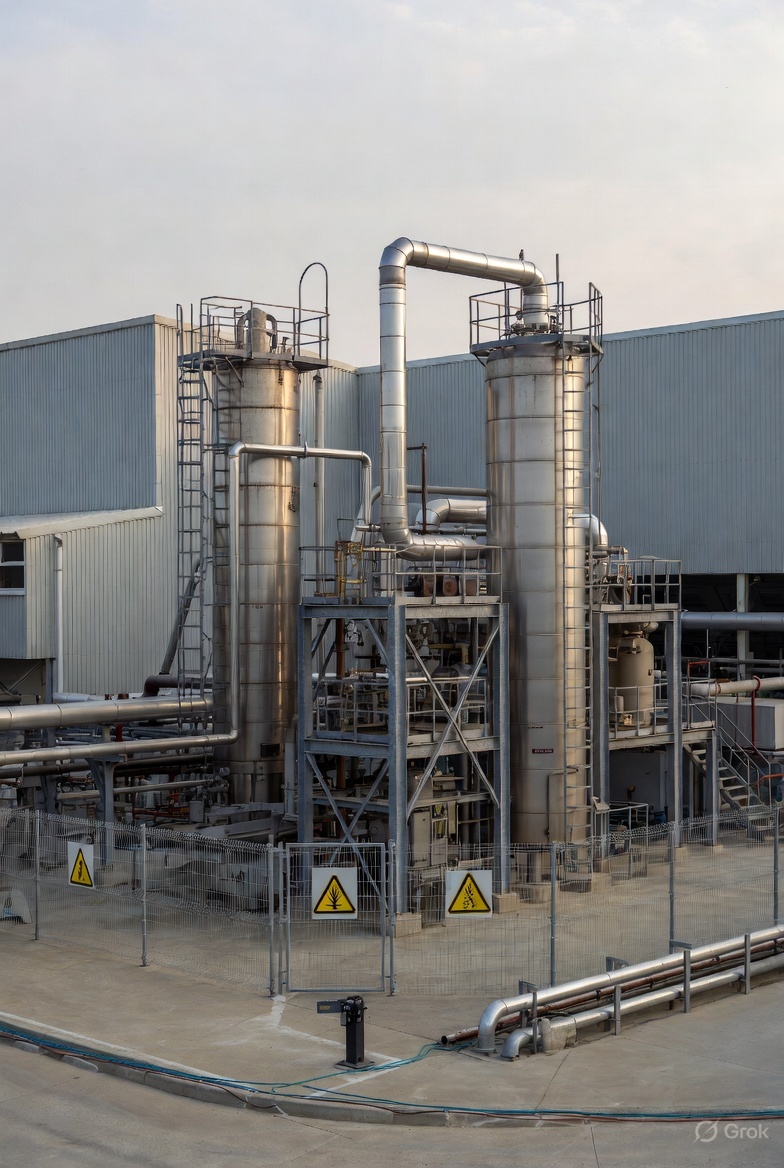
For more than a century, industrial chemical production has been defined by heat, pressure, solvents, and catalysts. Massive reactors, distillation columns, and solvent recovery systems have dominated plant layouts from petrochemical complexes to pharmaceutical manufacturing facilities. The assumption has always been simple: to make molecules react, you must dissolve them, heat them, and stir them long enough.
Mechanochemistry challenges that assumption.
Instead of relying primarily on thermal energy and solvents, mechanochemistry uses mechanical force—grinding, milling, compression, and shear—to initiate and drive chemical reactions. Once considered a laboratory curiosity, this approach is rapidly gaining industrial relevance. As sustainability pressures intensify and industries seek cleaner, more efficient processes, mechanochemistry is emerging as a transformative technology in chemical manufacturing.
What Is Mechanochemistry?
Mechanochemistry is the science of inducing chemical transformations through mechanical energy. When solid reactants are subjected to intense mechanical forces—such as collisions inside a ball mill—the energy delivered at microscopic contact points can break and form chemical bonds.
Unlike conventional solution-based reactions, mechanochemical processes frequently occur in the solid state. Reactants are placed in milling devices containing grinding media (usually steel or ceramic balls). As the mill rotates or vibrates, repeated impacts generate localized regions of high pressure and temperature. These microenvironments activate molecules without the need for bulk heating.
The result is a reaction system that often operates:
Without solvents
At near-ambient temperatures
With shorter reaction times
With fewer downstream separation steps
This seemingly simple shift—from heat-driven chemistry to force-driven chemistry—has profound industrial implications.
Why Industry Is Paying Attention
Industrial chemical production faces growing challenges:
Rising energy costs
Stringent environmental regulations
Waste disposal burdens
Carbon footprint reduction targets
Demand for flexible, modular production
Mechanochemistry addresses many of these pressures simultaneously.
1. Solvent-Free or Solvent-Reduced Processes
Traditional manufacturing frequently relies on large volumes of organic solvents. These solvents serve as reaction media but introduce complications:
High procurement costs
Fire and toxicity risks
Emission control requirements
Complex recovery systems
Large waste streams
Mechanochemical reactions can proceed without solvents or with only minimal liquid additives (a technique known as liquid-assisted grinding). Reducing solvent usage lowers both operational expenses and environmental impact. For pharmaceutical and specialty chemical manufacturers, solvent reduction also simplifies regulatory compliance.
2. Energy Efficiency
Conventional reactors consume significant energy for heating, cooling, and distillation. Mechanochemical systems concentrate mechanical energy directly at reactive interfaces. Because many reactions occur at room temperature, overall energy requirements may decrease.
Moreover, mechanical activation often accelerates reaction rates. Processes that traditionally require hours of reflux may complete in minutes inside a high-energy mill.
This efficiency aligns well with global energy optimization initiatives in chemical plants.
3. Simplified Plant Infrastructure
Eliminating solvent-intensive steps reduces the need for:
Large stirred tank reactors
Distillation columns
Solvent recovery units
Evaporators
Waste treatment systems
Mechanochemical equipment is often compact. Continuous extrusion systems, in particular, offer modular production possibilities. For specialty chemicals and pharmaceuticals, this can translate into smaller production footprints and lower capital investment.
Unique Reaction Pathways
Mechanochemistry does more than replicate traditional reactions. It often enables entirely new chemical pathways.
Solid-state reactions behave differently from solution-phase chemistry. Without solvent molecules surrounding reactants, intermolecular interactions change. Mechanochemical conditions can:
Favor alternative selectivity
Stabilize short-lived intermediates
Promote cocrystal formation
Enable catalyst-free reactions
Enhance atom economy
These advantages expand the synthetic possibilities available to industrial chemists.
Applications Across Industries
Mechanochemistry is no longer confined to academic research. Several industrial sectors are exploring or implementing mechanochemical processes.
Pharmaceutical Manufacturing
Pharmaceutical production demands high purity, polymorph control, and efficient synthesis routes. Mechanochemistry has shown particular promise in:
Cocrystal engineering to improve drug solubility
Salt formation
Polymorph screening
Solvent-free active pharmaceutical ingredient (API) synthesis
Solid-state reactions allow precise manipulation of crystal structures, which directly influence bioavailability and stability. Reducing solvent use also lowers residual solvent risks in final products.
Advanced Materials and Metal–Organic Frameworks
Metal–organic frameworks (MOFs) are porous materials used in gas storage, catalysis, and carbon capture. Traditional synthesis often requires solvothermal conditions involving high temperatures and organic solvents.
Mechanochemical methods produce MOFs more rapidly and with less solvent waste. This is particularly attractive for scaling carbon capture technologies where environmental performance is critical.
Polymer Science and Plastics Recycling
Mechanical force can initiate polymerization reactions or activate polymer chains for functionalization. Researchers are also investigating mechanochemical methods for plastic recycling, where mechanical energy helps break down long polymer chains into reusable monomers.
As the circular economy gains momentum, mechanochemistry could play a central role in sustainable polymer processing.
Inorganic Materials and Energy Storage
High-energy ball milling is widely used to synthesize advanced battery materials, nanomaterials, and alloys. Mechanochemical methods improve particle homogeneity and control particle size at the nanoscale.
For lithium-ion battery production, solid-state synthesis via mechanical activation can enhance electrochemical performance while reducing processing complexity.
Equipment and Process Technologies
Industrial mechanochemistry relies on specialized equipment capable of delivering controlled mechanical energy.
Ball Mills
Planetary and vibratory ball mills are common laboratory and pilot-scale devices. They use rotational motion to create repeated high-energy impacts.
Attritors and High-Shear Mixers
These systems provide intense mixing and grinding suitable for larger volumes.
Twin-Screw Extruders
Extrusion technology is emerging as a promising continuous mechanochemical platform. Twin-screw extruders combine shear, compression, and mixing in a controllable, scalable process.
Continuous extrusion addresses one of the main criticisms of mechanochemistry—its traditional batch orientation—by enabling steady-state production.
Challenges in Scaling Up
Despite its potential, mechanochemistry faces technical hurdles.
Energy Transfer Control
In traditional reactors, energy input is measured and controlled through temperature and pressure. In mechanochemical systems, energy transfer depends on:
Milling speed
Ball size
Collision frequency
Material loading
Reactor geometry
Scaling from laboratory mills to industrial systems requires careful modeling to ensure consistent reaction performance.
Monitoring and Process Analytics
Monitoring solid-state reactions in real time is challenging. Temperature and pressure readings alone are insufficient to describe reaction progress.
Advanced analytical tools such as in situ Raman spectroscopy and X-ray diffraction are being integrated into research systems. Industrial-scale adoption of such monitoring technologies remains an area of active development.
Equipment Wear and Contamination
High-energy impacts cause wear of grinding media and reactor surfaces. This can introduce trace metal contamination—unacceptable in pharmaceutical production.
To mitigate this, manufacturers must select wear-resistant materials and implement strict quality controls.
Sustainability and Regulatory Alignment
Mechanochemistry strongly aligns with the principles of green chemistry:
Waste prevention
Reduced solvent usage
Lower energy consumption
Fewer purification steps
Improved process intensification
As governments impose stricter environmental regulations and carbon pricing mechanisms, solvent-heavy processes face increasing scrutiny. Mechanochemical alternatives offer a pathway to compliance without sacrificing productivity.
Additionally, smaller equipment footprints and modular designs fit well within modern decentralized manufacturing models.
The Future of Mechanochemical Manufacturing
The next decade is likely to see significant advances in mechanochemistry. Key trends may include:
Integration with digital process modeling
AI-driven optimization of milling parameters
Hybrid systems combining mechanical activation with mild thermal inputs
Development of contamination-resistant reactor materials
Expansion into large-scale commodity chemical production
Continuous manufacturing platforms based on extrusion technology could become central to scaling mechanochemical processes.
As engineering understanding improves, mechanochemistry may shift from niche adoption to mainstream implementation.
Conclusion
Mechanochemistry represents a paradigm shift in industrial chemical production. By replacing solvent-intensive, heat-driven reactions with mechanically activated processes, it offers a compelling combination of sustainability, efficiency, and innovation.
The technology reduces solvent dependence, lowers energy consumption, simplifies downstream processing, and opens new reaction pathways. While challenges remain in scale-up, monitoring, and equipment durability, rapid advancements in process engineering are addressing these barriers.
In an era defined by environmental responsibility and resource efficiency, mechanochemistry provides more than an alternative—it offers a reimagining of how industrial chemistry can be performed. By harnessing force instead of heat, industries are discovering that sometimes the most powerful way to transform molecules is not to dissolve them, but to grind them into reaction.