


Mass transfer operations are fundamental to the field of chemical engineering and form the backbone of many industrial processes that we rely on every day. From the production of fuels and chemicals to environmental management, food processing, pharmaceuticals, and biotechnology, mass transfer operations play a central role in ensuring the efficiency, safety, and sustainability of these processes. Essentially, mass transfer is the movement of chemical species from one phase or region to another due to differences in concentration, pressure, or chemical potential. A deep understanding of mass transfer principles allows chemical engineers to design, optimize, and scale up processes that are both economically and environmentally efficient.
Principles of Mass Transfer
At the heart of mass transfer operations is the concept of a driving force. A driving force is the difference that causes a substance to move from one location to another. Most commonly, this is a concentration gradient, where molecules move from a region of higher concentration to a region of lower concentration. However, other driving forces, such as differences in pressure or chemical potential, can also induce mass transfer. The study of mass transfer combines knowledge from physical chemistry, fluid mechanics, thermodynamics, and transport phenomena to predict and control these processes.
A fundamental mechanism in mass transfer is diffusion. Diffusion is the movement of molecules due to random thermal motion, resulting in the spread of a substance from regions of high concentration to regions of low concentration. This process occurs in gases, liquids, and solids, but the rates and mechanisms vary depending on the medium. Fick’s laws of diffusion provide the quantitative foundation for describing how mass transfer occurs. Fick’s first law states that the flux of a substance is proportional to the concentration gradient, while Fick’s second law describes how concentration changes with time due to diffusion.
In practical applications, mass transfer rarely occurs in isolation. Often, it occurs in conjunction with convection, where fluid motion enhances the transport of species. The combination of diffusion and convection is referred to as convective mass transfer. Understanding the interplay between diffusion and convection is essential for designing chemical reactors, separation units, and other industrial equipment. Chemical engineers use the concept of mass transfer coefficients to quantify the resistance to mass transfer. These coefficients help predict the rate at which substances move between phases, such as from a gas to a liquid, or from a liquid to a solid.
Another key concept in mass transfer is phase equilibrium. Equilibrium relationships describe the maximum extent to which a substance can transfer between phases. Laws such as Henry’s law, Raoult’s law, and distribution coefficients are used to determine equilibrium concentrations and guide the design of separation processes. For example, Henry’s law describes the solubility of gases in liquids, which is fundamental to absorption processes. Distribution coefficients are used in liquid–liquid extraction to determine how a solute partitions between two immiscible liquids.
Modes of Mass Transfer
Mass transfer can occur through several mechanisms, each relevant to specific industrial applications:
Molecular Diffusion: Transfer of molecules due to concentration gradients. This occurs naturally at the molecular level and is the primary mechanism in gases and liquids when there is no bulk fluid motion.
Convective Mass Transfer: Transfer enhanced by fluid motion. Convection increases the contact between phases and accelerates the rate of mass transfer, which is important in reactors, heat exchangers, and packed columns.
Interphase Mass Transfer: Transfer between different phases, such as gas–liquid, liquid–liquid, or liquid–solid systems. This is a critical concept in operations like distillation, absorption, and extraction.
In real-world systems, mass transfer typically involves a combination of these mechanisms, and chemical engineers must consider both molecular diffusion and convective effects to accurately predict process performance.
Applications of Mass Transfer Operations
Mass transfer principles underpin a wide variety of chemical engineering processes, many of which are central to modern industry.
Distillation
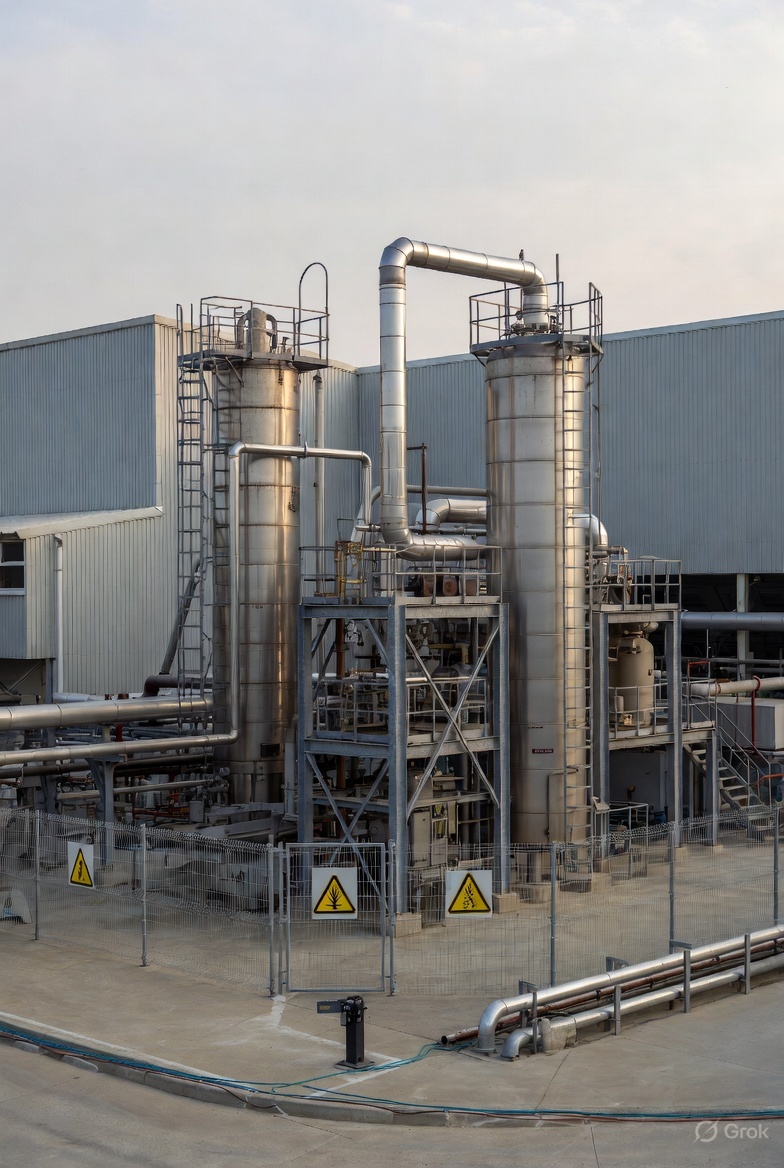
Distillation is one of the most common mass transfer operations and is used extensively in chemical, petrochemical, and pharmaceutical industries. It involves the separation of components in a liquid mixture based on differences in volatility. Mass transfer occurs between the liquid and vapor phases on trays or packing inside a distillation column. As the mixture is heated, the more volatile components vaporize, rise through the column, and condense at different levels, achieving separation. Distillation is used in refining crude oil, producing spirits, and purifying chemicals. The efficiency of distillation depends on factors such as vapor–liquid equilibrium, number of theoretical plates, and mass transfer coefficients.
Absorption
Absorption involves the transfer of a gaseous component into a liquid solvent. This operation is widely used for removing pollutants from gases and for chemical synthesis. For example, carbon dioxide or sulfur dioxide can be absorbed into water or alkaline solutions to reduce air pollution. Mass transfer occurs across the gas–liquid interface, and absorption towers are designed to maximize the contact area between the gas and liquid, thereby increasing the rate of mass transfer. Factors such as solubility, temperature, and agitation influence the efficiency of absorption.
Extraction
Liquid–liquid extraction is a mass transfer operation in which a solute is transferred from one liquid phase to another immiscible liquid. It is extensively used in pharmaceuticals, food processing, and biochemical industries to separate valuable compounds. Chemical engineers design extraction systems, such as mixer-settlers or centrifugal extractors, to achieve efficient mass transfer while minimizing solvent use. Distribution coefficients and phase equilibria are critical in designing extraction processes to ensure optimal separation.
Adsorption
Adsorption involves the transfer of a substance from a fluid phase onto the surface of a solid adsorbent. This process is widely used in environmental engineering for air and water purification, in gas separation, and in drying operations. Common adsorbents include activated carbon, silica gel, and zeolites. Chemical engineers optimize adsorption processes by selecting appropriate adsorbents, controlling temperature and pressure, and designing contactors that maximize surface area and mass transfer.
Drying
Drying is the process of removing moisture from solids by transferring water from the solid phase into a gas phase, typically air. Drying is crucial in food processing, pharmaceuticals, chemical manufacturing, and material production. Mass transfer in drying involves both diffusion of moisture within the solid and convective transfer from the surface to the surrounding gas. Efficient drying reduces energy consumption, preserves product quality, and prevents microbial growth.
Humidification and Dehumidification
Humidification and dehumidification are mass transfer operations involving the transfer of water vapor between air and liquid water. These processes are used in air conditioning, cooling towers, and environmental control systems. Humidification increases the moisture content of air, while dehumidification removes excess moisture. Chemical engineers design equipment such as packed towers, spray chambers, and heat exchangers to optimize mass transfer rates in these systems.
Importance in Chemical Engineering
Mass transfer operations are critical to the design, optimization, and operation of chemical processes. They are essential for:
Separation and Purification: Many industrial processes require the separation of chemical species to obtain pure products or remove impurities. Mass transfer principles guide the design of separation units such as distillation columns, absorption towers, and extraction systems.
Pollution Control: Absorption, adsorption, and membrane processes are widely used to remove pollutants from air, water, and industrial effluents. Mass transfer operations help chemical engineers reduce environmental impact.
Efficient Resource Use: Properly designed mass transfer systems minimize the use of raw materials and energy, leading to more sustainable and cost-effective operations.
Process Safety and Quality Control: Accurate modeling and control of mass transfer help maintain process stability, prevent hazardous conditions, and ensure consistent product quality.
Design Considerations in Mass Transfer Operations
Chemical engineers consider several factors when designing mass transfer equipment:
Phase Contact: Maximizing the interfacial area between phases enhances mass transfer. Equipment such as packed columns, trays, and membranes are designed to increase contact efficiency.
Residence Time: Sufficient contact time is necessary for the transfer to approach equilibrium. Flow rates, column height, and residence time are optimized to achieve desired separation.
Temperature and Pressure: These affect solubility, diffusion coefficients, and reaction rates. Engineers carefully select operating conditions to maximize mass transfer without compromising safety or product quality.
Mass Transfer Coefficients: Accurate estimation of mass transfer coefficients is critical for predicting rates of transfer and designing equipment.
Phase Equilibrium: Understanding equilibrium relationships helps in determining the maximum achievable separation and the efficiency of the process.
Conclusion
Mass transfer operations are an indispensable part of chemical engineering. They enable the separation, purification, and transformation of chemical species in a wide range of industrial applications. By understanding the principles of diffusion, convection, mass transfer coefficients, and phase equilibrium, chemical engineers can design and optimize processes that are efficient, safe, and sustainable. Applications such as distillation, absorption, extraction, adsorption, drying, and humidification highlight the central role of mass transfer in industry. As technological advancements continue and sustainability becomes increasingly important, mass transfer operations will remain a cornerstone of chemical engineering, supporting innovation in energy, environmental protection, pharmaceuticals, and beyond.
Chemical engineers who master mass transfer principles are better equipped to tackle the challenges of modern industry, including resource optimization, pollution control, and the development of innovative processes. The ongoing research in mass transfer, including computational modeling, novel materials, and process intensification, ensures that chemical engineers continue to enhance the efficiency and sustainability of industrial operations. By applying these principles, chemical engineers help drive the development of technologies that are not only economically viable but also environmentally responsible, securing a better future for industry and society.